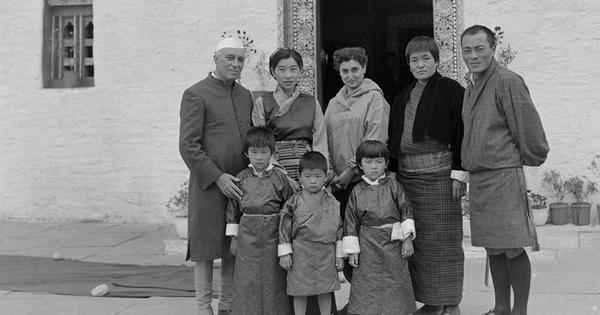
In the autumn of 1958, as cracks began to emerge in the Sino-Indian diplomatic relationship, Jawaharlal Nehru was forced to cancel a planned visit to Lhasa amid escalating political unrest in Tibet. Even so, India’s first prime minister was determined to undertake a Himalayan diplomatic mission. His destination shifted to the isolated kingdom of Bhutan, although the geography of the era dictated a circuitous route: Nehru would have to cross Sikkim’s Nathu La Pass into Tibet, travel through Yatung in the Chumbi Valley, and then proceed south into Bhutan.To make this journey, Nehru needed the permission of China, a country that, despite growing tensions, was still publicly regarded as a friend. Writing in the Brooklyn Daily in October 1958, journalist Bert Clemens noted that the “Chinese Reds” found themselves in an awkward position: “They had indicated that Nehru was more than welcome – for were not the Chinese people and those of India by history and tradition, the ‘staunchest of friends and allies?’ – in Tibet, but circumstances made it ‘dangerous’ for him to visit at this time for any period of time.”Ultimately, Beijing permitted Nehru to transit Tibetan territory en route to and from Bhutan, though the gesture lacked true warmth. “The Chinese gave him his transit visa and a ‘guard of honour,’ which accompanied him every inch of the journey across Tibet and back to India,” Clemens wrote.During his brief stay in Tibet, the Chinese hosted a banquet for Nehru, who was accompanied by his daughter, Indira Gandhi. At the event, General Tang Kwan-san raised a toast to the prime minister’s health and wished him a safe passage. In response, Nehru dryly thanked his hosts for the “kind arrangements” during what he pointedly termed his “accidental journey”.Clemens observed that the exchange between Nehru and his Chinese hosts appeared strained. The discomfort was particularly evident when the prime minister “managed to slip in some remarks about the close ties with Tibet over the past thousand years” and the “amicable relations” between the two lands. “The Chinese hosts gulped hard, but said nothing – they had strict orders to wine Nehru, dine him and get him out of Tibet as quickly as possible,” Clemens wrote.From Tibet, the 68-year-old Nehru travelled by mule and horseback into Bhutan, where he received a ceremonial welcome. While New Delhi enjoyed warm relations with the secluded Himalayan kingdom, the partnership was more complex than it appeared.Frontier allianceThe foundational architecture of modern relations between the two countries had been laid nearly a decade earlier. In August 1949, just as New Delhi was approaching its second anniversary of independence from British rule, India and Bhutan signed what was called the Treaty of Perpetual Peace and Friendship. A central provision of the treaty was its second article, which stipulated that Bhutan would be “guided by the advice of the Government of India in regard to its external relations”, while obliging India not to interfere in Bhutan’s internal affairs.The treaty also saw India increase its annual subsidy to Bhutan from Rs 1 lakh to Rs 5 lakh. At the time, Bhutan’s self-imposed isolation meant it possessed little modern infrastructure and few schools or hospitals.
When Nehru trekked through the Himalayas to build diplomatic bridges with Bhutan
Before the Sino-Indian War, Jawaharlal Nehru crossed Tibet to visit Bhutan, hoping to deepen ties with a kingdom emerging cautiously from isolation.
535 words~2 min read