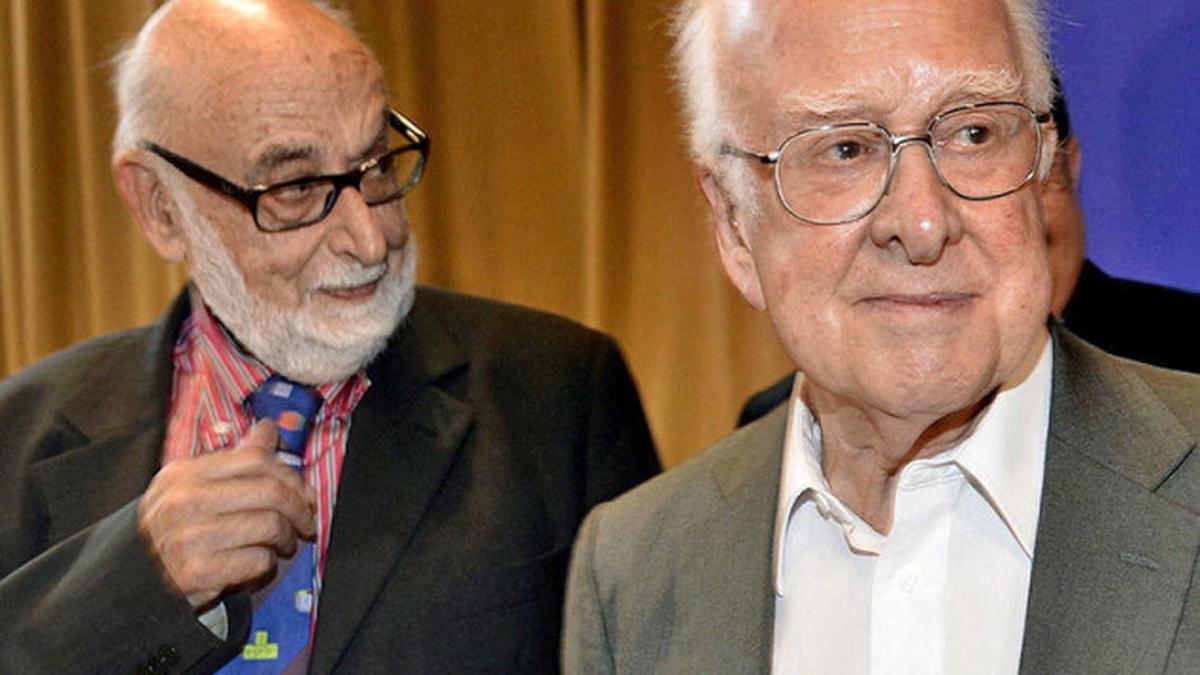
Belgian physicist Francois Englert (left) and British physicist Peter Higgs at CERN on July 4, 2012.
| Photo Credit: AP
The Belgian physicist and Nobel laureate François Englert passed away on June 18 aged 93. Englert’s best known work paved the way for the discovery of the Higgs boson in 2012. His contributions have changed the way physicists understand the fundamental nature of the universe.The Higgs boson became popular as the “god particle” worldwide and settled a long-standing problem in physicsEnglert’s parents were Polish-Jewish immigrants. He survived the Holocaust by moving between orphanages and foster homes to evade Nazi persecution. He spent most of his professional life in the Université libre de Bruxelles, where he obtained his PhD in 1959.In the early 1960s, he was working on the mystery of how subatomic particles get their property of mass. In 1964, together with the American-Belgian physicist Robert Brout, he published a landmark paper titled ‘Broken Symmetry and the Mass of Gauge Vector Mesons’. It proposed what is now known as the Brout-Englert-Higgs (BEH) mechanism.Brout and Englert theorised that the vacuum of space is not empty but filled with a fundamental field. By interacting with this field, otherwise massless particles would acquire the property of mass.This work solved a critical problem in the Standard Model, which is the main theoretical framework of particle physics.At the time, physicists struggled to explain why some fundamental particles, like the W and Z bosons, had mass while others, like the photon, did not. Englert and Brout’s paper, developed independently but simultaneously with the British physicist Peter Higgs, provided the missing piece of the puzzle.