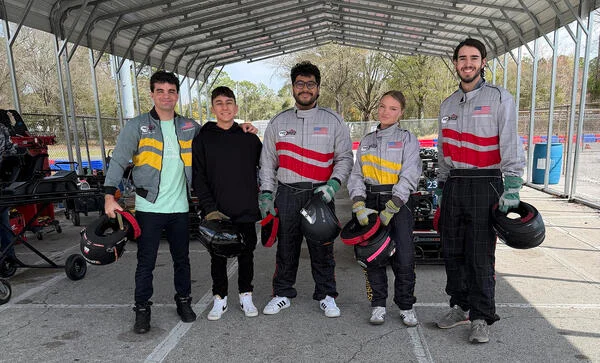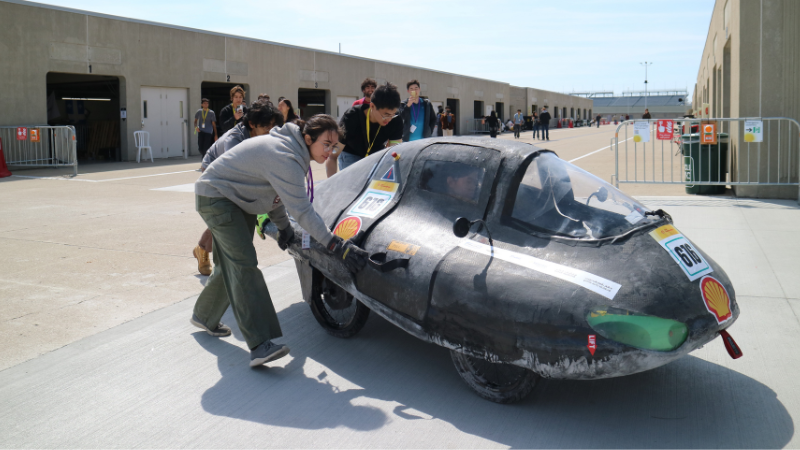
When first-year mechanical engineering student Christine Xu eased the Bruin Supermileage Vehicle up a 12-degree incline at the Indianapolis Motor Speedway this spring, three of her teammates had to push the car up the ramp by hand. Then they stepped away. The brakes held, and the team erupted.
It was the first time in three years the static incline test had worked, and minutes later, the dynamic run — in which the car rolls down the ramp and must stop on the slope — also succeeded. Those were two of the 12 technical inspections the team needed to pass to qualify for a run at the Shell Eco-marathon, an efficiency contest in which student teams from around the world attempt the same fixed-distance course using as little fuel as possible.
Even though Bruin SMV didn’t complete all of the technical inspections or record a timed run, the team fielded its strongest car in recent history and now has a promising blueprint for next year.
After several years of arriving in Indianapolis with incomplete vehicles — cars that “kind of existed but didn’t really run,” in the words of incoming external managing director Devin Huntington, a second-year mechanical engineering student — the UCLA Samueli School of Engineering team brought a vehicle that drove under its own power on a hydrogen fuel cell. It was a milestone for a club that has spent the past three years rebuilding around the competition’s most demanding category.