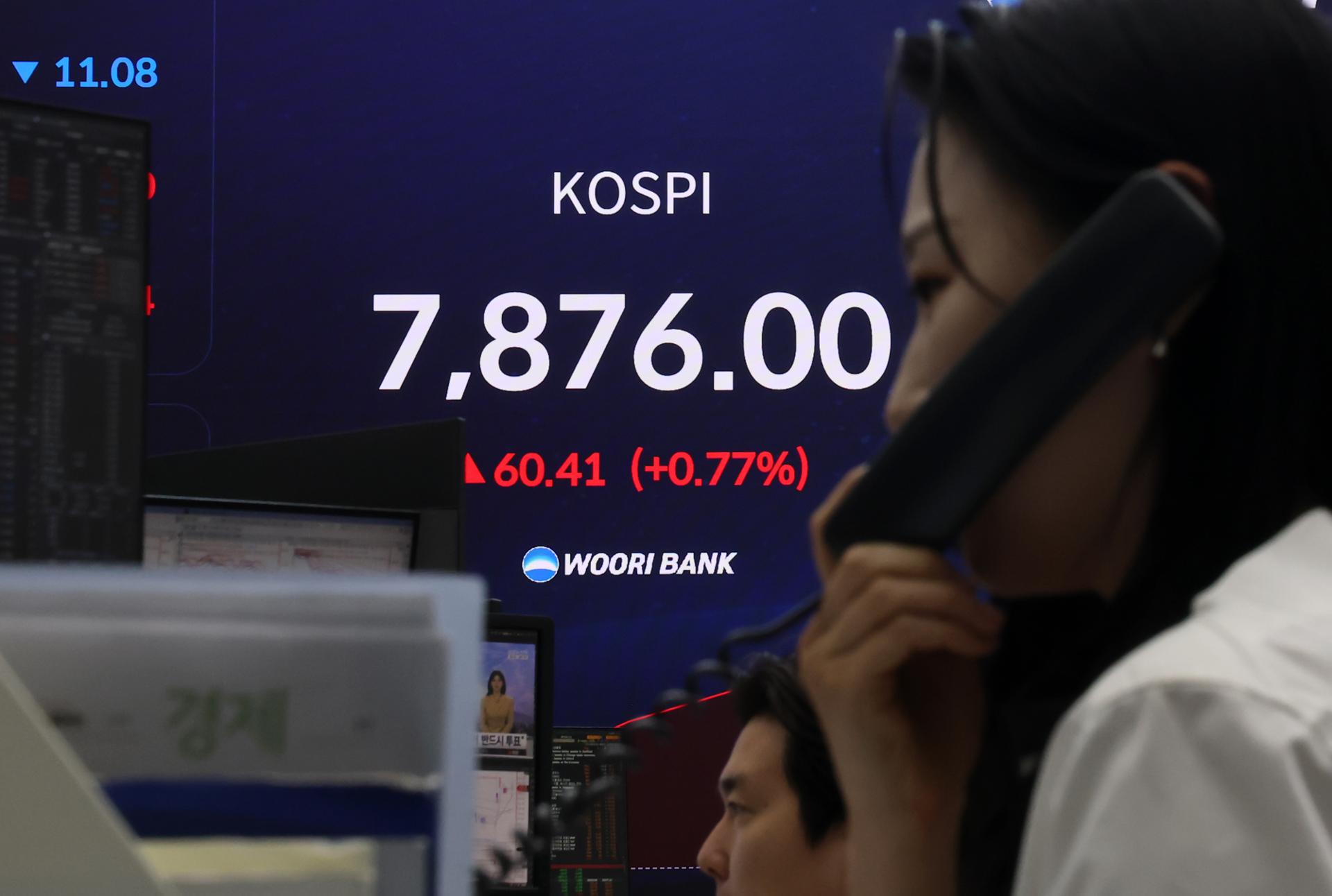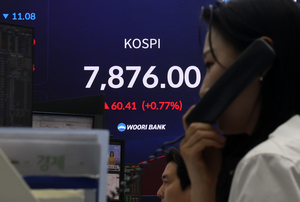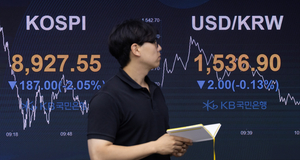
Hong Kong-listed products retain investor appeal despite launch of local alternatives aimed at stemming capital outflows Stock market indicators are displayed on a screen at the dealing room of KB Kookmin Bank in Yeouido, western Seoul, on Tuesday, as the Kospi fell below the 9,000 mark during intraday trading. (Yoon Chang-bin/The Korea Herald) South Korea's attempt to lure money back home by approving domestic single-stock leveraged exchange-traded funds has shown little impact: Korean investors continue to hold large positions in competing Hong Kong-listed products.According to data released Tuesday by the Korea Securities Depository, Korean investors' holdings of Hong Kong-listed single-stock leveraged ETFs surged in May and remained elevated through June 21, even after Korea introduced competing products on May 27.At the end of April, Korean investors held $117.7 million in Hong Kong-based CSOP's leveraged SK hynix ETF and $75.4 million in its Samsung Electronics ETF. By the end of May, those holdings had climbed to $287.0 million and $123.2 million, respectively.Though June figures cover holdings only through June 21, investor positions remained close to May-end levels at $279.6 million for the SK hynix ETF and $116.5 million for the Samsung Electronics ETF.The figures suggest the introduction of domestic products has so far failed to trigger a meaningful shift in investor funds.Korean regulators moved quickly to approve domestic single-stock leveraged ETFs after an estimated 700 billion won ($455 million) flowed into Hong Kong-listed products launched last year. Authorities argued that offering similar products at home would help stem capital outflows and support the Korean won.CSOP, Hong Kong's largest ETF manager, launched the world's first single-stock leveraged ETF tracking Samsung Electronics in May 2025. A similar product linked to SK hynix followed in October. The SK hynix ETF is currently the most popular Hong Kong-listed ETF among Korean investors, while the Samsung Electronics ETF ranks sixth.CSOP said both existing and new investors have continued buying the products."Hong Kong-listed leveraged ETFs offer Korean investors trading flexibility that is not available in the domestic market," said Lee Je-chung, an executive director at CSOP.Because the Hong Kong market remains open for an additional hour after the Korean market closes, investors can react to developments in Korea and adjust positions in Samsung Electronics and SK hynix. Investors can also continue trading through the Hong Kong market when Korean markets are closed for public holidays."These products provide investors with additional opportunities to manage their positions and potentially enhance returns," Lee said. "Combined with tax advantages and the Hong Kong dollar's peg to the US dollar, these factors have continued to attract both existing and new investors to the funds."The disappointing outcome has fueled criticism that regulators may have overestimated the significance of Hong Kong-listed products in the broader picture of Korean investors' overseas investments.Industry officials noted that assets invested in Hong Kong-listed leveraged ETFs amount to only a few hundred million dollars, while Korean investments tied to US stocks and ETFs run into the tens of billions of dollars."The assets invested in Hong Kong-listed leveraged ETFs account for only a small share of Korean investors' overseas portfolios," Lee said. "If the objective is to encourage capital repatriation, policymakers may also want to consider broader measures aimed at larger overseas markets."Another industry official argued that efforts to influence retail investors' overseas investments were unlikely to have a meaningful impact on the currency."Fundamentally, encouraging Korean companies with overseas operations to repatriate and convert their foreign-currency earnings into won would be far more effective in supporting the currency than targeting retail investors' investments," the official said.Even Korea's top financial regulator has expressed doubts about the policy.Speaking at a media briefing Monday, South Korea's Financial Supervisory Service Gov. Lee Chan-jin said the introduction of domestic single-stock leveraged ETFs had failed to achieve its stated objective, instead generating a range of unintended consequences."I regret not opposing the decision," Lee said. "The amount of capital brought back from Hong Kong has been minimal."He added that the products had amplified market volatility, increased the risk of losses for retail investors and encouraged excessive trading activity that primarily benefited securities firms.
Korea's bid to bring ETF money home falls short
South Korea's attempt to lure money back home by approving domestic single-stock leveraged exchange-traded funds has shown little impact: Korean investors conti
677 words~3 min read