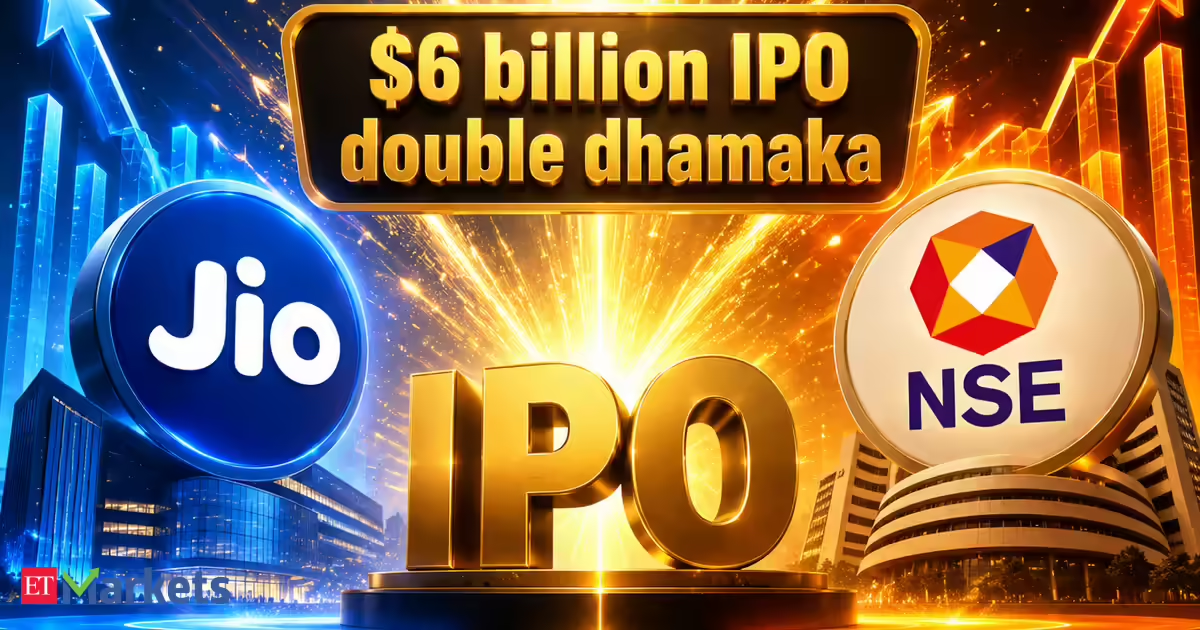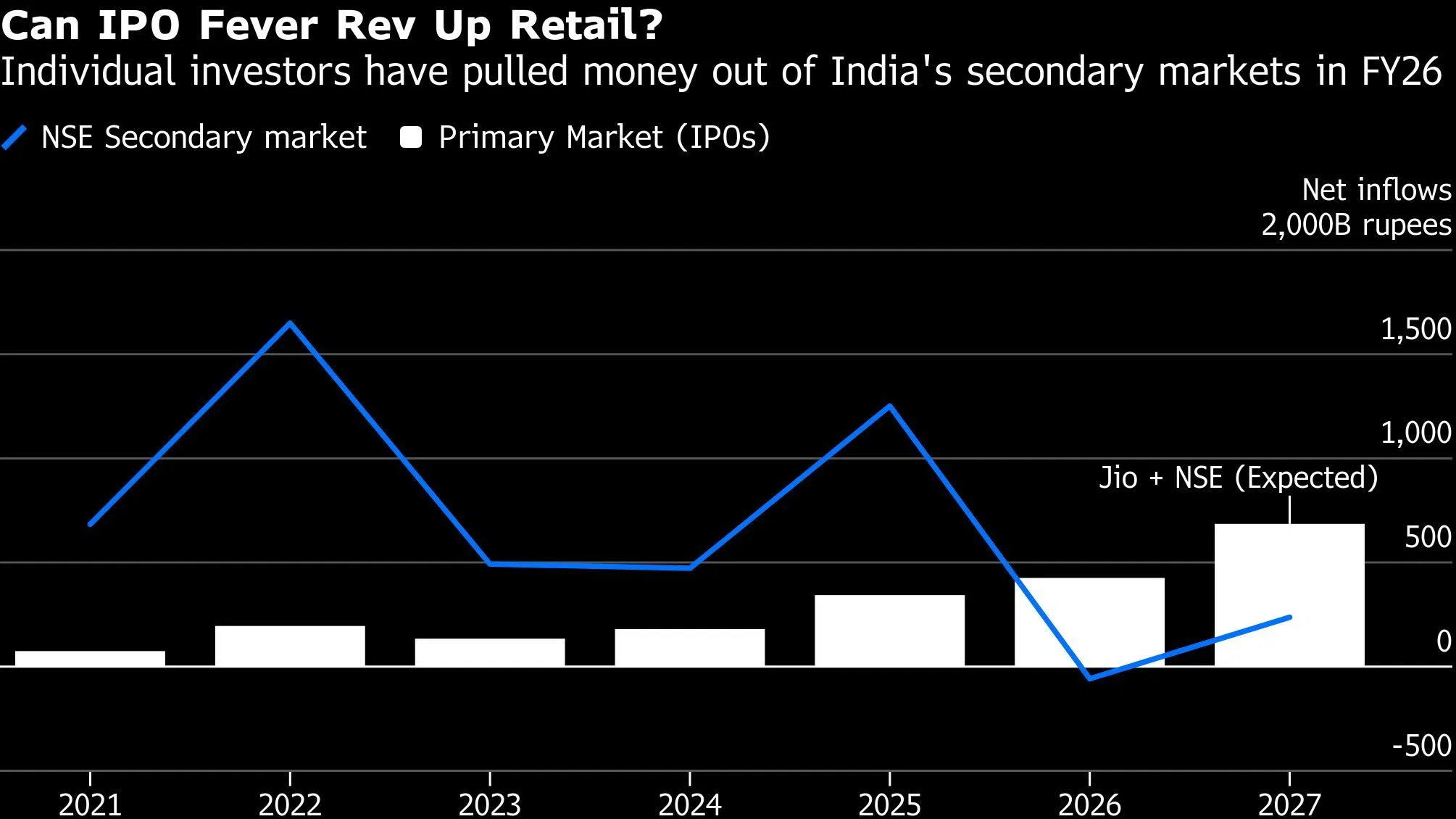
India's primary market has a steep climb ahead if it wants to match last year's record-breaking fundraising. After companies raised Rs 1.76 lakh crore through IPOs in 2025, fundraising in the first six months of 2026 has reached just Rs 19,854 crore, leaving a gap of more than Rs 1.5 lakh crore to bridge in the second half of the year.The task looks challenging, but the pipeline has suddenly become much stronger. Reliance Jio has filed its draft red herring prospectus (DRHP) for a proposed Rs 35,000 crore IPO. The NSE has also filed its draft papers for an estimated Rs 25,000 crore offer, while SBI Mutual Fund is expected to launch a public issue of around Rs 10,000 crore in the first week of July. Together, these three issues alone could account for nearly Rs 70,000 crore of fundraising.The question now is whether these marquee offerings can revive primary market activity and put 2026 back on track for another record year.Demand, not supply, has been the problemAnalysts point out that India's IPO pipeline has never been stronger. Hundreds of companies have already received Sebi approval or are awaiting regulatory clearance. The real challenge has been investor demand.Pranav Haldea, Managing Director of Prime Database Group, said the slowdown in IPO activity this year has been driven more by volatile secondary markets than by a shortage of issuers."The IPO market is not suffering from a lack of supply. The pipeline of companies approved by Sebi or awaiting approval is at its highest level ever. The challenge has been more on the demand side due to the volatility seen in the secondary market. Investors are being selective and expecting better valuations," Haldea said.He believes the upcoming mega offerings could improve market sentiment because they are profitable businesses with established franchises."If these issues get launched and do well, they could have a positive signalling effect and encourage both issuers and investors. However, one should not assume that strong demand for a few marquee IPOs will automatically translate into a broad-based revival across all sectors and issuers," he added.Jio, NSE and SBI Mutual Fund could change the moodUnlike many recent IPOs, the upcoming offerings involve businesses that already enjoy high investor recognition. Reliance Jio has filed draft papers for what is expected to be one of India's largest IPOs. The issue will consist entirely of a fresh issue of up to 27 crore shares, with no offer-for-sale component. The company is expected to raise around Rs 35,000 crore, with proceeds earmarked largely for debt repayment and future expansion.The NSE has also formally filed its DRHP after years of regulatory delays. The proposed IPO, expected to raise around Rs 25,000 crore, will be entirely an offer-for-sale by existing shareholders. SBI Mutual Fund, India's largest asset manager, is also preparing to tap the market with an IPO estimated at around Rs 10,000 crore.Together, these issues span telecom, financial infrastructure and asset management, three sectors with broad investor appeal.Paresh Bhagat, Chairman of Mangal Keshav Financial Services, believes these listings could restore confidence after a period in which several IPOs struggled after listing."These are among the most-watched public issues we've seen in years. They're established names with strong brands, solid profitability and huge investor recall. Their listings could help bring investor attention back to the primary market," Bhagat said.He, however, cautioned against viewing a handful of large deals as a complete solution. "A genuine revival of the IPO market can't rest on a few marquee names alone. Investor appetite is still linked to liquidity, valuations and earnings visibility. High-quality offerings like Jio, NSE and SBI Mutual Fund can certainly lift sentiment, but the market will also need a steady pipeline of fundamentally strong companies coming at sensible valuations," he said.Can 2026 still become a record year?Even after accounting for the proposed Jio, NSE and SBI Mutual Fund offerings, the market will still need several other large IPOs to match last year's Rs 1.76 lakh crore fundraising.A number of sizeable issues remain in the pipeline across financial services, manufacturing, healthcare and consumer businesses. Much will depend on market conditions, the pace of Sebi approvals and whether companies choose to proceed with their listing plans.Bhavesh Shah, MD and Head of Investment Banking at Equirus Capital, believes the broader backdrop has improved."Primary market sentiment is already showing signs of revival, aided by the healthy response to some of the recent IPOs. The easing of geopolitical tensions is another positive trigger. Going forward, the sustainability of this momentum will depend on the continuation of economic and earnings growth," Shah said.He continues to expect around $20 billion of IPO fundraising in India during 2026."The pipeline remains exceptionally strong and marquee offerings such as Jio, NSE and SBI Mutual Fund, if launched this year, will contribute meaningfully to the overall fundraising numbers, further deepening investor participation and reinforcing confidence in India's primary markets," Shah added.Bigger than fundraisingThe significance of these listings extends beyond the amount of money they could raise. Jio's IPO will be the first major listing by a Reliance consumer business since Reliance Retail was carved out. NSE's public issue will end nearly a decade of uncertainty around the country's largest stock exchange. SBI Mutual Fund's listing will provide investors access to India's biggest asset management company.If these companies price their offerings reasonably and deliver healthy post-listing returns, they could restore confidence after a mixed year for IPO performance. That, in turn, may encourage more companies to access the market and help investors become more comfortable participating in fresh issues.(Disclaimer: Recommendations, suggestions, views and opinions given by the experts are their own. These do not represent the views of Economic Times)
Rs 1.5 lakh crore behind 2025! Can Jio, NSE and other mega IPOs put 2026 on course for another record year?
India's primary market faces a significant fundraising gap to match last year's record. However, upcoming mega IPOs from Reliance Jio (Rs 35,000 crore) and NSE (Rs 25,000 crore), alongside SBI Mutual Fund (Rs 10,000 crore), could inject much-needed demand. Experts believe these established names can revive investor sentiment, but a broad-based revival hinges on sensible valuations and a steady pipeline of quality companies.
TL;DRAI
Jio, NSE, and SBI Mutual Fund IPOs (Rs 70,000 crore) bridge India's Rs 1.5 lakh crore 2026 fundraising shortfall. Primary market revival signals investor confidence in India's tech economy; unlocks M&A activity and growth-stage funding cycles for enterprises.
939 words~4 min read