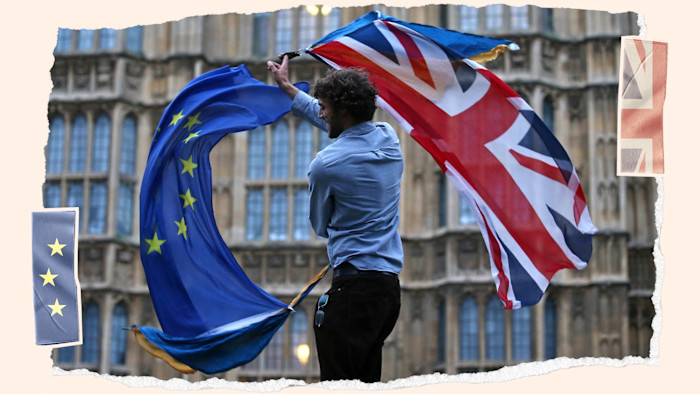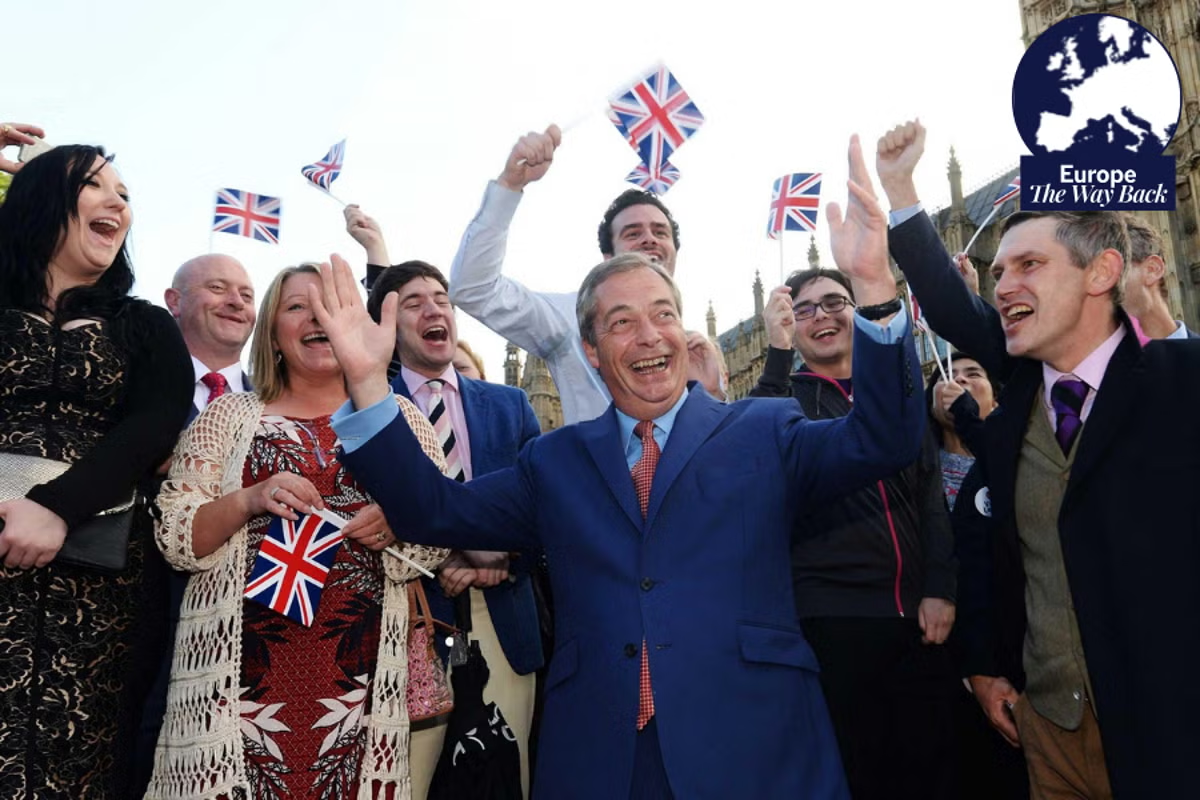
My suitcase was packed – but I stayed to find out what drove Brexit votersJulia EbnerAustrian researcher on counter-extremism, co-executive director of the Institute for Strategic Dialogue, and a dual British-Austrian citizenWhat she wrote after the referendum: “I invested all my time, money and energy in a marriage that is now doomed to fail – because no matter what the concrete consequences will be for EU migrants residing in the UK, the atmosphere has changed and I no longer feel welcome here.” What she says now: I remember waking up in shock 10 years ago. My suitcase was waiting to be packed. Emotionally, it felt as if I had just found out that my partner had cheated on me.But once the initial emotions had passed, I did what most people would do in a committed marriage: instead of filing for divorce, I decided to investigate what had gone wrong. I spent a lot of time listening to leave voters and I quickly realised that it would be wrong to judge an entire country based on a narrow majority. Britons had been forced into a life-changing binary decision amid a campaign marked by political instrumentalisation, foreign interference and algorithmic amplification of divisive content.Now here I am a decade later: no longer an Austrian national living in the UK, but a voting British citizen, a mother of two British children, an academic at a British university and a frequent adviser to the British government. I even swore my loyalty to King Charles.Against the backdrop of growing hostility towards immigration, foreign cultures and languages, I am also doing my best to keep my European side alive. I feel privileged because neither my skin colour nor my religious affiliation gives away my non-British roots. Ten years on, it is clear that the xenophobic resentment didn’t end with Brexit. Ukip’s “breaking point” poster and the murder of the British MP Jo Cox in 2016 were early warning signs of a larger trend.From the Southport riots to the Unite the Kingdom rally, from the protests in Southampton to the violent escalations in Belfast, the extreme right has succeeded in mainstreaming its anti-immigration ideas. Yet the loudest calls for patriotism are the greatest risk to those British values that I chose to embrace.The world is different now but Britain’s natural place is in the EUGuy VerhofstadtFormer prime minister of Belgium and former chief Brexit coordinator for the European parliamentWhat he wrote after the referendum: “Brexit will be a sad, surreal and exhausting process. The EU must use the UK’s departure to reform and move forward. Britain can choose to be a partner in this process, or it can be an impediment to it. Let us hope for a future relationship based on trust and genuine partnership.”What he says now: A decade on, Brexit has not resolved Britain’s relationship with Europe. It has merely made it more complicated, more costly and more frustrating. The promises made in 2016 have not matched reality. Trade barriers have increased and Britain has found itself outside the room when decisions affecting its future are taken.The world has changed too. In the face of Russian aggression, economic competition from authoritarian powers, climate breakdown and rapid technological transformation, the case for European cooperation has become stronger. Countries acting alone cannot address these challenges effectively.For me, the lesson of the past 10 years is clear: Britain’s natural place is in the European Union. The EU isn’t perfect. But Britain’s interests, values, security and prosperity are fundamentally European.A generation of young Britons see no contradiction between being proudly British and proudly European. They understand that their future security and opportunities are bound up with the continent to which they belong.The responsibility now falls to them. The generation that lost its European citizenship without being asked should not resign itself to a permanent loss. Political decisions can be reversed, and the next chapter of Britain’s European story has yet to be written. Young Britons should have the ambition to write it.Leaving Brexit Britain was the best decision of my lifeOliver ImhofGerman writer and freelance journalist formerly based in the UK, now in MadridWhat he wrote after the referendum: “As a democrat I have to accept a defeat. I have to accept being oppressed by a majority of an older generation that seems intent on depriving us of our future. This is why I am leaving this country. When? Definitely before the ink dries on the divorce contracts. Where does the journey go? I do not know yet, but hopefully somewhere where it is warm and our generation has a voice.”What he says now: In September 2018, I packed my bags in the least emotional goodbye possible to a city I once loved. I left behind an amazing bunch of people, but I was so fed up with the UK that I wasn’t exactly dabbing my eyes when the plane took off from Gatwick. The moment the airport gate opened in Madrid, I felt only relief.Leaving has turned out to be the best decision of my life so far. While the UK was battered by Brexit and the Covid-19 pandemic, Spain came out thriving. Ironically, it did so by adopting everything British people voted against in the 2016 referendum. Sensible and relatively liberal migration policies brought a fresh spirit to the capital. A functioning welfare state provides basic services so no one gets left behind. Hard work guarantees you a decent life in sunny weather. It almost makes you feel as if the Spanish economy works for the people and not the other way around.Oliver Imhof in Madrid. Photograph: Oliver ImhofYet every year I return to the UK. Often I’m shocked by the levels of poverty, half-empty high streets and sense of insecurity, although I sometimes miss life in London, a city where no one is really a foreigner. Bureaucracy on the continent can be sluggish sometimes, and Anglo-Saxon qualities such as hunger for innovation and open-mindedness are things I do appreciate.I hope the UK can overcome its divisions and rejuvenate the progressive mentality that once made the country great. Ideally, it will do so as part of a united Europe one day.Irish writer and associate professor of Irish performance studies at Concordia University in CanadaWhat she wrote after the referendum: “It is perhaps best, then, that we come to terms with the discomfiting idea that Ireland will, in a sense, be partitioned a second time. And, yes, this could unsettle the peace. All parties – the UK, Northern Ireland, the Republic and the EU – need to do everything in their power to ensure that the border they create is one that fits the contours of our past and our present.”What she says now: I remember joking about the fact that no Brexiter could offer a coherent plan for Northern Ireland; that they’d just, to quote Paul and Linda McCartney’s banger Give Ireland Back to the Irish. It was urreal that Brexit could happen, when there really was no plan.The unionist community was against a customs border in the Irish sea, while the nationalist community rejected a return to a hard border on the island. I remember parsing the possibilities with friends and family: what a return to checkpoints would look like, the danger posed to a peace agreement that was, at that point, less than two decades old. Reading my column, I’m brought back to those anxieties, and to the hope that those in power would privilege peace. Ultimately (to cut a long story short), the customs border was put in the Irish Sea, and the peace preserved.In 2016, I speculated that Brexit would bring Ireland closer to unity, which it has. The customs solution for Northern Ireland post-Brexit was supposed to offer a best-of-both-worlds scenario, in which it retained access to the EU single market while remaining part of the UK. But Brexit has contributed to widening the gap in living standards between the North and the Republic. Standards of living in the Republic are now much higher, and that gap is widening. More people now travel from the North to the Republic to work. And this new economic reality correlates with a shifting identitarian and political landscape. The statistics I cited in 2016 for “British only” (40%), “Irish only” (25%) and “Northern Irish only” (20%) identities in Northern Ireland now stand at approximately 32%, 29%, and 20% respectively: that is to say, post-Brexit, the numbers of self-proclaimed unionists and nationalists are close to even. Meanwhile, Fine Gael, one of Ireland’s major political parties, is drafting policy for unity. If people in Northern Ireland vote eventually to join the Republic, there’ll be a plan.‘Brexodus’ didn't quite happen – but the UK is no longer a promised land Jakub KrupaFormer UK correspondent for Polish media, now the Guardian’s Europe live bloggerWhat he wrote after the referendum: “The idealistic image of the UK that many Europeans have always had – a place of cultured and informed public debate, along with a trademark openness – has changed over the last few months, with a rather ugly face of xenophobia and anti-migrant sentiment dominating the picture instead. Maybe I am naive, but I still firmly believe that Britain is better than this.”What he says now: In the wake of the Brexit referendum, I called for a country that works for everyone, EU citizens included. Facing deep uncertainty and incidents of abuse, many doubted whether the UK would still be the place for them in the future. Ten years on, the vast majority have stayed, even as the dynamic has shifted significantly. So there has not been quite the Brexodus some would have you believe – nowhere near, in fact – but even so, at the moment more Romanians and Poles are leaving the UK than coming in. Britain is no longer the promised land it once was.This new reality is often dissected with thinly veiled condescension – perhaps a function of Britain’s exceptionalism, which is still very much alive. “Wait, what? Even in Poland, that country of tabloid-ridiculed swan-eating, physical labourers that we looked down on, things are better now?” It is ironic that a Polish passport is now more potent than a British one, and that more and more Brits shake their family trees for Polish roots. They are more than welcome to visit, but only for less than 90 days in any given 180-day period – Schengen means Schengen.The millions of EU citizens still here are now relying on the settled status and rights granted to them as part of the Brexit settlement. But as Nigel Farage recently told the Italian newspaper La Repubblica that he would rip up their rights if Reform gets elected in 2029, they will face sleepless nights over their future.Faced with this ongoing precariousness, or perhaps wanting to express their love for their new home, or both, just under half a million have naturalised or registered as UK citizens since 2016 (468,322, to be precise). Romanians, Poles and Italians have led the way.
‘I remember the shock’, ‘It can still be reversed’ – what do Europeans think of Brexit now?
After the 2016 referendum, panellists from other EU countries responded in the Guardian. Ten years on, we’ve gone back to them
2,711 words~12 min read