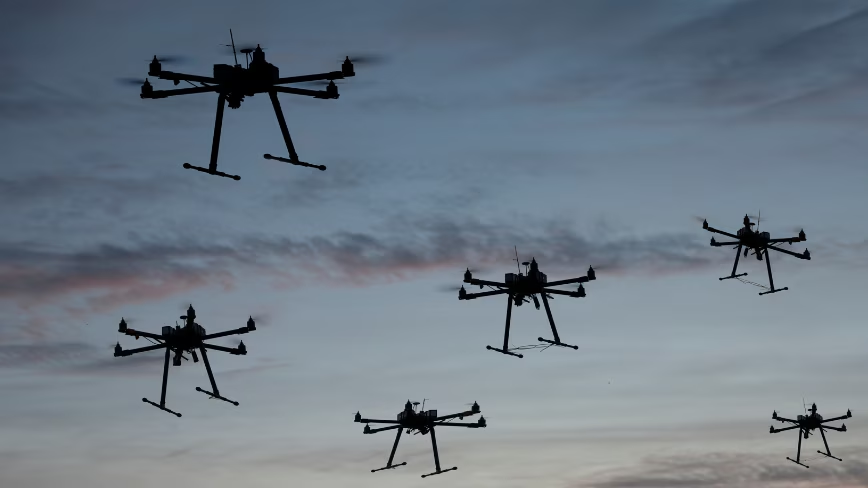
Replay attacks on drone command links are not theoretical. A ground station sends ARM at timestamp T. An adversary records the packet. Thirty seconds later they retransmit it verbatim. If the drone accepts it, you have a serious problem — and in a jammed or contested environment, the attacker can do this silently.
The standard defense is a monotonically increasing nonce: every packet carries a counter, and the receiver only accepts packets with counters strictly greater than the last accepted value. Simple in concept. The implementation details are where things get interesting.
This post walks through the nonce design in CleitonQ, a post-quantum authentication layer for MAVLink v2, and the three decisions that are non-obvious but matter for security.
The Problem: Concurrent Control Loops
A drone's onboard software runs several concurrent threads: a 100 Hz telemetry loop, a command processor, and potentially a mesh relay. All of them sign outbound packets. All of them need nonces.