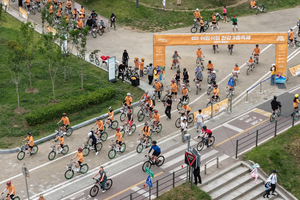
Cyclists are seen at a festival at Ttukseom Hangang Park in Seoul on June 7. (Yonhap) Cycling is both an effective form of exercise and a convenient means of travel. But under Korean law, bicycles are also subject to a wide range of traffic rules.The rules are intended to protect both pedestrians and riders, who generally have a higher risk of injury than people in cars or other vehicles.Some bicycle rules are often ignored in practice, such as wearing a helmet or avoiding the pavement. Traffic police may be more flexible with bicycle-related violations than with car-related ones, but that does not mean the rules are optional.Where bicycles should be riddenUnder Korean traffic law, bicycles are treated as vehicles, meaning they generally belong on the road, not on the pavement.As the slowest-moving vehicles on most roads, bicycles should keep to the far-right side of the road. The best option is to use areas marked for bicycles.If there is no such area, riders should use the rightmost lane. In such cases, bicycles should keep to the right side of the lane — using half or less of the lane — and slow down or stop when they may hinder pedestrians.It is illegal to ride bicycles on the pavement, and doing so is punishable by a fine.Bicycles ridden by children, older adults and people with physical disabilities are allowed on the pavement.Bicycles ridden by adults without disabilities are also allowed on the pavement if it is impossible to ride on the road, such as when there is construction work or damage to the road.In practice, many people do ride bicycles on the pavement, and police rarely ticket them. This regulation is among the most commonly violated, and authorities are often flexible in enforcing it. But this does not mean it is legal, and officers can issue tickets to bicycle riders at any timeBike lanesBike lanes are legally reserved for bicycles and “personal mobility devices.” The latter refers to small electric scooters weighing less than 30 kilograms and capable of speeds of less than 25 kilometers per hour. On regular roads, riders may see a narrow red strip marked with a bicycle symbol and the words “bicycles only.”Riders may also see regular-sized lanes marked with a bicycle symbol. These are lanes where bicycles have priority, but cars and motorcycles may also use them. A man ride a bicycle on a beachside road on Jeju Island, June 5. (Yonhap) Rules for riding on the roadHaving to stick to the far-right lane can make left turns challenging for cyclists.The correct and safe way to do so is to cross the intersection in accordance with the traffic signal, then wait for the green light to turn. Riders should not try to turn left by following left-turn signals at traffic lights, as bicycles lack the speed and protective features of cars.When moving past a stopped car, a bicycle must pass on the right side of the vehicle. Bicycle riders should also allow faster-moving vehicles to pass them by moving as far to the right as they can without endangering themselves or others.When changing direction or maneuvering in any way other than going straight, riders must signal with their hands.Pedestrian safetyCyclists should be mindful of pedestrian safety at all times. Riders who need to use the sidewalk for any reason must get off their bicycles and move them by hand. The same applies when using a crosswalk.As with cars, bicycles turning right at an intersection should not hinder pedestrians on a crosswalk. On roads used by both vehicles and pedestrians, bicycles should move slowly while keeping a sufficient distance from pedestrians, slowing down or stopping if necessary to ensure their safety.Preparing to rideChecking safety gear and the condition of your bike is the first step before riding. Wearing a helmet is one of the requirements stipulated in the Road Traffic Act for bicycle riders.Head injuries are common among cyclists, but there is no written legal punishment for not wearing a helmet. The lack of a penalty in the 2020 revision of the act, which added the helmet requirement, has caused some dispute here.Riders are advised to check their bike's tires, the condition of the brakes and chain, and whether the seat and handlebars are securely fixed.Both headlights and taillights — or rear reflectors — are required when riding late at night, and failure to have such equipment can lead to a fine. Only white or yellow headlights and red taillights or reflectors should be used.Other rules to rememberRiding a bicycle while under the influence of alcohol is considered drunk driving. Though it is subject to a lower level of punishment than drunk driving in a car, habitual violators could have their bicycles seized by authorities.
Bike rules in Korea: What riders should know
Cycling is both an effective form of exercise and a convenient means of travel. But under Korean law, bicycles are also subject to a wide range of traffic rules
787 words~4 min read