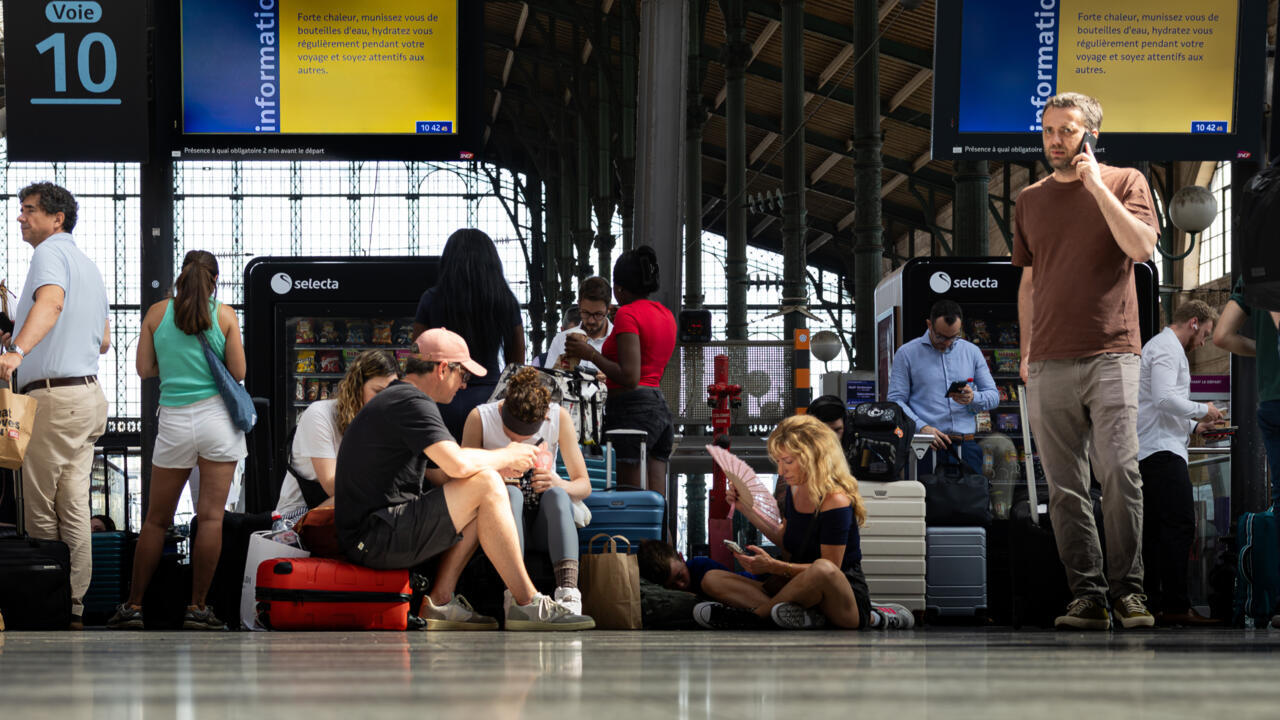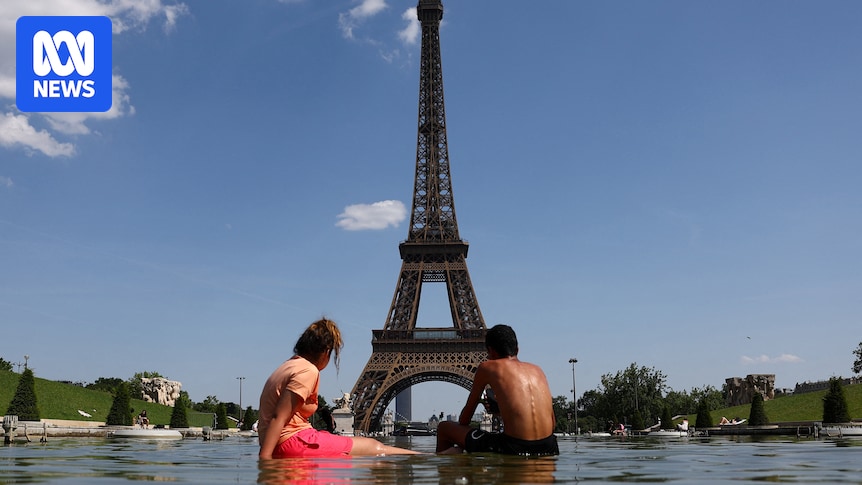
At least 18 people have died in France, including two children left in a hot car, as a heatwave over Europe has smashed temperature records in several cities.As schools in France closed or modified timetables on Monday, forecasters in Britain predicted temperatures could break records for June this week.The temperature in Bordeaux in France's western wine country rose to 41.9 degrees Celsius, breaking a record set last August.In Poitiers in central France it reached 41.2C, beating a previous high set in 1947.Europe is warming at more than double the global rate. (Reuters: Abdul Saboor)In San Sebastián, in Spain's traditionally cooler north, the temperature was set to reach 40C.That is more than double the city's historic average for June 22, according to the Reuters Climate Monitor, which showed Europe as the continent furthest from its historic norm on Monday.An April report by the World Meteorological Organization found Europe was warming at more than double the global rate.Two children die in hot carFirst responders were unable to resuscitate two children, aged two and four, who were found unconscious by their mother in the family car outside their home, said a prosecutor in Carpentras, south-east France.Three elderly people, aged between 80 and 95, died over the weekend in the Bordeaux region from health issues caused by the heatwave, local government official Sophie Brocas told France TV late on Sunday.A pharmacy thermometer shows a temperature of 43 degrees Celsius in Nantes. (Reuters: Stephane Mahe)"Swim only in places that are supervised," French Civil Safety service spokesperson Jerome Boulanger said after 13 people were reported drowned from Sunday into Monday.Drowning deaths spiked by 172 per cent in France last year during heatwaves as swimmers tried to cool off.The heatwave affecting large parts of Europe is known as an Omega block because it takes the shape of the Greek letter Ω, with a bulge of hot air in the middle and cooler air either side, said Clair Barnes, a research associate in extreme weather and climate at Imperial College in London.A woman rests in the shade of the trees at the André Citroën park. (Reuters: Sarah Meyssonier)"It's drawing warm air up from North Africa, from the Sahara, and that's why we have this really intense heat. It's very slow-moving and it means there's kind of no wind, no breeze for respite," she said.Heatwaves and storms are being intensified by climate change, pushing temperatures higher and causing more rainfall, she said.UK heat to break June recordThe Met Office, Britain's national weather forecaster, said on Monday that a four-day heatwave there could push temperatures above 39C in some places, easily breaking the June record of 35.6C set in 1957 and 1976.Just a few weeks ago, Britain had shattered its record high temperature for May."Thirty-six degrees is going to be disgusting," said data scientist Lewis Jennings, out walking in central London.A woman shields herself from the sun with an umbrella as she walks in the garden of the Palace of Versailles. (AP Photo: Thibault Camus)Paris was due to register its highest temperature for June, with the mercury reaching 38.4C, according to preliminary numbers from Météo-France."We are seeing temperatures between 5 and 10 degrees above normal for this time of year, and in some northern areas even more than 10 degrees above average," said Rubén del Campo, spokesperson for Spain's AEMET weather agency.On Monday, Italy also issued heatwave red alerts for 12 cities.Two people use a water mister on a street in Paris. (Reuters: Alice Sacco)Utility Iren was doubling workers' shifts and adding generators to address sporadic power cuts in Turin as the electricity grid came under strain, a spokesperson said.Birds such as swifts, swallows, sparrows and starlings, which make their nests in the eaves of roofs, have been particularly affected by abnormally high temperatures, said Romaine de Jaegere, founder of the Centre for the Rehabilitation of Animals Living in the Wild refuge in Temploux in Belgium."Temperatures on the roofs can sometimes reach 50, even 60 degrees Celsius. So they prefer to jump rather than let themselves die and literally cook in their nests," Mr de Jaegere said, adding that the shelter had received 150 animals in the last three days.ABC/Reuters
Children die in hot car as Europe bakes
At least 18 people died in France, including two children left in a hot car, as a heatwave hung over Europe, smashing temperature records in several cities.
690 words~3 min read