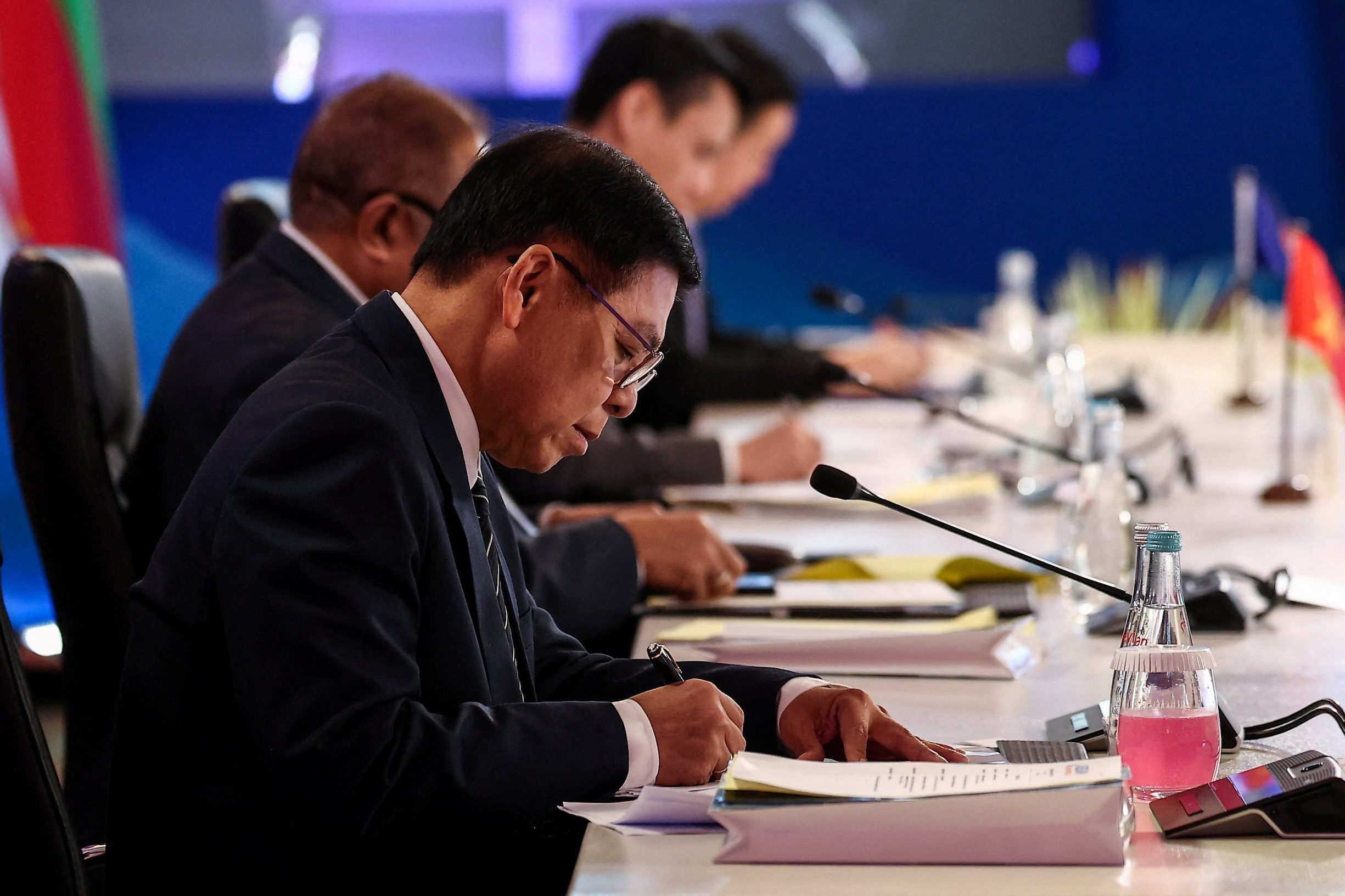
VITIT MUNTARBHORN Recently, a conference on international law was held by the Ministry of Foreign Affairs in Bangkok to provide space to a young generation of lawyers. It was a timely reminder that even though the international system is fragile, Thailand should engage actively with what remains of that system. There are also new cogs in the wheel of that spectrum. International law is basically the set of rules to guide the conduct between states and between states and other international actors. Traditionally, it was rather top-down in treating individuals as objects of duties rather than as subjects of rights. However, this has been changing due to a more horizontal approach that provides room for nonstate stakeholders. International rules such as the prohibition of threat or use of force by one state against another state are now complemented by more grounded norms and mechanisms to enable protection of individuals and communities.The fact that some superpowers violate international rules, such as those in the UN charter, does not justify internationally wrongful acts by other entities. This is pertinent to those rules which protect the international order from aggression and destruction, on the one hand, and human-cum-environmental well-being, on the other hand. Even if a superpower has reneged on climate change-related action, Thailand still needs to pass a clean air law and a climate change law expeditiously, as well as ensure cross-border interaction.There are other key directions of note. First, even if multilateralism represented by the UN is fragmented, various opportunities open the door to engagement. The plurilateral approach of involving a number of countries, even if this is not totally universal, is still to be explored. The Investment Facilitation Agreement of the World Trade Organization remains important to help reduce paperwork for investment affecting developing countries, even though the appeals’ process for trade disputes is now blocked by omnipotent channels.Second, there are new multilateral settings which offer a doorway to cooperation. An emerging example is the treaty on the protection of oceans beyond national jurisdiction (known as the Agreement under the UN Convention on the Law of the Sea on the Conservation and Sustainable Use of Marine Biological Diversity of Areas beyond National Jurisdiction, or BBNJ), which regulates activities on the high seas. The majority of countries now agree that if there are to be areas for exploration and exploitation, they must be subject to due diligence and environment impact assessment, which cannot be left to the unilateral action of a state. Thailand should aim to have representation in the committees under this treaty.Third, regional and bilateral arrangements can help to reduce the impact of the weakened multilateral system. For Thailand, whatever the vicissitudes of international trade, it is essential to finalize a free trade area with the European Union with impact on not only trade and commerce but also as a shared political umbrella for partnership covering digitalization, artificial intelligence and human security-cum-development.Fourth, agreements to protect the interests of foreign investors need to be adjusted to ensure fair treatment of developing countries. There are scores of these investor-state agreements which impose too heavy a burden on the latter in relation to the notion of "fair and equitable treatment." In reality, this means that foreign investors can bypass local jurisdiction by taking disputes to outside arbitration with exorbitant awards from arbitration panels (sometimes with transparency problems). The right of the country receiving the investment to regulate the process was raised at the conference. There is more room to employ national judicial systems to ensure exhaustion of local remedies rather than shifting investment disputes to unpredictable external quarters.Fifth, preparedness and astute planning are essential to enable the country to negotiate in the various dispute settlement mechanisms at the international level. Resort to the International Court of Justice is unlikely by the country due to its past experience with the Court. On sea-related matters, there are other options such as the International Tribunal for the Law of the Sea or arbitration, which can both lead to binding decisions. Under the Law of the Sea Convention, if such mechanisms are not chosen, the default process is compulsory conciliation with nonbinding recommendations, while being open to consensual processes such as negotiation and consultation. In regard to conciliation, to date, the process has been facilitated by the Permanent Court of Arbitration in the Hague, dating back to the pre-World War I era with arrangements still pertinent today.Sixth, while international peace and security remain at the heart of global issues, there are new aspects of that panorama. Protection of civilians in times of war is ever-relevant as part of international humanitarian law. Recently, an international treaty on cybercrimes was adopted, pitching the call for action in regard to cyberspace, evidenced by rampant online scams and other violations. The power-based context surrounding these elements, including the presence of nondemocracies, should not be overlooked.Seventh, the need for intelligent communications strategies is essential in a world of increasing misinformation and disinformation. This invites a proactive approach to employ all the channels possible — multilateral, regional and national — to ward off hate campaigns from abusive settings and to trigger political, media and other leverages to counter distortions.Eighth, the term "middle powers" has come to the fore, inviting this country to coalesce with African, Central/South American and other regions to overcome the dilemma of irresponsibility emanating from various superpowers. With regard to resources, whether land, sea, air or space, there are some domains which should belong to "common humanity" rather than one state alone. Certain "commons" such as the stars and the planets should not be open to national appropriation.Finally, sustainable human development and human rights remain pivotal for international and national action. The current global Sustainable Development Goals which began in 2015 will expire in 2030. Planning for the future is essential, even if some superpowers have become more insular and pugilistic.The next phase of development planning will not be able to sidestep issues of war and peace, climate change and related disasters, and the advent of nonstate actors, such as the business sector, and nonhumans, such as AI. A spiritual response (not necessarily religious) invites the global public not to be immersed only in materiality but also to be open to psychosocial interaction and socialization with empathy, such as through caring and sharing action, inspired by local-global wisdom.- - -Vitit MuntarbhornVitit Muntarbhorn is a professor emeritus at the faculty of law at Chulalongkorn University and a former UN Special Rapporteur. The views expressed here are the writer’s own. — Ed.(Asia News Network)
[Vitit Muntarbhorn] New cogs in international law
Recently, a conference on international law was held by the Ministry of Foreign Affairs in Bangkok to provide space to a young generation of lawyers. It was a t
TL;DRAI
Muntarbhorn advocates Thailand's pivot to EU bilateral deals on AI/digitalization and ocean treaties, bypassing weakened UN multilateralism. For tech execs, this signals Southeast Asia's move toward independent compliance and AI governance frameworks, reshaping regional supply-chain policy.
1,084 words~5 min read