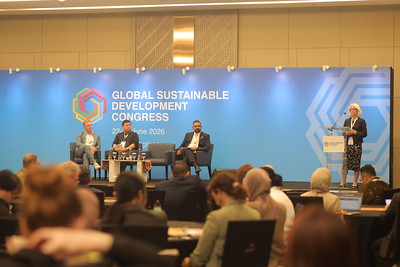
The way universities evaluate the success of their sustainability work is little understood at a “grassroots” level and needs to evolve if the United Nations’ Sustainable Development Goals (SDGs) continue beyond 2030, a forum has heard.
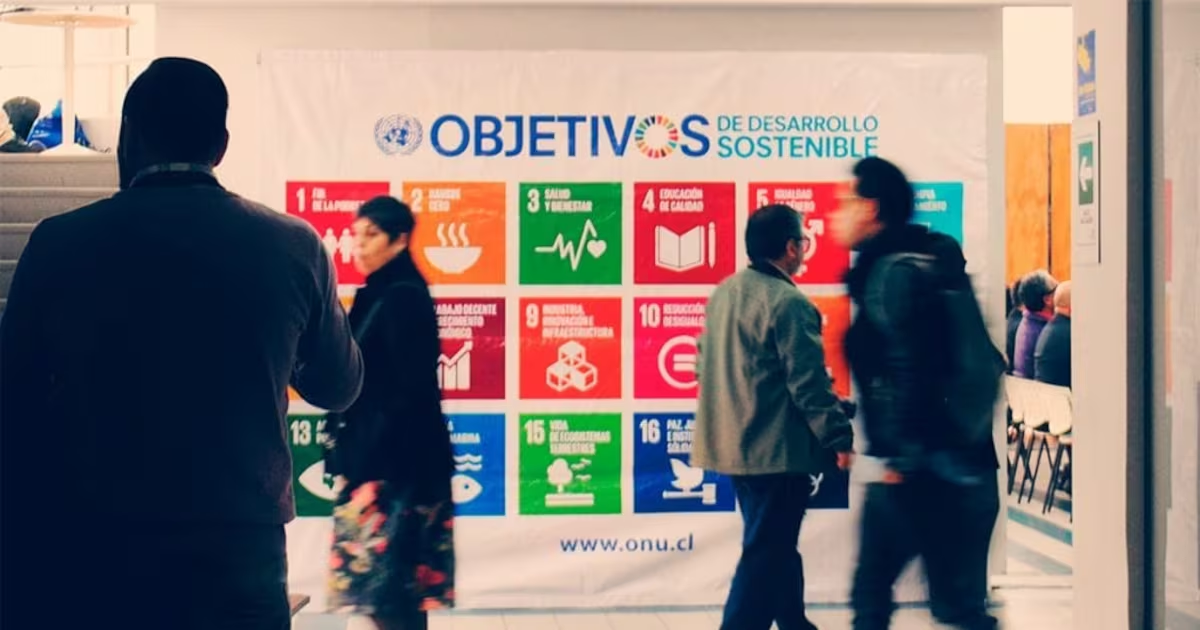
University leaders told the opening session of Times Higher Education’s Global Sustainable Development Congress in Jakarta that the SDGs have “shifted the paradigm” by entrenching the notion that economic growth and the environment cannot be considered independently from each other. But most SDG targets will not be achieved by their 2030 deadline, and the framework “needs to continue”, and it must evolve by treating citizens as “partners and not recipients”.
Rachel Martin, senior director of sustainability with Elsevier, said one of the reasons for the SDG framework’s “imperfect” progress was a widespread failure to understand – or embrace – the personal. “Technology alone is not going to drive progress,” Martin said.
“[For example] there’s a high expectation that vaccines are going to deliver what we want them to deliver. But these technology solutions, without a cultural understanding and contextualisation, will not work.”
Rembulan Kania Maniasa, executive director of the Green School Foundation in Bali, said the SDG framework had not had great impact at the “grassroots” level. “Oftentimes…local communities have a hard time understanding it,” she told the forum.