Author(s): Yashraj Behera
Originally published on Towards AI.
Cursor’s in-house coding model did not come from nowhere. The company confirmed it started from an open-weight checkpoint anyone can download, then spent its own compute on top. That single fact changes what building your own version actually requires. It is not cloning magic. It is an integration project, and the integration is the part you control.
In March 2026, Cursor launched a coding model it called Composer 2 and described as frontier-level. Within a day, a developer watching the app’s network traffic spotted a telling model identifier, and the truth came out. Composer was not trained from scratch. It started from Moonshot AI’s open-weight Kimi K2.5, the same file anyone can download for free, with Cursor’s own training layered on top. The company later confirmed it plainly, writing that Composer is built on Moonshot’s Kimi K2.5 checkpoint.
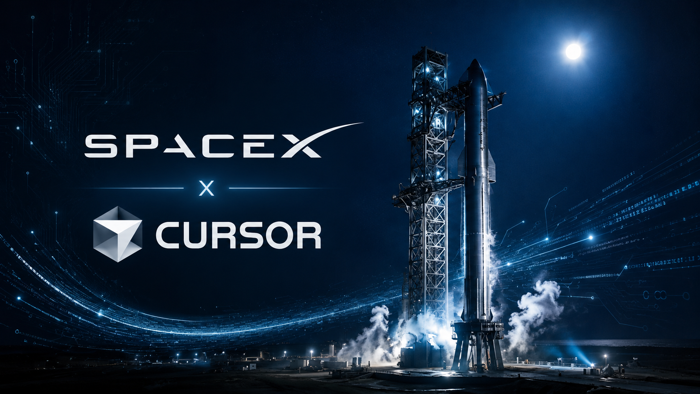
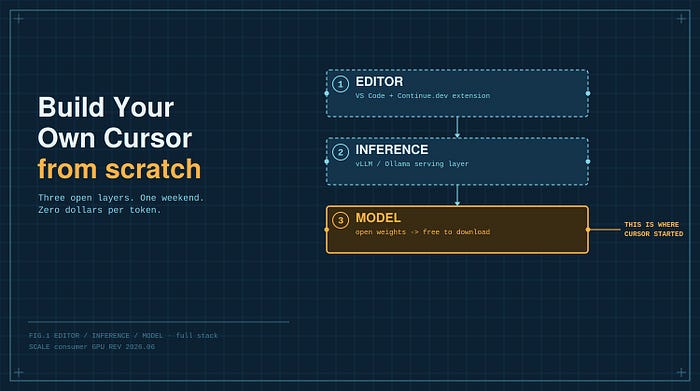
Set aside the disclosure drama, because the interesting part is what this tells you about building your own. That free checkpoint, it turned out, was the foundation of something enormous. Cursor grew so fast that in June 2026 SpaceX agreed to acquire its parent company for sixty billion dollars. A tool whose brain began as a free download is now the subject of one of the largest acquisitions in software history. Which raises an obvious question, if the starting point is free, how much of this can you build yourself? A frontier coding tool turns out to be three things stacked together: an editor, an inference engine, and a model. The editor is open source. The engine is open source. And the model, it turns out, can be a free download too. The thing that felt like proprietary magic is mostly an integration, and that means you can build a working version yourself, one that runs on your own hardware, keeps your code on your own machine, and costs nothing per token once the GPU is paid for.