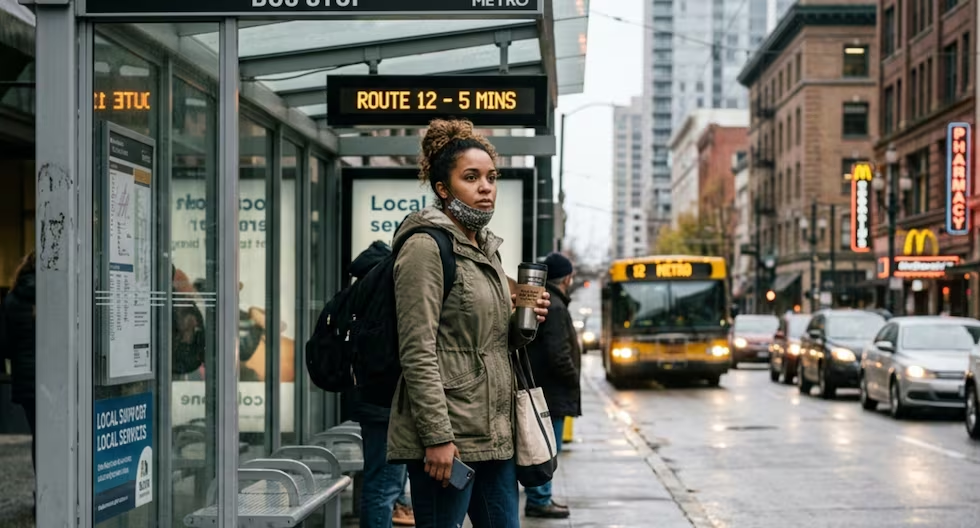
Every morning, millions of people do the exact same thing. They leave home at the same time, stop at the same traffic light and follow the exact same route to work, school or the grocery store. Even when navigation apps suggest faster alternatives, they often ignore them. To some people, this may seem boring or repetitive. But psychology suggests something very different. Taking the same route every day is often a sign that the brain is trying to simplify life in a world that has become increasingly complicated. In many cases, this habit is less about avoiding change and more about managing mental energy.Here is what psychology says may actually be happening.Psychology says humans are cognitive misersOne of the most established ideas in social psychology is Cognitive Miser Theory. Introduced by psychologists Susan Fiske and Shelley Taylor in 1984, the theory suggests that humans naturally conserve mental energy whenever possible. The brain is constantly searching for shortcuts. Every new route requires additional processing.Should I take the highway? Will traffic be heavy? Is there road construction today? By choosing the same path every day, the brain eliminates unnecessary calculations. This allows people to reserve mental resources for more important tasks. In other words, the route becomes one less problem to solve.You Might Also Like:Decision fatigue may be pushing people toward routinesModern adults make thousands of decisions every day. Researchers have long studied a concept called decision fatigue. Psychologist Roy Baumeister and colleagues found that repeated decision-making can gradually deplete mental resources and make people less effective at future choices. This may explain why routines feel comforting.People intentionally simplify certain parts of life to avoid overwhelming themselves. Modern examples are easy to find. Some successful executives wear similar outfits every day. Others eat the same breakfast each morning. Many people rely on familiar routes for the same reason. They are reducing cognitive demand.Habit theory says repetition eventually becomes automaticAnother explanation comes from habit research. Psychologist Wendy Wood has spent decades studying how habits shape behavior. Her research suggests that nearly half of everyday behaviors are repeated in the same context until they become automatic.Over time, the brain transfers repeated actions from deliberate decision-making to automatic processing. The daily route eventually requires very little conscious effort.You Might Also Like:People sometimes arrive at their destination and realize they barely thought about the journey. That is because the behavior has become deeply embedded in their routine. This is not absent-mindedness. It is efficient automaticity.Uncertainty Reduction Theory explains why familiar roads feel comfortableHumans generally prefer predictability over uncertainty. Uncertainty Reduction Theory, developed by Charles Berger and Richard Calabrese, explains that people naturally seek information and familiarity to reduce feelings of unpredictability. Although the theory was originally developed to explain social interactions, psychologists increasingly apply it to everyday behaviors.A familiar route creates certainty. People know where traffic slows down. They know where accidents usually occur. They know approximately how long the journey will take. That predictability can reduce stress, especially during demanding periods of life.Need for Cognitive Closure may explain why some people love routines more than othersNot everyone enjoys spontaneity equally. Psychologist Arie Kruglanski developed the Need for Cognitive Closure Theory to explain why some people have a stronger preference for certainty, structure and predictability.Individuals with a higher need for closure often prefer routines because routines reduce ambiguity. This does not mean they dislike adventure. Many of these same people enjoy traveling and trying new experiences. However, they often prefer having stable systems in their everyday lives. Daily routines become anchors that provide consistency.Modern life may be increasing our need for familiar habitsToday's environment is filled with constant stimulation. Emails arrive all day. Phones buzz every few minutes. News updates never stop. Psychologists frequently discuss cognitive overload, which occurs when people process too much information at once.Under these conditions, routines become psychologically valuable. Modern examples are everywhere. People order the same coffee every day. They sit in the same spot at work. They follow identical morning rituals. The daily route becomes another source of stability.Psychology says the route itself is not important — the mental relief isPsychology teaches us that everyday habits often reveal how humans adapt to stress. The road itself is not the story. The relief is. The relief of one less decision. The relief of fewer uncertainties. The relief of knowing exactly what comes next.In a world that constantly demands attention, predictability has become a form of comfort. And perhaps that is why so many people continue taking the same route every day. It is not necessarily because they fear change. It may simply be because their brains have found an efficient way to protect their mental energy. Sometimes the healthiest thing the brain can do is make one small part of life wonderfully predictable.FAQsWhy do some people always take the same route every day?The brain often prefers familiar routines because they reduce mental effort and increase predictability.Is taking the same route a sign of being resistant to change?No. Many people simply use routines to conserve energy for more important decisions.
Psychology says people who take the same route every day aren't boring, they may be reducing mental overload in a stressful world
Psychology teaches us that everyday habits often reveal hidden emotional needs. The route itself is rarely the real story. The relief it creates is. It is the relief of having one less decision to make and the comfort of knowing exactly what comes next in an unpredictable world.
TL;DRAI
Repetitive routines reflect cognitive efficiency: the brain conserves mental energy by automating decisions. For tech managers, this explains why stable infrastructure and familiar processes protect decision-making capacity for AI governance, M&A, and technology strategy.
838 words~4 min read