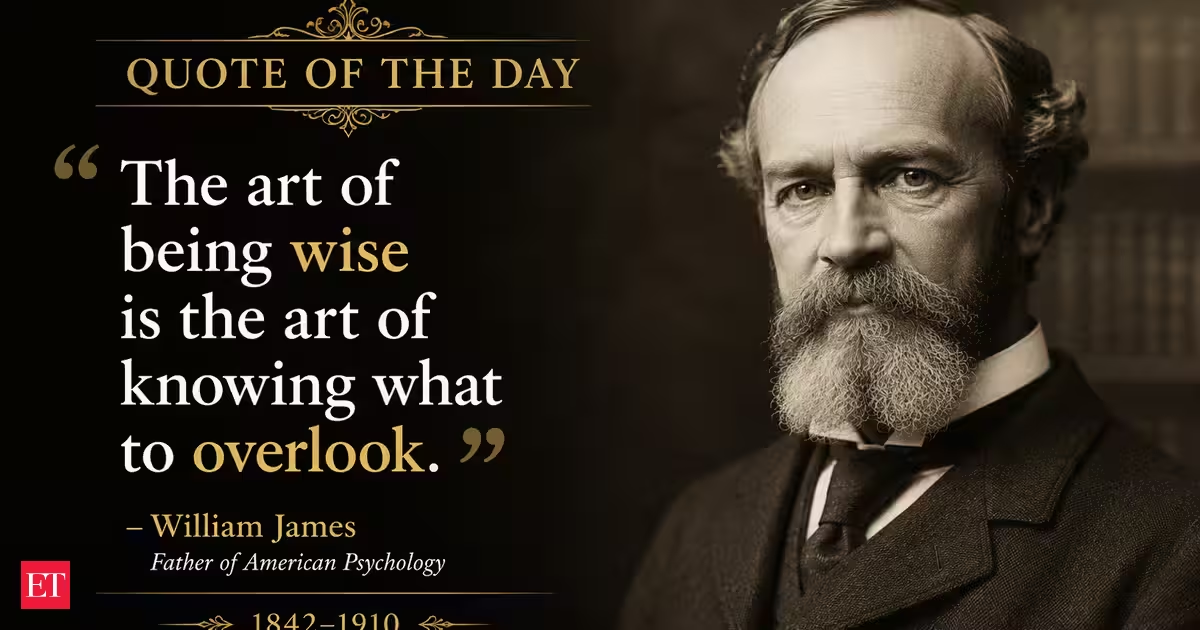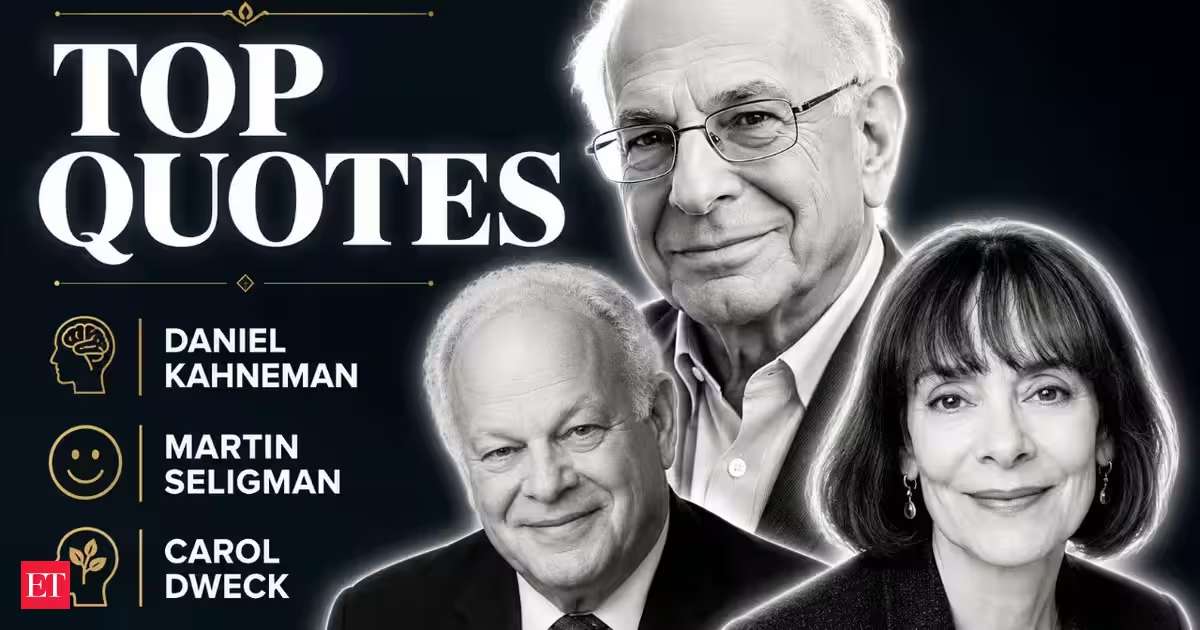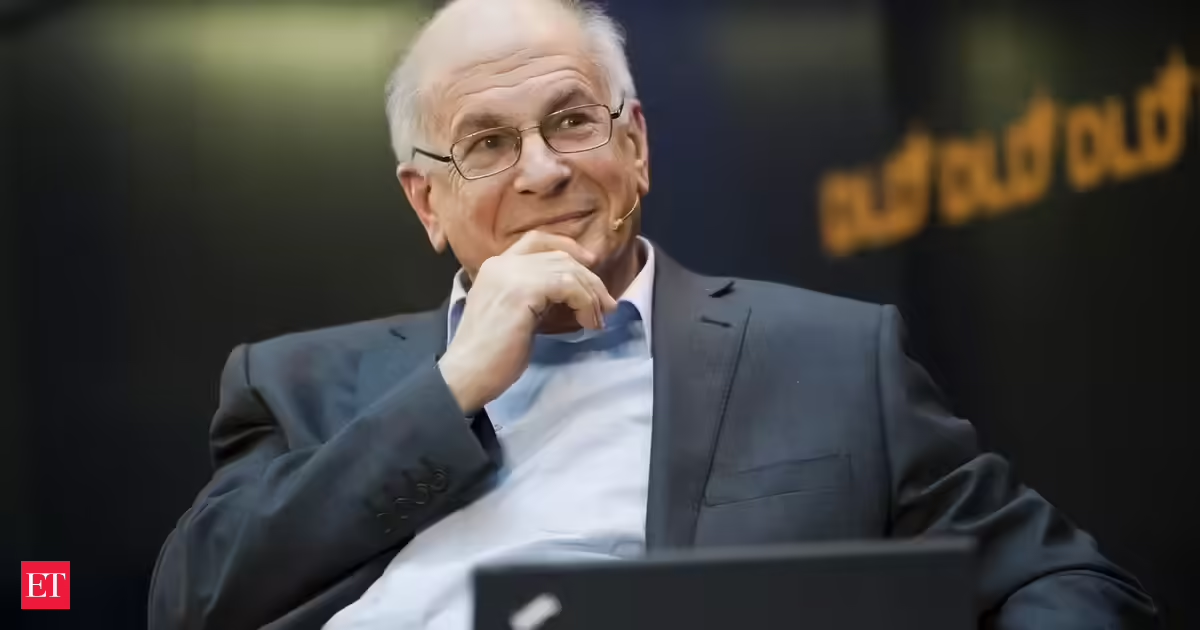
Word of Wisdom by Nobel Laureate Daniel Kahneman: Most people think intelligence is about being quick with answers. It's about solving hard problems fast, scoring high on tests, and thinking sharply under pressure. But Daniel Kahneman — Nobel Prize winner, psychologist, and one of the most profound thinkers of the modern era — saw it differently. He said, "Intelligence is not only the ability to reason; it is also the ability to find relevant material in memory and to deploy attention when needed." That sentence, simple on the surface, carries the weight of decades of research and a lifetime of watching how humans actually think, decide, and fail.This isn't just an academic observation. It's a practical truth that changes how you look at your own mind. Intelligence, in Kahneman's framework, isn't a fixed scoreboard. It's a living system — one that depends on what you store, what you notice, and where you choose to focus.The person who can retrieve the right memory at the right moment, and who can hold their attention steady when the world pulls it in every direction, that person holds a quiet but enormous power. And most of us never think about building that kind of intelligence. We are too busy chasing the performance of intelligence instead of the practice of it.Word of Wisdom by Nobel Laureate Daniel Kahneman: Intelligence Is More Than Raw BrainpowerThink about the last time you made a great decision. It wasn't pure logic, was it? Somewhere in that moment, your mind pulled up a past experience, a lesson learned, something someone once told you, or a pattern you had seen before. That retrieval — quiet, fast, almost invisible — is what Kahneman was pointing to. The ability to find relevant material in memory is not passive. It is a skill. It separates the experienced surgeon from the new one, the wise leader from the energetic but reckless one, the master chess player from the enthusiastic beginner.Abraham Lincoln is a beautiful example of this. Lincoln was not the fastest thinker in any room. But he was a voracious reader and a man who stored wisdom deeply. He read the Bible, Shakespeare, Euclid, and the speeches of Henry Clay with the intention of absorbing something lasting.When the Civil War demanded decisions of extraordinary moral and strategic complexity, Lincoln did not freeze. He drew on a rich internal library, built over years of quiet reading and reflection. His intelligence was not just his reasoning in the moment. It was the accumulated memory of everything he had chosen to hold onto.There is an old proverb from West Africa that says, "Until the lion learns to write, every story will glorify the hunter." Memory, in this context, is the lion learning to write — recording your own experience so you can use it, not just survive it. When you deliberately reflect on your failures and your victories, when you journal, when you discuss ideas until they settle into understanding, you are building the kind of memory that makes intelligence real. You are not just living life. You are archiving it.How Attention Decides Who You Become — and Where Most People Go WrongWilliam James, the father of American psychology, once wrote that the faculty of voluntarily bringing back a wandering attention is the very root of character. He said that if you have it, you have everything. Kahneman's insight about deploying attention when needed echoes this perfectly. Attention is not just about focus. It is about choosing what matters enough to give your mind to. And in a world designed to steal your attention at every moment, that choice has become one of the most important and most neglected forms of intelligence there is.Consider Thomas Edison. He was not the most formally educated man in his field. But he had a quality that set him apart from brilliant contemporaries who came and went — he could hold his attention on a problem far longer than most people thought reasonable. The invention of the light bulb famously required over a thousand attempts. Edison did not experience those as failures. He called them discoveries of what didn't work. That is attention deployed with discipline, curiosity, and extraordinary patience. That is Kahneman's intelligence in action.Most of us deploy our attention reactively. We give it to whatever is loudest, most urgent, or most stimulating in the moment. Social media platforms are engineered to exploit this tendency. But intelligence — the deep kind Kahneman described — requires us to make the opposite move. It requires us to pause, to ask what actually deserves our focus right now, and to hold that focus even when something shinier is pulling at the edge of our awareness. This is hard. It is also one of the most trainable skills a human being possesses.What Failures Teach Us That Success Never Can — Lessons from Kahneman's Own LifeKahneman himself was no stranger to intellectual humility. He spent much of his career documenting the failures of human reasoning — and then spent years discovering that he was subject to those same failures himself. He wrote about this openly in his masterwork, Thinking, Fast and Slow. He described how even knowing about cognitive biases does not make you immune to them. That honesty is itself a form of intelligence. It is the kind that comes only from paying attention to your own mistakes without flinching.There is a Japanese proverb that carries this lesson well: "Fall seven times, stand up eight." But Kahneman's version might read differently. It might say — fall seven times, understand why you fell, adjust what you store in memory, redirect your attention, and then stand up. The standing is not enough. The understanding is what changes the trajectory. History is full of people who kept standing without ever understanding. They repeated the same cycles, dressed differently each time. The ones who broke those cycles were the ones who paid attention to the pattern.The economist John Maynard Keynes is often quoted as saying, "When the facts change, I change my mind. What do you do?" That is memory and attention working together in real time. Keynes was not being arrogant. He was being honest about what intelligent adaptation looks like. You hold onto what you have learned, you stay alert to new information, and when the evidence shifts, you let your conclusion shift with it. This is not weakness. This is the highest form of intellectual courage.10 Wisdom Quotes That Expand Kahneman's Vision of Intelligence — Words That Can Shift Your ThinkingKahneman's insight lives in good company. Across centuries and cultures, the deepest thinkers have circled the same truth about what intelligence really means. Read these slowly. Let them settle.""The measure of intelligence is the ability to change." — Albert Einstein"— ""An investment in knowledge pays the best interest." — Benjamin Franklin"— ""Knowing yourself is the beginning of all wisdom." — Aristotle"— ""It is not that I am so smart. It is just that I stay with problems longer." — Albert Einstein"— ""The wisest mind has something yet to learn." — George Santayana"— ""Education is not the learning of facts, but the training of the mind to think." — Albert Einstein"— ""Memory is the treasury and guardian of all things." — Marcus Tullius Cicero"— ""Where focus goes, energy flows." — Tony Robbins"— ""The secret of getting ahead is getting started — breaking your overwhelming tasks into small, manageable ones, and starting on the first one." — Mark Twain"— ""You will never reach your destination if you stop and throw stones at every dog that barks." — Winston Churchill"— Each of these lines is a different entry point into the same truth. Intelligence is not a static gift. It is a dynamic practice. It is built in the library and in the quiet mornings. It is sharpened by failure and deepened by reflection. It lives in the moment you catch your attention drifting and gently bring it back. It lives in the old memory you recall just in time to avoid a mistake you once made.The world will always reward the loud intelligence — the quick answer, the confident voice, the sharp comeback. But the intelligence Kahneman described moves quietly. It is the person who says little and sees everything. It is the leader who pauses before speaking because they are actually thinking. It is the friend who asks the question no one else thought to ask. You can build that. Starting today. Starting right now — by choosing what you pay attention to, and deciding what is worth remembering.Daniel Kahneman gave us a gift. Not a formula. Not a shortcut. A mirror. Look into it and ask yourself: What am I storing in memory that is actually worth keeping? And where, right now, is my attention truly going? Answer those honestly, and your intelligence will not just grow. It will transform.
Word of Wisdom by Nobel Laureate Daniel Kahneman: "Intelligence is not only the ability to reason; it is also the ability to..." - One of the most valuable lessons from Thinking, Fast and Slow shows why remembering the right experience can matter more than acquiring new knowledge every day
Word of Wisdom by Daniel Kahneman: The global understanding of human capability changed when Nobel Laureate Daniel Kahneman introduced his groundbreaking framework on cognitive processing. True mental power extendsfar beyond simple logical calculations or high score achievements on standard academic exams. The revolutionary Daniel Kahneman intelligence theory on memory access and attention control explains how our minds genuinely operate under severe real-world stress.
1,475 words~7 min read