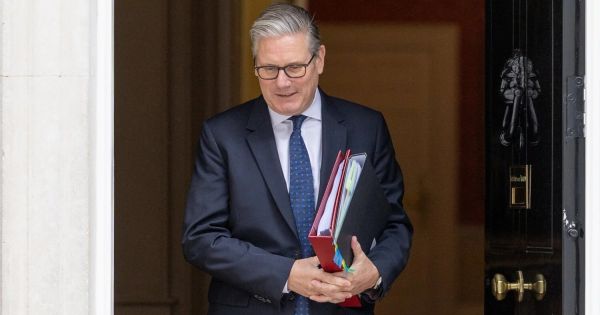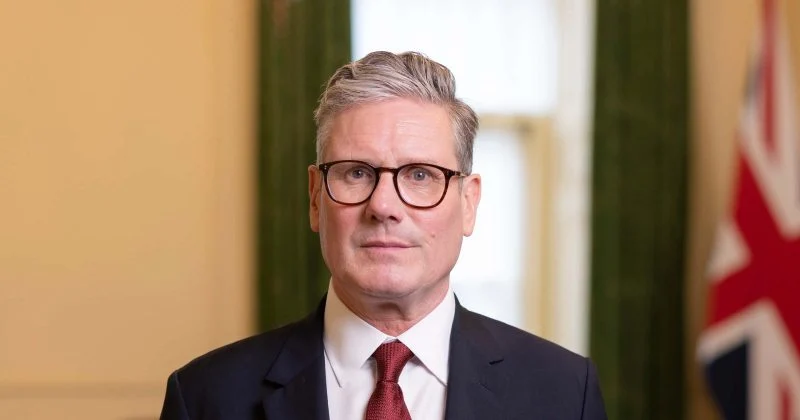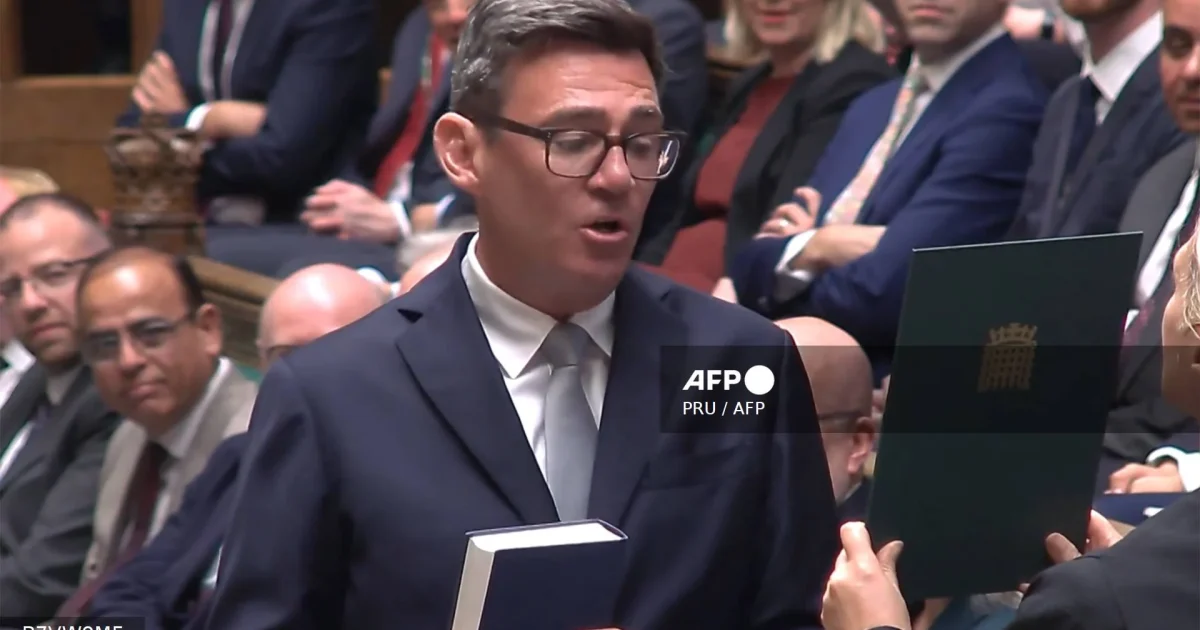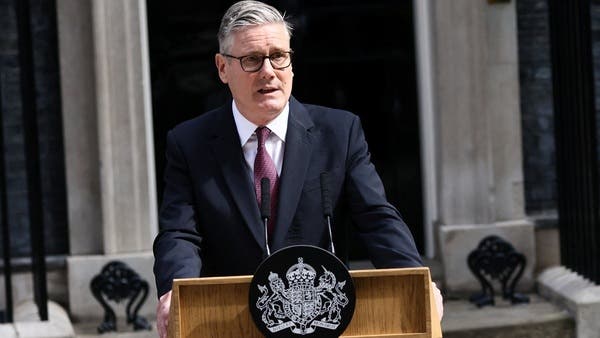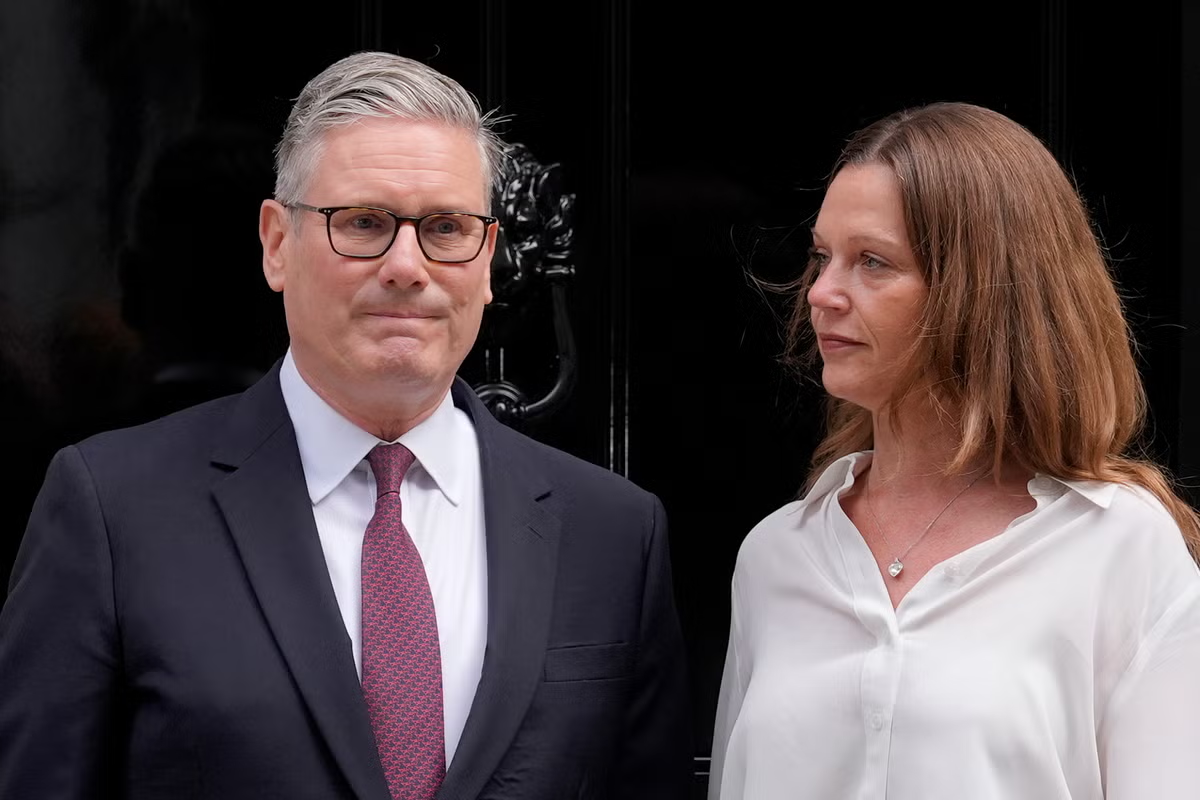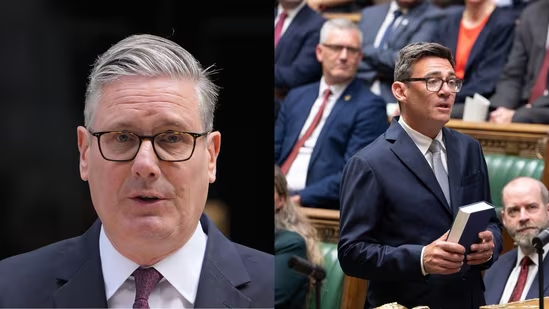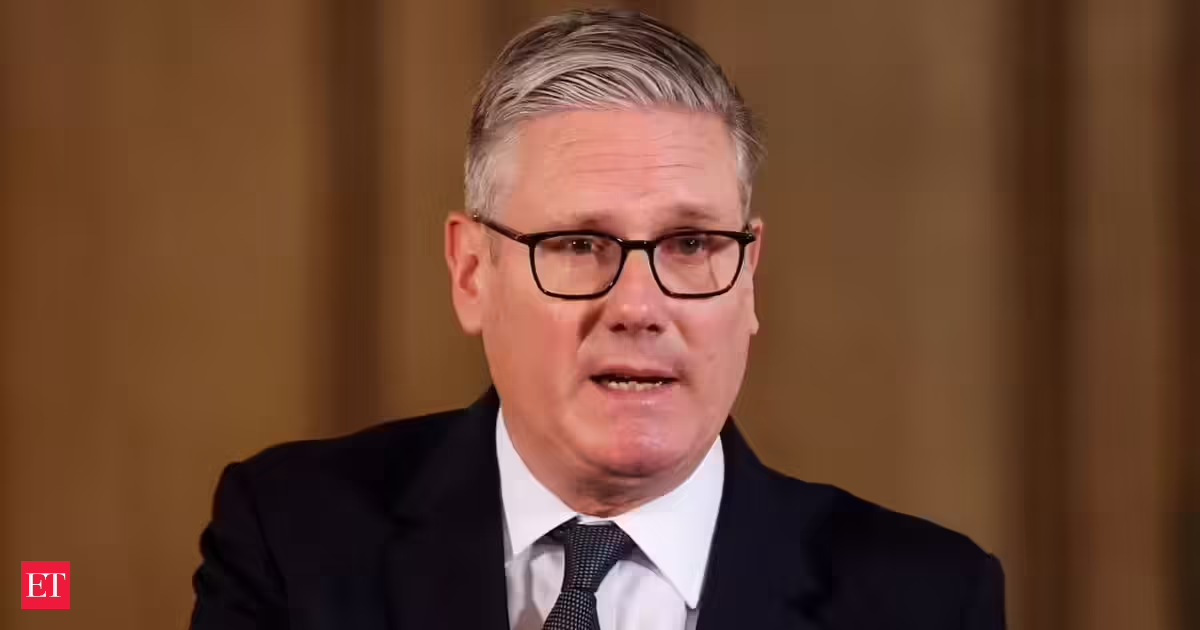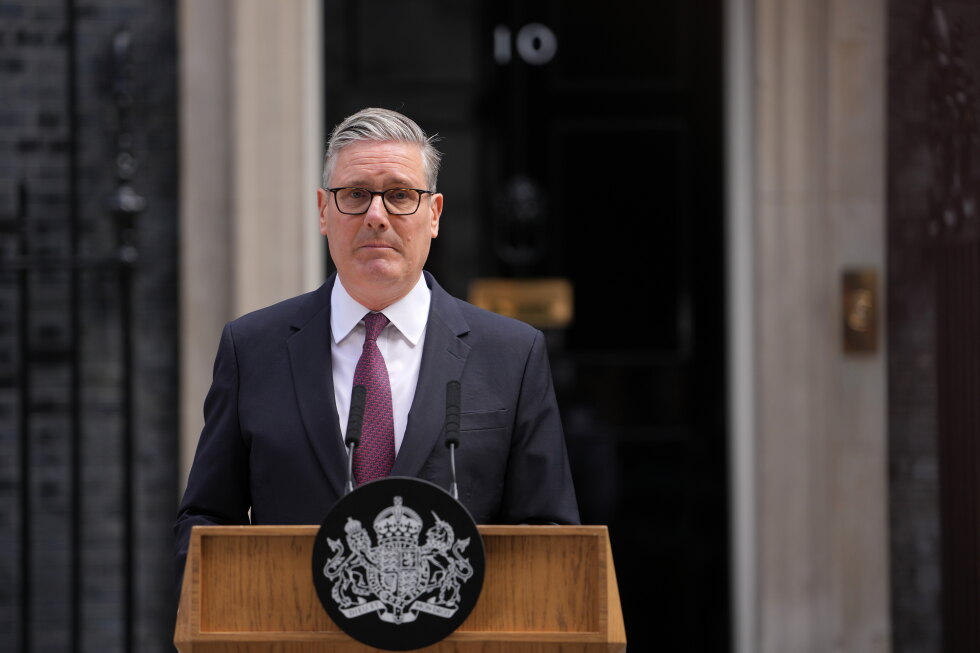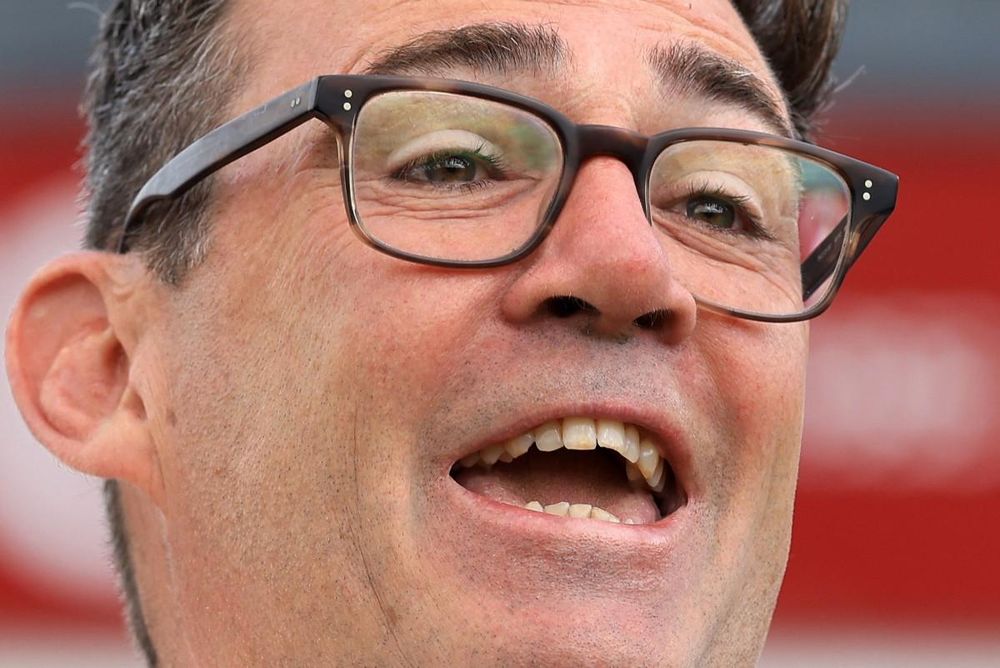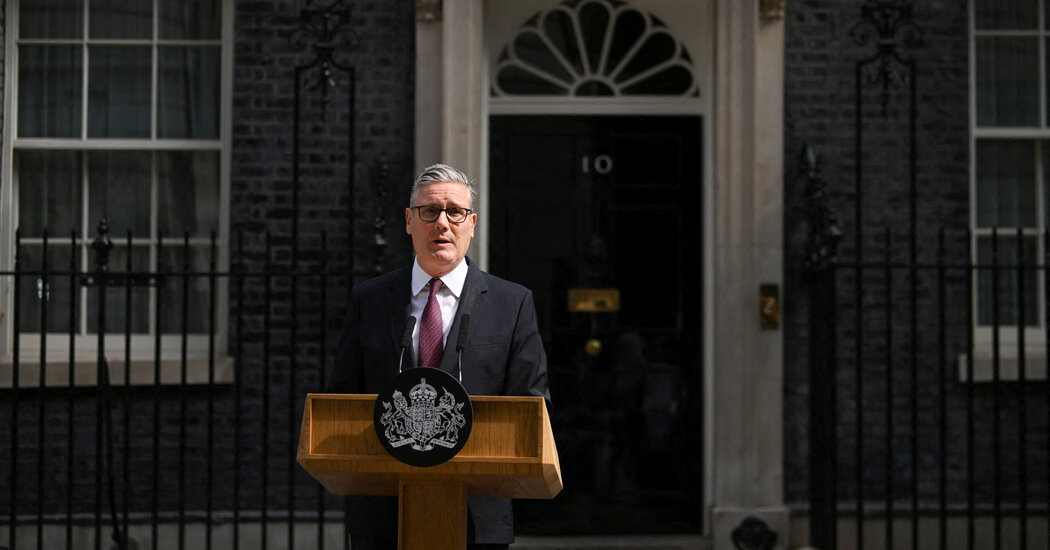
Latest PinnedHere’s the latest.Prime Minister Keir Starmer of Britain announced his resignation on Monday, bowing to a mutiny inside his Labour Party and paving the way for Andy Burnham, the former mayor of Greater Manchester, to likely become the country’s next leader.Mr. Starmer said that he would remain as prime minister until a new party leader is selected, by September, rather than fight to remain in the job he won almost two years ago. His decision means that Britain will have its seventh prime minister in a decade, extending a period of political turmoil for the country since it voted to leave the European Union in 2016.“Every decision I’ve taken has been about putting the country I love first. That is why I will resign as leader of the Labour Party,” Mr. Starmer said in front of No. 10 Downing Street, his voice breaking with emotion as he thanked his wife for being “a rock by my side.”Mr. Burnham is a popular Labour politician whose resounding victory last week in a special election energized his bid to become prime minister. He said on social media on Monday that he would formally seek to replace Mr. Starmer, calling the transition “a positive process of renewal for our party and our country.”Moments later, Mr. Burnham received the endorsement of Wes Streeting, a former health secretary and another potential challenger in Labour’s leadership race — meaning the party will most likely avoid a bruising and divisive contest. “We could spend the summer exaggerating small differences, or we can roll up our sleeves and help him to deliver the change our party and our country needs,” Mr. Streeting wrote in a statement, referring to Mr. Burnham.Mr. Starmer became prime minister in 2024 when Labour won a large parliamentary majority and ended 14 years of Conservative Party government. But Labour earned a record-low vote share in that election, prompting one analyst to call the victory a “loveless landslide.”Mr. Starmer’s standing was damaged this year by revelations about his decision to appoint Peter Mandelson as ambassador to the United States despite his ties to the convicted sex offender Jeffrey Epstein. But it was Labour’s devastating losses in local elections in May that were the breaking point for many in the party.Here’s what else we are covering:Parliament: Mr. Burnham is expected to arrive in Parliament around 2 p.m. local time to be formally sworn in to office as the representative from Makerfield, an area in northwestern England. Timeline: Mr. Starmer said he wanted formal nominations to replace him to open on July 9. A new Labour leader would then be elected by September and become prime minister. If Mr. Burnham is the only candidate, he could take over as early as July.Economy: Markets were holding steady after Mr. Starmer’s announcement. The pound was slightly lower, but off earlier lows. Not much is known about Mr. Burnham’s economic policies or how they would impact Britain’s bond market.Legacy: In his remarks, Mr. Starmer defended his record, citing investment in health care, increased military spending and falling illegal immigration. But he struggled with a sagging economy and criticism that he often backtracked on policies.Olivia O’Sullivan, an analyst at Chatham House, a British think tank, said that part of Mr. Starmer’s appeal on the international stage had been his apparent steadiness. “While the U.K.’s parliamentary system allows for political parties to change leaders in this way, frequent changes mean international counterparts must once again build relationships and trust with a new leader,” she said in a statement.As Britain wonders what economic policies Andy Burnham might pursue, his advisers are pointing to a report published today by the think tank Mainstream as instructive.The paper, titled “The Productive State,” said that the central source of the country’s economic challenges has been “the privatization of essential services” to firms guided only by profits, and that the government should be a “builder and provider rather than regulator or redistributor.”The paper’s authors and others note that Burnham brought Manchester’s public transit system under local government control. The so-called “Bee Network” and its bright yellow buses, which are free in the city center, are one success that Burnham’s supporters point to as evidence he can carry out change, although critics question how widely that could be applied.AdvertisementSKIP ADVERTISEMENTInvestors wonder where the British economy goes next.ImageKeir Starmer, the British prime minister, outside 10 Downing Street on Monday.Credit...Adrian Dennis/Agence France-Presse — Getty ImagesAfter weeks of speculation about Keir Starmer’s fate as Britain’s prime minister, when the moment of his resignation arrived, on Monday, the reaction in financial markets was relatively calm.Traders appeared placated by the slight easing of political uncertainty as Mr. Starmer laid out a timeline to leave Downing Street by the end of summer. The pound recovered from earlier losses against the U.S. dollar and was trading slightly stronger. Britain’s government bonds, which had been underperforming against their European peers, fell back in line. The yield on 10-year bonds, known as gilts, dropped slightly.The position of the next leader of the Labour Party, and therefore, prime minister, could still be contested. But the expectation is that Andy Burnham, most recently the mayor of Greater Manchester, will take up the role.Still, there is plenty of uncertainty, especially about Mr. Burnham’s economic policies and what they could mean for the country’s finances.When Mr. Burnham’s path to Downing Street became clearer last month, investors balked. Gilt yields rose as traders were concerned that Mr. Burnham would be inclined toward spending and tax plans that would lead to more borrowing, adding to Britain’s already large debt pile.Mr. Burnham has sought to reassure investors, and Monday’s benign market reaction suggests he has mostly succeeded.But several analysts have noted that Mr. Burnham will be constrained by Britain’s economic backdrop of slow growth and relatively high debt and interest rates.“There is no clarity yet on any new direction in government policy as a whole and who the key personnel will be,” economists at Investec bank, a wealth management company, wrote in a note on Monday. “But what is certain is that while the faces at the top will change, the huge challenges facing the U.K. will stubbornly stay in place.”For markets, the next most important question is: Who will be the next chancellor overseeing the country’s finances?Rachel Reeves, the current chancellor who is deeply entwined with Mr. Starmer, is widely expected to be replaced. But Ms. Reeves has built up credibility with bond markets by adhering to strict fiscal rules to try to push down Britain’s debt levels, even when facing pressure from within the Labour Party to spend more. Mr. Burnham, as part of his efforts to the build trust of investors, has said he would keep Ms. Reeves’s fiscal rules in place.Mr. Burnham and his advisers have signaled that he might seek to transfer what he did in Manchester, most notably franchising public transit, to the rest of the country. He calls the approach “Manchesterism.” He has been critical of Britain’s vote a decade ago to leave the European Union.“The four horsemen of Britain’s apocalypse are deindustrialization, privatization, austerity and Brexit,” he has said. He has spoken of the benefits of bringing essential services and utilities “under public control” and giving more power to local governments.Britain will have its 7th prime minister in a decade.ImagePost-Brexit Britain has seen six prime ministers: David Cameron, Theresa May, Boris Johnson, Liz Truss, Rishi Sunak and Keir Starmer.Credit...Pool photo by Steve Parsons; Pier Marco Tacca/Getty Images; Pool photo by Danny Lawson; Leon Neal/Getty Images; Pool photo by Lucy North; Lucy North/Press Association, via Getty ImagesPrime Minister Keir Starmer of Britain led his Labour Party to a resounding election victory just two years ago, promising an antidote to years of Conservative Party turmoil that had seen a quick succession of leaders come through 10 Downing Street.Now he, too, has announced his resignation, meaning Britain will soon have its seventh prime minister in a decade. That revolving door has become a feature of Britain’s volatile politics in the post-Brexit era.Some have criticized the swapping out of prime ministers as undemocratic, and opposition politicians often use the moment to call for a new general election. But in Britain’s parliamentary democracy, a change of prime minister does not require a general election, as British voters do not elect a premier but rather a party to govern. It is the party that gets to decide who is at the helm.Here’s a timeline of the changeovers.2016: Brexit vote brings down David CameronDavid Cameron, Britain’s prime minister from 2010 to 2016, called a referendum on the country’s withdrawal from the European Union, in an attempt to keep his Conservative Party united. He campaigned for Britain to remain in the bloc, and when a slim majority voted on June 23, 2016, in favor of leaving, he announced plans to step down.2019: Failed talks end Theresa May’s tenureMr. Cameron’s successor, Theresa May, faced her own struggles as she took on the complex task of navigating Britain’s departure from the E.U.Hard-line euroskeptics in the Conservative Party rebelled against Ms. May, who favored a softer Brexit that would have kept Britain largely within the E.U.’s economic orbit. Her plan failed to pass Parliament three times, and in May 2019 she said she would resign.2022: Scandals topple Boris Johnson.Boris Johnson, the former mayor of London and one of Ms. May’s most vocal critics, succeeded her and eventually secured a Brexit deal.But Mr. Johnson, known for his brash persona, was eventually brought down by a series of scandals, including parties held in Downing Street that defied his own government’s coronavirus lockdown rules.2022: Liz Truss lasts just six weeks.Liz Truss succeeded Mr. Johnson but was Britain’s shortest-serving prime minister, famously outlasted in her final days in office by a head of lettuce.Her introduction of an unfunded tax plan proved disastrous to the economy — the British pound fell to its lowest ever level against the dollar — and her party swiftly ousted her.2024: Rishi Sunak calls a general election.Ms. Truss’s successor, Rishi Sunak, made history as the first British prime minister of Indian heritage. He was seen as far more competent than Ms. Truss, but the preceding years of turmoil in the Conservative Party had dented the party’s popular support, and he was forced to call a general election after about a year and a half in office.The Labour Party, led by Mr. Starmer, won by capitalizing on frustration with the Conservatives.2026: Starmer, deeply unpopular, is on his way out.Labour’s victory, however, was not followed by smooth sailing.As Britain’s economic outlook remained gloomy, Mr. Starmer took heat for policy reversals, and critics accused him of lacking charisma. After damaging losses for the Labour Party in local elections in May 2026, pressure grew on Mr. Starmer to step aside.When Andy Burnham, a popular Labour mayor of Greater Manchester, won a seat in Parliament last week with a resounding majority, Mr. Starmer’s departure was increasingly seen as inevitable.AdvertisementSKIP ADVERTISEMENTAfter being sworn in, Andy Burnham shook hands with the Speaker of the House of Commons, Lindsay Hoyle. If Burnham does become prime minister, Hoyle will soon be trying to keep him in order at the weekly session known as Prime Minister’s Questions — often noisy exchanges between the prime minister and the opposition leader, Kemi Badenoch.Andy Burnham has just been sworn in as the member of parliament for Makerfield, a seat he won in last week’s election that set the scene for the events of today. (Two other new lawmakers have also been sworn in, though they were slightly overshadowed by the focus on a potential prime minister in waiting.) There were loud cheers from the Labour benches as his name was announced.VideoAndy Burnham has done a lot over the course of a train journey of just under three hours from Manchester to London. He issued his first statement confirming his intention to pursue the leadership of the Labour Party (and ultimately become prime minister), praised Starmer for his two years in the post and reflected on his time as Manchester mayor.He also managed to change from a relaxed T-shirt into a smart navy suit and crisp white shirt. He will now head to Westminster to be sworn in as the member of parliament for Makerfield in northern England.Perhaps the most awaited train into London today — the 10:54 a.m. from Manchester, carrying the man who may be Britain’s next prime minister, Andy Burnham — has just arrived.He traveled to London to be sworn into his new seat in parliament later today, shortly after Starmer announced his plans to resign as prime minister. The BBC tracked the final approach of Burnham’s train by helicopter, and he was met on the platform in London’s Euston Station by a pack of journalists ready to pepper him with questions.VideoCreditCredit...BBC News, via ReutersAdvertisementSKIP ADVERTISEMENTWho will replace Starmer? Here’s what happens next.ImagePrime Minister Keir Starmer and his wife, Victoria, returning to 10 Downing Street after he announced his resignation on Monday.Credit...Kin Cheung/Associated PressWill Britain’s next leader be chosen by contest or by something more like a coronation?In his resignation statement on Monday, Prime Minister Keir Starmer announced a timetable for his departure from Downing Street that left open two options for the process to replace him.Option 1: A full leadership contestUnder this scenario, a competition would take place to replace Mr. Starmer as the Labour Party’s leader and — because of the majority the party has in Parliament — as the prime minister.In his speech, Mr. Starmer said that he would ask Labour’s governing National Executive Committee to open nominations for party leader on July 9 and to close them by the time Parliament takes its summer recess. No exact date has been decided yet but is likely to be between mid to late July.To run, a candidate needs the support of 81 Labour lawmakers and of a small number of constituency parties and trade unions or other groups affiliated with the party.The favorite is Andy Burnham, a popular Labour politician and the former mayor of Greater Manchester, who won a parliamentary seat last week in a special election.ImageAndy Burnham arriving at Manchester Piccadilly station on Monday morning, on his way to London to be sworn in as a member of parliament.Credit...Temilade Adelaja/ReutersSeveral other Labour politicians have given signs they might take part in a contest, including Al Carns, the former armed forces minister. But the person who was considered the most likely to join a contest, Wes Streeting, the former health secretary, ruled himself out on Monday by endorsing Mr. Burnham.Should anyone other than Mr. Burnham have enough support to join the field, the final choice would be made in a vote of the Labour Party’s fee-paying members and affiliated trade union supporters.In this scenario, a new leader would be “in place before Parliament returns in September,” Mr. Starmer said. That date has not been set but is usually early in the month.Option 2: Burnham is the only candidate and wins by defaultIf Mr. Burnham is the only candidate by the time nominations close, he will win by default and secure the position of Labour leader some time between the middle and the end of July.Once that has been confirmed, Mr. Starmer would make the short journey to Buckingham Palace to formally offer his resignation to King Charles III, concluding his time as prime minister.Shortly afterward, Mr. Burnham would also visit the king and be invited to form a government and replace Mr. Starmer — a formality that, under the British system, would confirm him in the country’s top political job.Starmer had been expected to speak in Parliament on Monday afternoon about the G7 summit he attended last week in France. David Lammy, the foreign secretary, is now scheduled to make the statement instead, sparing Starmer a second appearance after his resignation speech this morning.By the time Keir Starmer leaves office, he will have served a little over two years as prime minister, the third-shortest term for a British prime minister this century, but comfortably longer than his two predecessors. Liz Truss left after 50 days, and Rishi Sunak’s Conservatives lost the general election less than two years after he took office. The exact length of his tenure depends on whether anyone challenges Andy Burnham in the upcoming Labour leadership contest.AdvertisementSKIP ADVERTISEMENTWes Streeting, the former health secretary under Starmer and a potential challenger to lead the party, threw his support behind Burnham on Monday. In a statement on social media, he wrote: “Having spoken at length with Andy in recent days, I’m convinced that there is a place for those ideas under his leadership; that he is committed to building an inclusive party that draws on the best of our political traditions; and that he can win the fight of our lives against the forces of nationalism.”Andy Burnham has confirmed that he plans to stand in a leadership election for the Labour Party. In a post on social media, he thanked Starmer for his service as prime minister and wrote, “His decision marks the beginning of a transition and it is important that this process is conducted in an orderly and responsible way. I will put myself forward as part of this process.”ImageCredit...Temilade Adelaja/ReutersLabour’s political rivals could benefit from its internal turmoil as a leadership contest begins, and they know that. Nigel Farage, the leader of Reform U.K., the populist right wing party that has consistently outperformed Labour in opinion polls, is (unsurprisingly) calling for a new general election.“Reform demands an election, and we are ready to deliver radical change,” Farage wrote in a post on social media. “If Labour thinks it can shove another professional politician into No. 10, it has another thing coming.”ImageCredit...Temilade Adelaja/ReutersThe way that Britain has shuffled through prime ministers at a rapid pace over the last decade is relatively unusual in the country’s history. Since it is a parliamentary democracy (unlike the presidential system of the United States) a leadership change doesn’t require a general election. British voters do not elect a prime minister but a party -- in this case Labour. But the party’s opponents have already begun calling for an election. Nigel Farage, the leader of the populist right wing party Reform U.K., wrote on social media: “Reform demands an election, and we are ready to deliver radical change.”AdvertisementSKIP ADVERTISEMENTSo far, Andy Burnham has not responded publicly to Starmer’s announcement. Starmer said he would ask the Labour Party to start the process to replace him as its leader on July 9, which means Burnham won’t be able to quickly capitalize on the momentum from his huge victory last week, when he won a seat in Parliament. But it will give him more time to work on his agenda.Reactions to Starmer’s announcement are arriving in email inboxes. The leader of the rail and transport union in Britain said Starmer “did the decent thing.” Maryam Eslamdoust, general secretary of the union, said “The Labour Party now has an opportunity to pivot to the policies this country and working people desperately need.”President Trump, whose relationship with Starmer deteriorated over the last year, posted Sunday night that the prime minister would step down, following numerous news reports suggesting as much. “Keir Starmer will resign as Prime Minister of The United Kingdom,” Trump wrote on TruthSocial. “He failed badly on two very important subjects- IMMIGRATION AND ENERGY (OPEN NORTH SEA OIL!). I wish him well!”Financial markets are holding steady after Starmer announced a timeline for his departure from No. 10. The pound is slightly lower, but off its lows from earlier this morning. Now the focus is turning to Starmer’s likely successor, Andy Burnham. But at this stage not much is know about how Burnham would approach economic policy and what that would mean for the country’s bond market.AdvertisementSKIP ADVERTISEMENTUrsula von der Leyen, the president of the European Commission, has just given Starmer some generous praise, reflecting the work that he put in to repair ties with the European Union after Brexit, and his support for Ukraine in its ongoing war against Russia. “It can take many leaders years to grow into the statesman you became in just two years,” she wrote on social media. “European and Ukrainian security is stronger because of you. Thank you, dear Keir.” ImageCredit...Pool photo by Carl CourtOne potential issue for Labour is that the main contenders to succeed Starmer are men. Although it sees itself as a progressive party, Labour has never had a permanent female leader (two women have acted as leader temporarily.) Britain’s three women prime ministers were all Conservatives.Starmer’s resignation raises questions about the future of Britain’s foreign policy. None of the leading candidates to succeed him have any real experience with foreign policy at a time of global unrest. Whoever takes over will need to confront the ongoing war in Ukraine, instability in the Middle East, a rising China and a United States that is pulling back from its decades-long commitments to Europe and NATO.Analysts at Deutsche Bank noted how this resignation was happening on the eve of the 10-year anniversary of the Brexit vote, “something the U.K. still hasn’t come to terms with.” They wrote that the political turmoil since 2016 “underlines the immense difficulties many incumbents have in the western world today. Everyone arrives in the post with great hopes but then the lack of growth and the financial realities hit. Until you have stronger economic growth and are less constrained by debt it’s highly likely the conveyor belt of PMs will continue.”AdvertisementSKIP ADVERTISEMENTThe focus now moves to Andy Burnham’s next move and whether what follows is a contest or a coronation. Does Burnham do a deal with the other likely challenger, Wes Streeting, perhaps offering him a plum cabinet post to try to avoid a leadership battle? Or does Labour engage in an open competition to select its new leader and Britain’s next prime minister?ImageCredit...Ryan Jenkinson/Getty ImagesIn his speech, Starmer said he accepted the desire of his colleagues to replace him with “good grace.” But he also listed what he said were his achievements, outlining why he fought to stay in Downing Street in a tone that suggested he felt unfairly treated. Starmer said that the economy was improving, that wait lists for health treatment were falling, that new rights for renters had been created and that there had been progress on curbing illegal immigration.AdvertisementSKIP ADVERTISEMENTAdvertisementSKIP ADVERTISEMENTAdvertisementSKIP ADVERTISEMENTAdvertisementSKIP ADVERTISEMENTAdvertisementSKIP ADVERTISEMENT
Starmer Resigns as UK Prime Minister, and Burnham, a Labour Rival, Wins Key Endorsement: Live Updates
Prime Minister Keir Starmer stepped down as leader of the governing Labour Party. Andy Burnham, the party’s most popular politician, said he would seek the prime minister’s job and secured the support of a potential rival.
3,718 words~17 min read