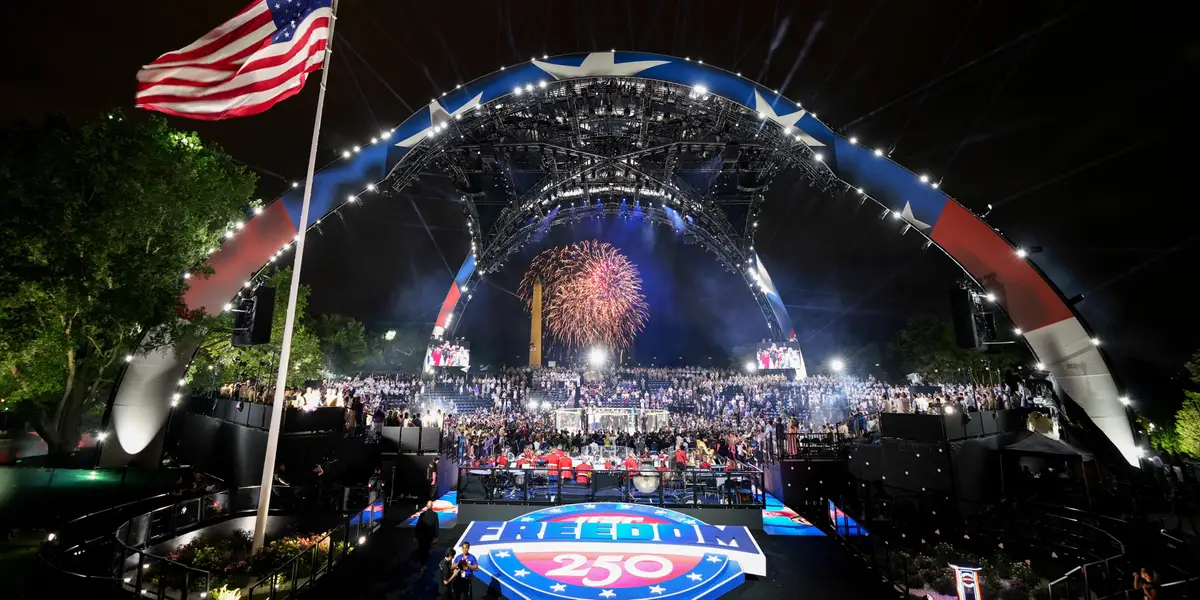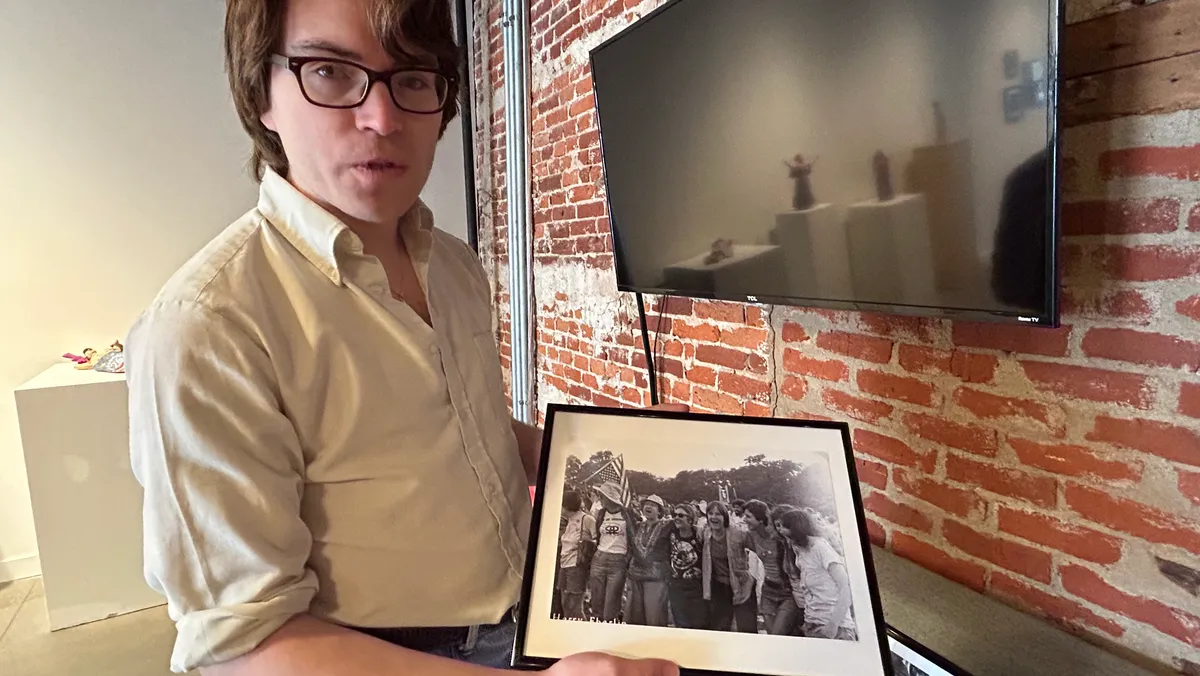
Organizers across the country say their 250th anniversary events celebrate parts of American history that are missing from the national conversation.PHILADELPHIA — As the city gears up for America's 250th birthday party, artists at Huddle, a gallery in the Northern Liberties neighborhood, are looking back to the Bicentennial. And they're not celebrating that milestone ‒ or the current one.Instead, these artists, through photographs and ceramic sculpture, fabric and painting, are celebrating the lesbian, gay, transgender, non-binary and queer activists who fought in the 1970s for civil rights ‒ and the LGBTQ+ people and their allies who are doing so today."This Is (Not) a Celebration" integrates archival materials from the William Way LGBT Community Center and the Philadelphia Gay News, both of which launched in 1976, as well as other publications and organizations, and traces the gay rights movements of the 1970s.The event is part of an ongoing national conversation about our history: Whose voices are lifted, whose stories are told, and who determines what and how we remember and learn from our past. Some organizers say America's complicated and at times difficult history is being glossed over by fireworks and flag-waving ‒ or that it's being politicized by an administration that has actively worked to advance its version of history.Scarlett DeLorme, Justin Jain and Amy Cousins, the artists whose work is on display at Huddle, aren't the only people who are seeking to expand the discussion of American history during the semiquincentennial ‒ a growing number of people across the country are hosting events, exhibitions and programs in an effort to counter what they say is an effort by the Trump administration to exclude or erase the stories of marginalized people during the nation's 250th birthday celebrations.Among the events: "Reclamation Day: A Reunion of Hope" on June 19-20 in Brooklyn, New York, with dozens of artists showcasing their work hosted by Black Liberation Indigenous Sovereignty (BLIS) Collective, which advocates for reparations, land returns for Native Americans, bonds for newborns and a universal basic income."We didn't want to make this about choosing or 'canceling' the Fourth," said Trevor Smith, co-founder and executive director of the group. "We want to hold the contradictions of this country and the love. Too often we see things in black and white, but we're also talking about the love and resilience" in both the Black American and Native American experiences.The "virtue of being American," he said, "is facing our history honestly," and "celebrating the wins and the contributions of Black, Indigenous and working people."June 27 events will take place in various locations with an anchor event in Washington, DC, co-led by two youth-oriented groups (Get Free and Next250) and 50501, a progressive protest movement. Youth250 will host a national effort June 27 to write "Letters to America," and present storytelling campaigns, public art and other participatory actions.A "Week of Repair" campaign from June 19 to July 4 brings together 23 projects coordinated by Liberation Ventures, a group advocating for reparations and reparative actions at the community level.Nicole Carty, executive director of Get Free, said her organization began planning for the semiquincentennial in 2020, but when Donald Trump won a second term in 2024, they knew they might need to take a more confrontational approach."Now we have an administration that is so passionately... scrubbing history from museums, trying to shape curriculum in universities, rolling back civil rights ‒ there is a clear campaign to rewrite history," she said.Noting that polls show support for President Trump waning, Carty said it's due in part to his efforts to change signage at national parks and historic sites like the President's House in Philadelphia."Turns out this is a really unpopular thing to do, erase Americans from history," she said."We're happy to collaborate" with groups taking a more measured approach, she said, "but we're pushing a little more to fully reckon with our history and recognize there's much more work to be done to create an America that fully lives up to its promises."To those who question the patriotism of people who organize protests in response to America's 250th birthday, Carty countered, "Being able to criticize this country is a form of patriotism.""There is a lot to celebrate, and we've come very far as a country," she said. "Where we are is a testament to the ancestors who fought for equality and freedom for all of us."Meanwhile, polls show many Americans feel pessimistic about the future of democracy and our nation, though attitudes are sharply drawn along political lines. More than two-thirds of Americans believe the U.S. "is in real danger of losing important democratic rights and freedoms."A Public Religion Research Institute survey found around half of its respondents said they were either extremely or very proud to be American (51%) or proud of the nation’s 250-year history (49%).Organizers say 'once-in-a-generation celebrations' are for everyoneFreedom 250, a Trump administration-backed organization, has planned blockbuster events to celebrate America's big birthday, including a UFC fight at the White House and the Great American State Fair.USA TODAY reached out to the organization about criticisms from advocates surrounding the events."The 250th anniversary belongs to all Americans, and that's the whole point of Freedom 250," Julia Friedland, a spokesperson for Freedom 250, said in an emailed response to USA TODAY."Freedom 250 is not interested in a back-and-forth with critics; we're interested in hosting once-in-a-generation celebrations for Americans to join — in person or from their backyard July 4th backyard barbecue. So instead of arguing about who's welcome, we'd invite organizers and skeptics alike to come see for themselves — at the State Fair, the [FIFA World Cup] Fan Zone, a Freedom Truck near them, or on the Mall on the Fourth."Most of the artists originally slated to perform at the Great American State Fair in the days leading up to July 4 pulled out of the event, with many of them saying they were concerned about the partisan nature. After a UFC fight on the White House lawn, Trump announced a July 4 rally at the Lincoln Memorial with military bands and fireworks, saying, "We are going to have fun, and celebrate America!"How the LGBTQ+ community 'leveraged the Bicentennial'Back in Philadelphia, some are approaching America's big birthday with mixed emotions.Justin Jain, a ceramic artist, actor and producer, was inspired by activism but also the energy, joy, community and creativity of the LGBTQ+ activists who came before him."There was a lot of rage for (earlier activists), but they pivoted to pleasure and tried to center joy as resistance," he explained. "I'm struggling with that: How much do I lean into the rage, and how much should I be really joyfully me?" The 250th anniversary of the United States brings up "complicated" feelings, he said.Groups like Dyketactics, Radical Queens and Gay Liberation Front, and activists including George Lakey, Tom Wilson Weinberg, Arleen Olshan, among others, are all featured prominently in "This Is (Not) a Celebration," through photographs, sculpture and archival materials like zines, newspaper clippings and flyers.Jake Foster, art exhibitions manager for the William Way Center, is 33 but has a strong appreciation for the queer activists who paved the way for LGBTQ+ people ‒ strong enough that he became emotional as he talked about the discrimination, demonization and brutality many of them faced as they tried to live and love openly.DeLorme's tintype and ambrotype photographs of Philadelphia's LGBTQ+ elders, including Wilson Weinberg and Olshan, aim to show them as real people, loving and living out their later lives after years of activism. She wanted to ensure their experiences are included in Philadelphia's and America's history."I'd ask them, How did you do this, and how did you get through all you went through?'" she said, hoping to draw a connection with younger LGBTQ+ people. "I feel there's some pressure now that they're older to talk to them while they're still here."Erasing or ignoring their stories, she said, "only benefits bigots, for us to be isolated and siloed, away from each other, old versus young.""We're positioning this against [Freedom250 and America250] in the same ways the LGBTQ community really leveraged the Bicentennial," Foster said. "To say, like they did, there are still too many people without equal rights and more needs to be done."Protest and exercising free speech, he said, "are integral to what this country should be, and it's not something we've always lived up to. We need to understand our history so we can be inspired by that history."Ad campaign says American identity isn't politicalViewers in some television markets, including New York, Baltimore, Pittsburgh, Atlanta and yes, Washington, DC, are seeing ads offering a different perspective on Philadelphia, the birthplace of American independence.The ads aren't a political statement, according to the nonprofit behind them. Instead, they're a true picture of Philadelphia's, and America's, history.A series of ads themed "Indivisible" highlights the contributions of four American demographics: Latino/a, Black, Asian American/Pacific Islanders and LGBTQ+."Too many Americans are being forced to choose between their heritage and their American identity," said Neil Frauenglass, CEO of Visit Philly, the tourism nonprofit for the Greater Philadelphia area that's behind the ads. "We thought that's a false choice."The ads, though, are not meant to be political or partisan, he emphasized."We're not making a political statement; we're stating a historical fact," Frauenglass told USA TODAY. "We're reminding people of that truth from the place where it was born ‒ American identity is multicultural."Frauenglass acknowledged that "the line is becoming thinner" between culture and politics, but said Visit Philly is responding to the cultural cues, especially in a diverse city of neighborhoods where ethnic, religious and racial groups live and coexist in close proximity ‒ and have, for generations."We want to make sure we tell the full story of Philadelphia, and we have a responsibility to tell the complete American story," he said. "We don't just want to celebrate the milestone ‒ we want to deepen its meaning."A native New Yorker who's lived in Philadelphia for a decade, Frauenglass said the city's history and its Revolutionary roots were and still are big draws for visitors: "We were founded with radical ideas about freedom and we want people from every place, every country and culture to come here, explore Philadelphia and celebrate" the nation's 250th birthday.Phaedra Trethan is a national correspondent for USA TODAY, writing about history and Americana. Contact her by email at ptrethan@usatoday.com, on X @wordsbyphaedra, on BlueSky @byphaedra, or on Threads @by_phaedra
A growing movement aims to fix America's big birthday celebration
Organizers across the country say their 250th anniversary events celebrate parts of American history that are missing from the national conversation.
TL;DRAI
Questo articolo non è rilevante per Warptech News. Parla di celebrazioni storiche USA, diritti LGBTQ+ e politica domestica americana — zero connessione con tech, AI, o business digitale. Non rientra nel perimetro editoriale (manager IT, CTO, decisioni di stack/tech/AI). Non posso forzare un riassunto "tech" dove non c'è alcun elemento tecnologico. Se intendi testarmi su un articolo effettivamente tech, sono pronto. ✓
1,731 words~8 min read