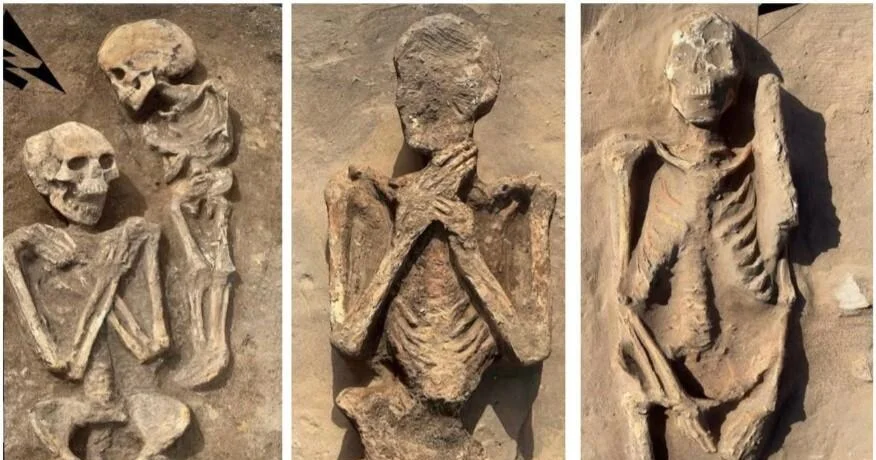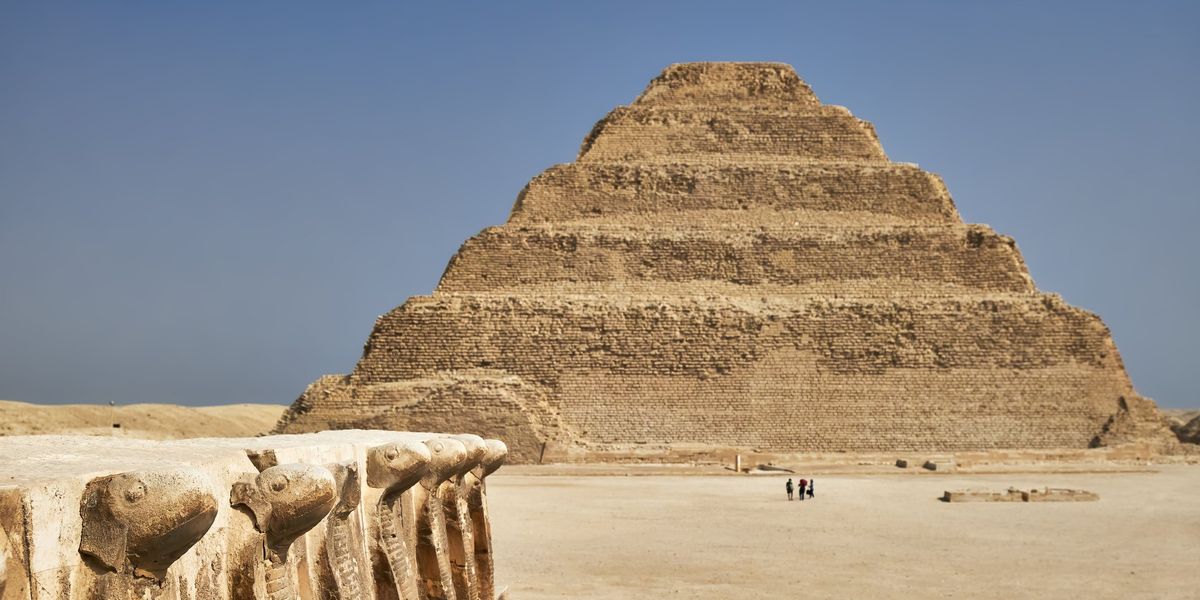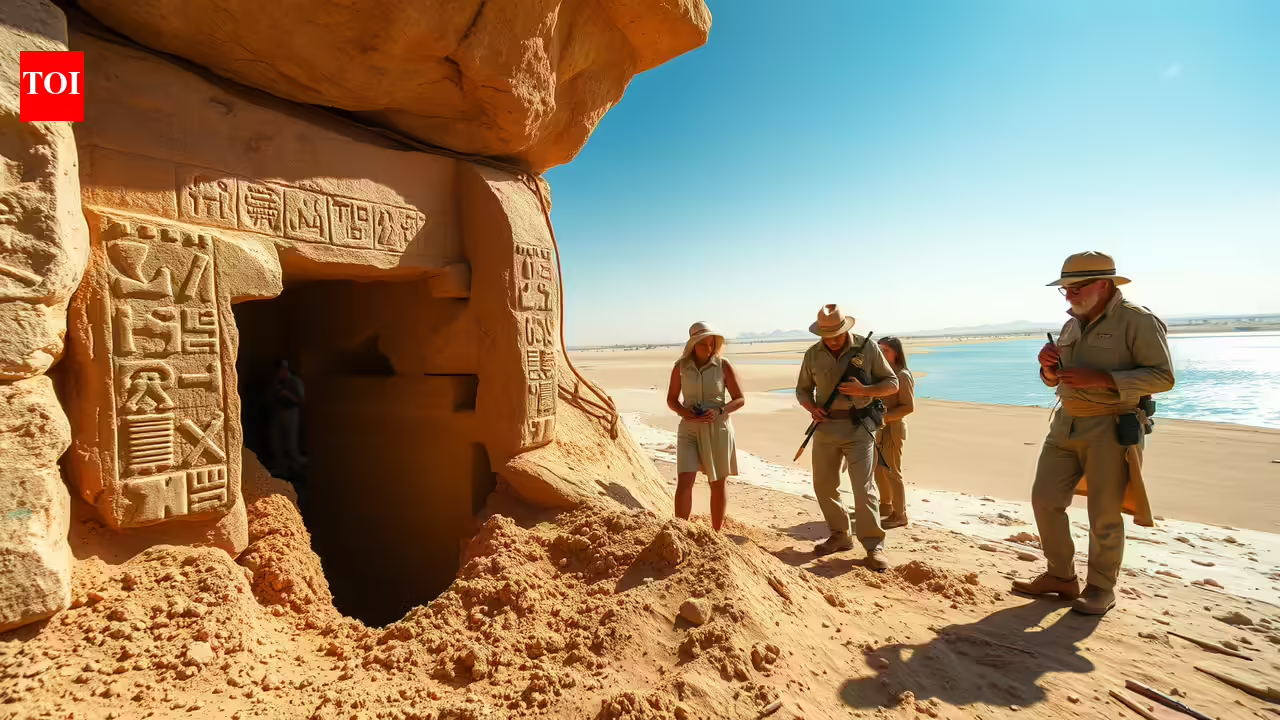
The pyramids of Egypt are so iconic that it's easy to forget they had to be invented. Somebody, at some point, had to figure out how to build increasingly ambitious stone structures and that process of trial and error didn't happen overnight. A new discovery on the eastern bank of the Nile in Egypt's Minya Governorate is now offering rare physical evidence of what that experimental phase looked like. Archaeologists from Egypt's Supreme Council of Antiquities have uncovered two Early Dynastic tombs at the Jabal al-Tayr site dating back roughly 5,000 years, along with a cluster of older Predynastic burials and later graves from the Late Period. Taken together, the finds suggest this stretch of the Nile was a significant burial ground for millennia and that the people who built these early tombs were already working with engineering ideas that would eventually lead to the step pyramid and beyond.The Jabal al-Tayr excavation: what the Supreme Council of Antiquities found at this Minya necropolisThe site sits on a plateau roughly 25 kilometres northeast of Minya city, on the Nile's eastern bank. It's a location that Egyptian archaeologists have long considered archaeologically significant, but the current excavation has produced finds that go beyond what was previously documented.The two Early Dynastic tombs are the headline discovery. Hisham El-Leithy, Secretary-General of the Supreme Council of Antiquities, described the first as "a rare architectural discovery due to its unique geometric design." The second closely mirrors the first in layout but is in considerably better condition it largely escaped the stone quarrying that damaged the first tomb in later periods, leaving its original features intact for researchers to study directly.Alongside the two main tombs, the team found part of a Predynastic cemetery. Several individuals had been buried in a crouched position, wrapped in plant mats that have since largely decomposed. Pottery vessels with distinctive black-topped decoration were placed beside some of the bodies, and these have been dated to the Naqada II and Naqada III periods the centuries just before Egypt unified under a single ruler. Separate burials from the Late Period were also uncovered, including individual and collective graves, some containing the remnants of wooden coffins. The site appears to have functioned as a necropolis across multiple eras, with different communities returning to it generation after generation.Walls that narrow from base to top: the engineering logic that connects these tombs to pyramid architectureThe most significant detail in the first tomb isn't its age it's the way its walls were built. Mohamed Abdel Badie, Head of the Egyptian Antiquities Sector, explained that the walls are thicker at the base and gradually narrow toward the top. This might sound simple, but it points to something important: an early, deliberate understanding of how to distribute weight in a tall stone structure.This tapering principle, broader foundations, narrower upper sections, is the same logic that underpins the stepped profile of the Step Pyramid of Djoser at Saqqara, built around 2650 BCE, and later the true pyramids that followed it. What the Jabal al-Tayr tombs suggest is that this engineering idea didn't emerge fully formed in the royal building programmes of Dynasty III. It was being explored earlier, in smaller-scale funerary structures, by builders working in Middle Egypt well before pyramids became a royal statement.Abdel Badie was careful to frame it as an early stage rather than a direct predecessor: the tomb's design "may represent an early stage in the evolution of engineering concepts that eventually led to the construction of the Step Pyramid and later the true pyramid." But the implication is clear: Jabal al-Tayr was part of a broader process of architectural experimentation happening across the country during Egypt's formative centuries.Similarities with King Den's tomb at Abydos and what they reveal about early Egyptian state formationThe architectural comparison that has drawn the most attention from researchers is the one between the Jabal al-Tayr tombs and the tomb of King Den at Abydos. Den was one of the most prominent rulers of Egypt's First Dynasty, reigning around 2950 BCE. His tomb is the largest known from the First Dynasty, with a floor space of roughly 135 square metres and a depth of over six metres, a complex structure that included a ritual annex, storage magazines, and over 130 subsidiary chambers. It also features the first known use of a staircase leading to a burial chamber, an innovation that later became standard in Egyptian funerary architecture.The preliminary studies carried out on the Minya tombs show structural and spatial similarities between them and Den's burial complex, in how the internal spaces are arranged and how the walls were constructed. El-Leithy said this connection "reinforces the archaeological importance of Jabal al-Tayr and confirms its status as a key necropolis used continuously from the Predynastic through the Late Period."What makes this comparison particularly interesting is what it implies about how architectural knowledge moved around in early Egypt. Abydos, in Upper Egypt, was the royal burial ground of the First Dynasty. Jabal al-Tayr is in Middle Egypt, hundreds of kilometres to the north. If builders in both places were working with similar structural approaches at around the same time, it suggests that ideas, techniques, and possibly trained craftspeople were travelling across the country during the earliest stages of Egyptian state formation well before the kind of centralised administration that would later organise pyramid construction projects.Oxide lines, wooden supports, and Naqada pottery: the archaeological detail that survived stone robbersDespite the damage the first tomb suffered at the hands of later stone robbers who removed blocks for reuse in other constructions, a common fate for ancient structures across Egypt, enough survived to give archaeologists a detailed look at how it was originally built. Oxide lines were found on surviving stone surfaces, traces left by the cutting and extraction process used by the original builders. These marks reveal a precision stoneworking technique that is rarely preserved in such early structures.Large wooden support beams were also found integrated into the walls. Some ran the full length of a wall; others were installed as shorter reinforcing sections. This use of timber framing inside stone walls is an interesting detail it suggests builders were already thinking about structural reinforcement, using organic materials to stabilise masonry in ways that complement the tapering wall design.The Naqada II and III pottery recovered from the Predynastic burials adds a separate but equally important layer to the picture. These ceramic styles are well-documented markers of the cultural period immediately preceding Egyptian unification, and finding them at Jabal al-Tayr confirms that the site was already a meaningful burial location before the Early Dynastic tombs were constructed above it.What comes next: ongoing excavations and the search for a larger necropolis at Jabal al-TayrThe excavations at Jabal al-Tayr are continuing. Mission director Sami Dardiri, who heads the Central Department for Antiquities of Middle Egypt, has indicated that further campaigns will focus on sectors adjacent to the two main tombs, with particular interest in whether there is an enclosing wall that once marked out a dedicated elite burial area. Photogrammetric surveying of the stone blocks still in situ is underway to produce three-dimensional models of the original structure.There is also the broader question of how large the Jabal al-Tayr necropolis actually was. What has been uncovered so far points to a site of considerable historical depth and complexity. Whether it turns out to contain more Early Dynastic tombs of similar architectural significance remains to be seen but the discoveries announced this week have already given Egyptologists enough to reconsider how widely spread Egypt's earliest architectural ambitions really were, and how much of that story is still waiting underground.
Egypt uncovers 5,000-year-old tombs that may reveal the birth of the pyramids
The pyramids of Egypt are so iconic that it's easy to forget they had to be invented. Somebody, at some point, had to figure out how to build increasingly ambitious stone structures and that process of trial and error didn't happen overnight.
1,268 words~6 min read