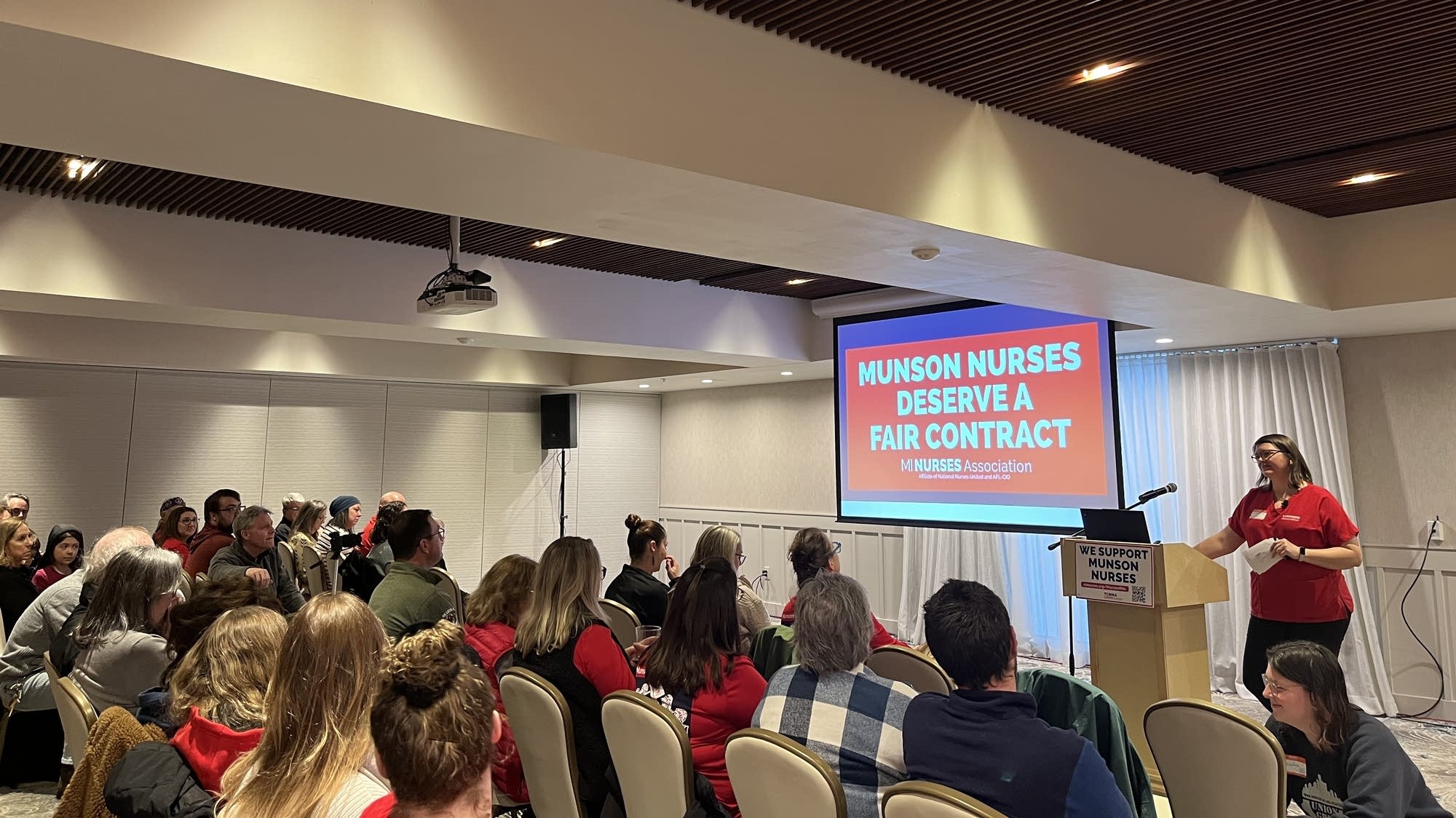
A few months ago, the nurses union at Munson Medical Center, a hospital in Traverse City, Michigan, organized a rally.Union president Laura Nilsson stood at the front of the room, listing the union’s demands in their new contract — things like higher staffing numbers and also regulations around artificial intelligence. “We understand technology is coming,” Nilsson said. “We generally want it to be good for us and our patients, but right now, there's a lot of unknowns. What we don't want technology to do is replace nursing judgment. We don't want it to take jobs.Companies are developing AI tools that do everything from taking notes on appointments to proposing real diagnoses based on someone’s medical records.This winter, a nurses’ union in New York City with more than 10,000 members got protections from AI in their contract. And even if AI tools can do some of the work of nursing, it wouldn’t be the same, said James Walker a critical care nurse at Munson who is on the union bargaining committee.“Say we’re checking blood pressure and the blood pressure cuff isn’t on the patient appropriately,” he said, pointing out that having AI wouldn’t be the same as the physical presence of a nurse. “And so, that number is just pulled into the system without verifying whether it's accurate. That value could potentially lead to a wrong decision.”Max Topaz, a professor of nursing at Columbia University, said new technology is often just handed to nurses and they’re forced to use it without “thinking about how these technologies are going to be integrated into practice.”In a recent study looking at the use of AI in healthcare, researchers from Stanford and Harvard found even top-performing AI models, from Anthropic and Google, produced 12 to 15 severely harmful errors per 100 cases. The worst-performing models made mistakes in 40 out of 100 cases.“This is exactly why nurses are concerned,” said Topaz, “these technologies have to be vetted and validated, and we need to know what the error rates are.”Munson Medical Center’s chief nursing officer, Jenn Standfest, represented the hospital at the bargaining table. She said “the growth of AI in healthcare really can be a positive thing. I mean, it is trying to support a reduction in some of the clerical tasks,” which sometimes cause burnout that AI could reduce. “It's a really important space and we want to get it right,” she added.If the hospital does decide to buy new AI software, nurses in northern Michigan will now have a voice in how it’s rolled out.
Nurses want a seat at the table when it comes to AI in healthcare
Claire Keenan-Kurgan at Interlochen Public Radio chronicles how nurses unions are bargaining over the use of artificial intelligence in the workplace.
TL;DRAI
Nurses' unions secure AI clauses in contracts; Stanford/Harvard: top AI models generated 12–15 errors per 100 cases. Healthcare AI deployment requires employee governance and validation—precedent for regulated industries on enterprise AI compliance and vetting.
422 words~2 min read