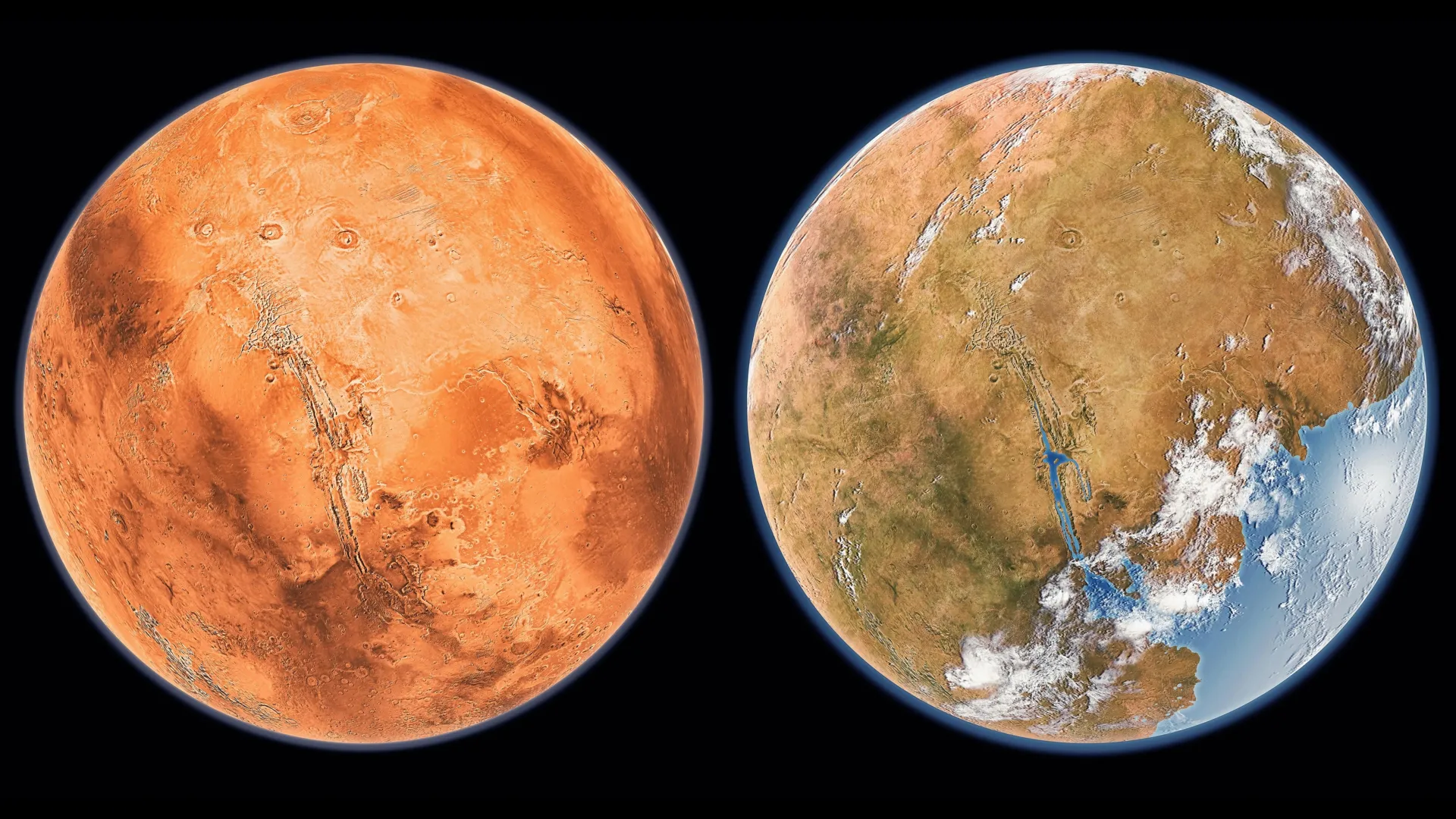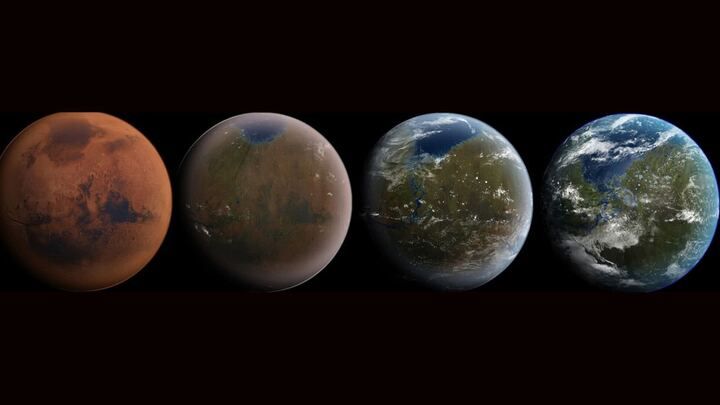
Artist's illustration depicting the terraforming of Mars — turning into a more Earth-like world.
(Image credit: Daein Ballard, CC BY-SA)
GOLDEN, Colorado — Scientists are engaged in research with an eye toward transforming the cold climes of Mars into a far more habitable place for Earthlings in the future.One notion proposed is the dispersion of an aerosol meant to help warm up Mars' atmosphere. The idea is projected to be a first step toward terraforming the Red Planet. Also emerging recently as a new field of study is "applied astrobiology," which seeks to appraise what would be needed to create sustainable habitats and biospheres beyond Earth.Scientists have drawn up a research blueprint for assessing the viability of warming the Red Planet, outlining what it might take to make Mars a place in space where life can thrive. Importantly, that roadmap does not presuppose that warming Mars is desirable. Rather, its purpose is to identify what is required for Mars to be warmed, what it would cost and what could go wrong.Keep the option openEdwin Kite, an associate professor of geophysical sciences at the University of Chicago, detailed the plan here at a Space Resources Roundtable, which was held from June 2 to June 5 on the campus of the Colorado School of Mines.Kite's talk showcased a mission concept prototype to validate aerosol dispersal to warm Mars' atmosphere as a first step toward terraforming the Red Planet."Creating sustainable habitats and biospheres beyond Earth is an enormous scientific and technical challenge, but it's one we'll have to surmount if we're going to extend life beyond Earth," Kite told Space.com."We do not yet know enough to create a biosphere from scratch," he added. "Applied astrobiology, like planetary science, requires contributions from many disciplines."Kite said that relatively modest research investments can keep open the option of extending life beyond Earth as the scientific exploration of Mars continues.The roadmap, Kite explained to Space.com, identifies several approaches to warming Mars. Solid-state greenhouse membranes, he said, offer the nearest-term benefits, with direct applications to moisture farming and life support at human bases on Mars.Strengthening Mars' natural greenhouse effect might warm large regions of the globe, Kite noted, although many aspects remain to be worked out. Each approach carries scientific and technical risks that research must address, he added.