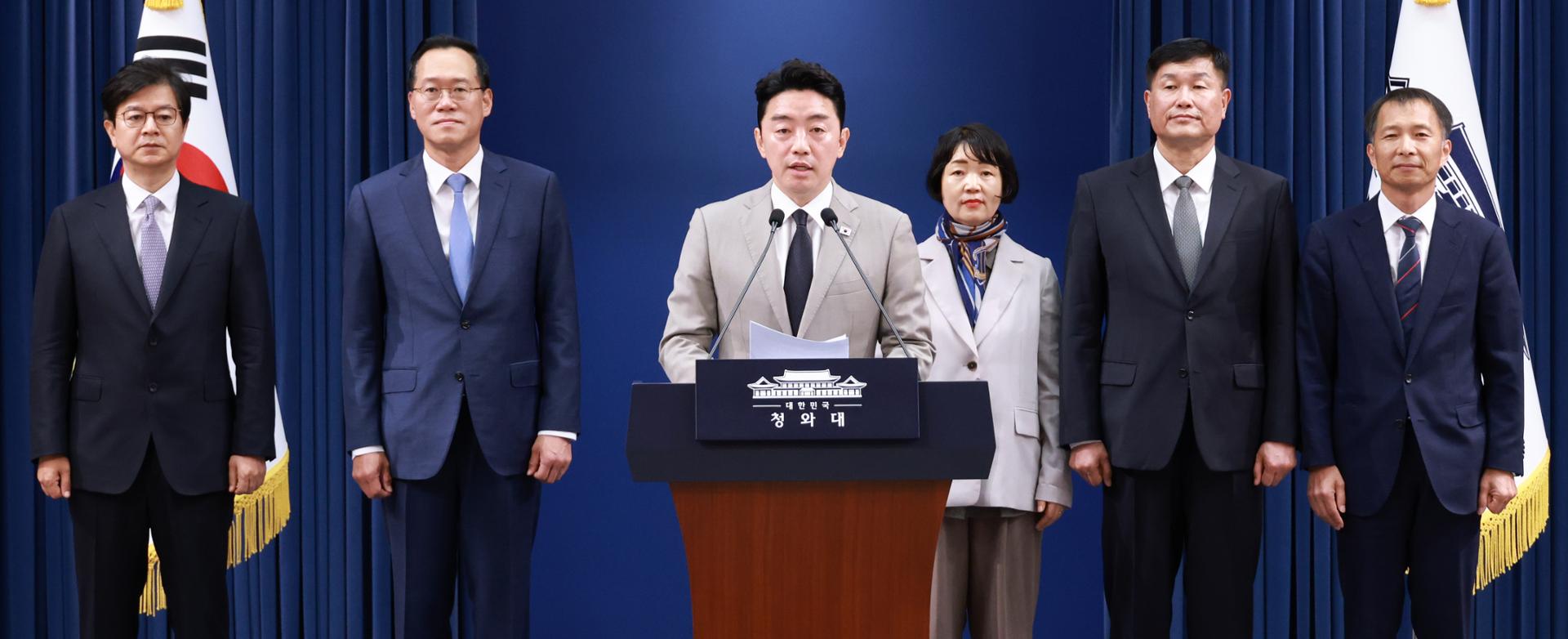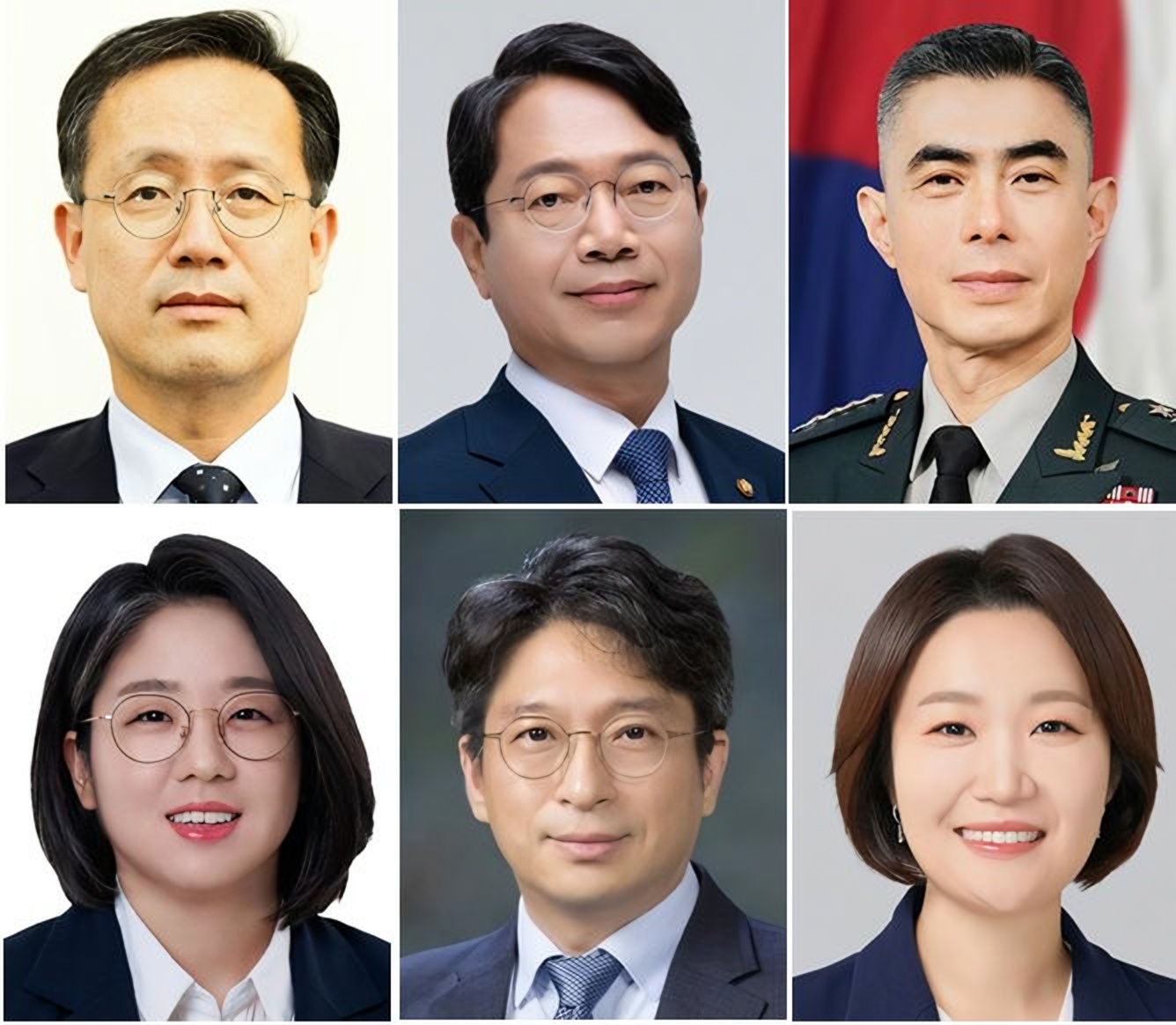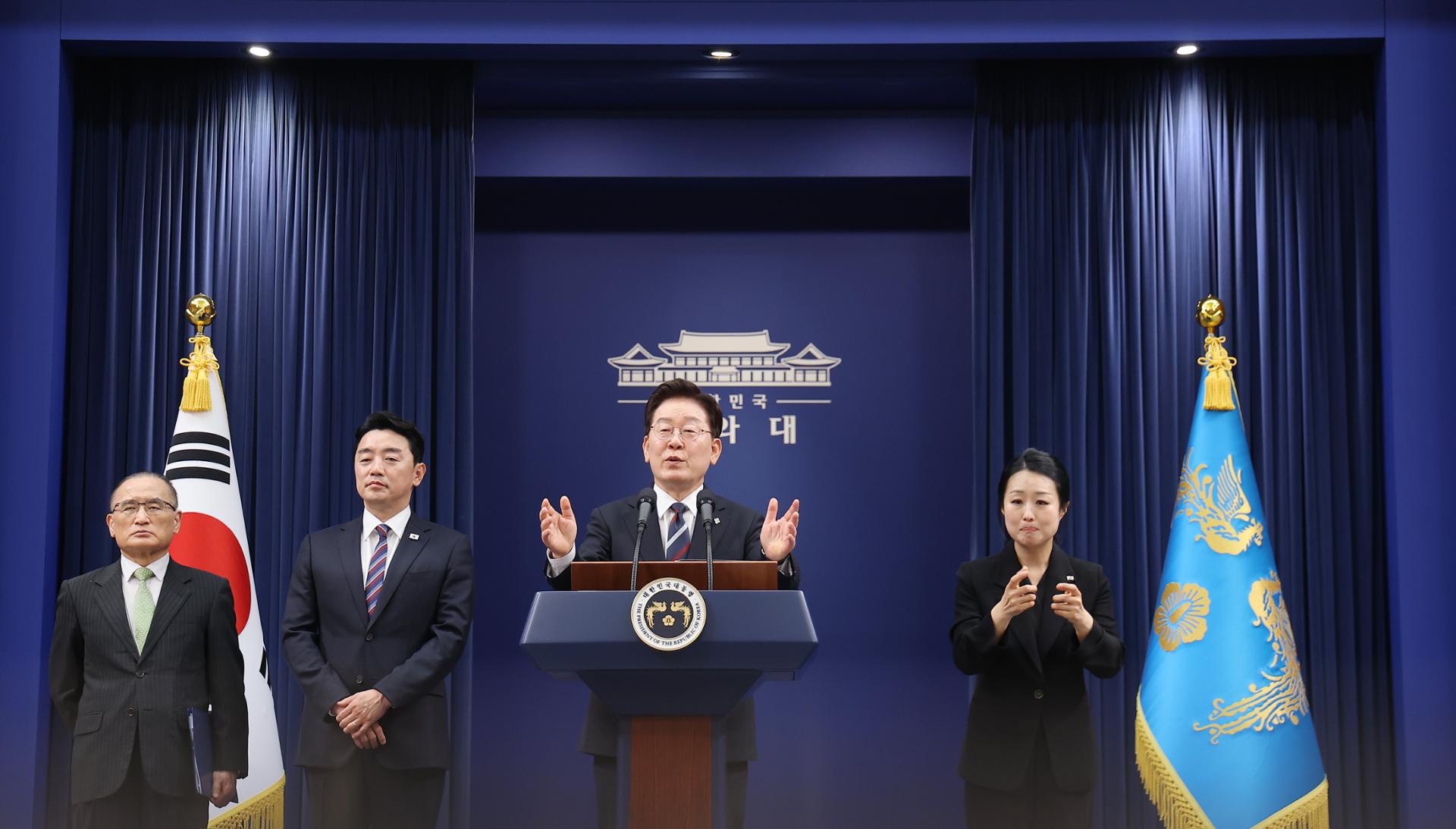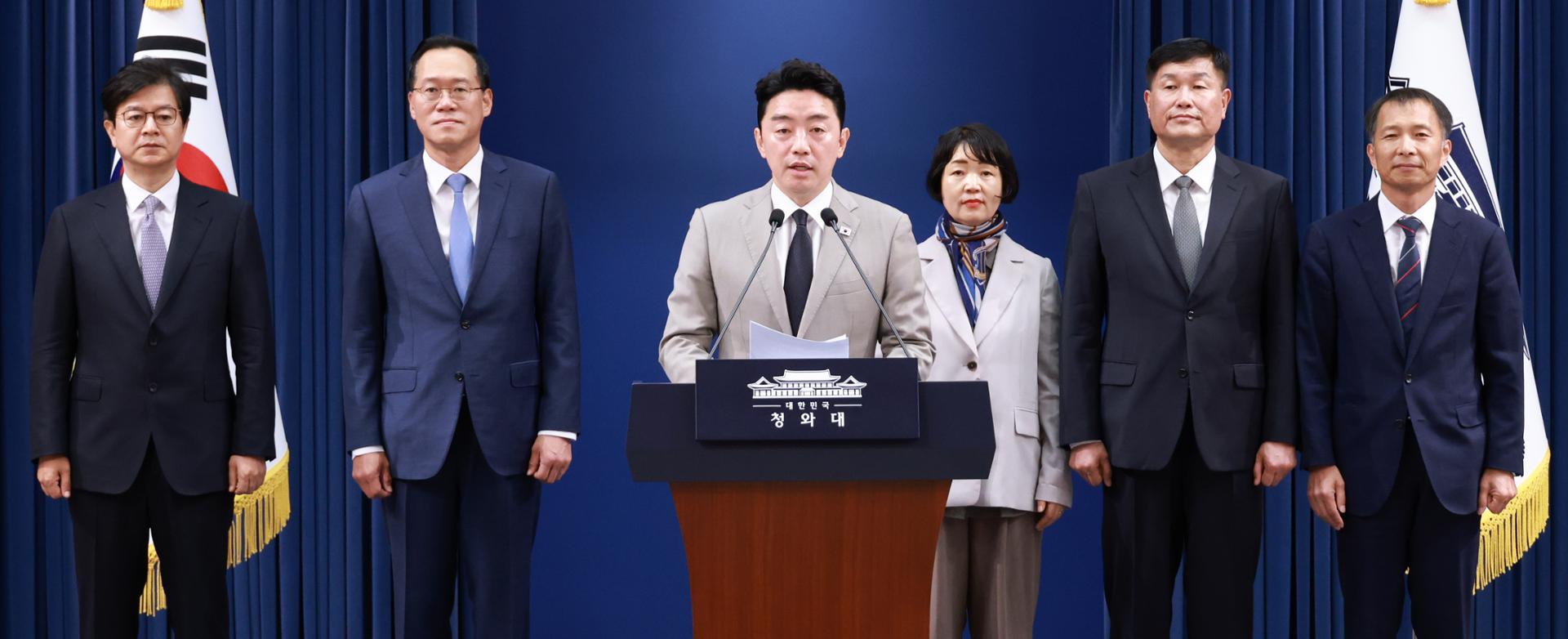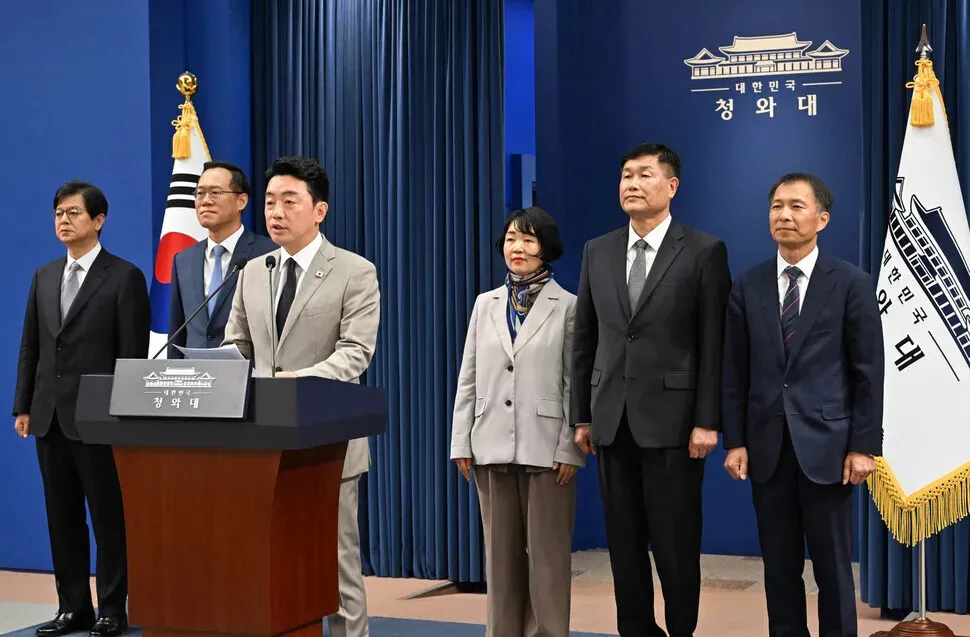
Kang Hoon-sik, the Blue House chief of staff, introduces the new senior secretaries to the president from the Blue House on June 21, 2026. (pool photo)
Speed and reform appear to have been the guiding principles for South Korean President Lee Jae Myung’s reshuffle of senior advisers on Sunday. This reshuffle, which comes as Lee enters his second year in office, can be seen as an attempt to get back on track following the dizzying aftermath of the June 3 local elections and to prioritize communication and the implementation of national policy priorities. Kang Hoon-sik, the Blue House chief of staff, said the new slate of appointees “highlights our strong will for reform and determination to push ourselves to keep moving forward.” The Blue House replaced five of 11 senior-level positions — seven senior secretaries, one adviser, three deputy directors. “A total of six people will be appointed, as the position of senior secretary for AI and future planning, which has been vacant since Ha Jung-woo ran for the parliamentary by-election on June 3, will also be filled,” Kang said. “It would be accurate to call this a moderate-to-major reshuffle of the Blue House.” As Lee’s approval rating dips beneath the 60% mark, the administration seems intent on turning the tide through an overhaul of the Blue House personnel. Most noteworthy is the replacement of the senior secretaries for civil affairs and social policy. Lee has appointed yet another former prosecutor as the senior secretary of civil affairs and justice, following Oh Gwang-soo and Bong Wook. The new senior secretary of civil affairs and justice, Han Chan-sik, served as chief prosecutor of the Seoul Eastern District Prosecutors’ Office from 2018 to 2019, and led the investigation into the Ministry of Environment employee blacklist during his tenure. Han left the prosecution service when Yoon Suk-yeol, his junior from the Judicial Research and Training Institute, was appointed as prosecutor general. Yoon later went on to be elected president of Korea, only to be impeached and imprisoned for his attempted self-coup in December 2024. Han will be responsible for seeing through the launch of two new judicial agencies that will replace the existing prosecution service, which will be dismantled in October, as well as making amendments to the Criminal Procedure Act concerning the prosecutors’ supplementary investigative powers. The Blue House appears hopeful that Han, with his deep understanding of the prosecution service and investigative system, can quickly resolve these issues in a mediating role. The Rebuilding Korea Party, however, voiced concerns about Han’s past investigation of the Ministry of Environment blacklist. “With discussions of the second phase of prosecutorial reform scheduled for the second half of 2026, we are concerned by Han’s history of being antagonistic to reform,” the party said. There are also signs of backlash from hard-line supporters within the ruling party who are in favor of overhauling the prosecution service. Kim Kyoung-ja, a pharmacist-turned-labor activist, has been appointed as presidential secretary for social policy with a view toward quickly knocking out policy priorities. Kim has served as deputy head of the Gyeonggi branch of the Korean Health and Medical Workers’ Union, as well as vice chair and senior vice chair of the Korean Confederation of Trade Unions. Kim’s relationship with Lee spans over 20 years, having worked alongside the president in the campaign to establish Seongnam Medical Center in 2003.The Blue House sees Kim as the person to get the job done when it comes to innovative labor policies, including prevention of industrial accidents. Her appointment adds yet another official from a labor background to the administration’s lineup of key labor policymakers. Labor Minister Kim Young-hoon formerly worked for the Korean Confederation of Trade Unions, while Lee Ok-nam, the secretary to the president for labor, previously built a career in the Federation of Korean Trade Unions. The pick of Sung Ki-hong, a journalist of over 30 years who rose through the ranks to become president of Korea’s main wire service Yonhap News Agency, to serve as senior secretary to the president for public relations and communications suggests that the Blue House is looking to grow its communication with the public. “There was a shared recognition that better communication and engagement are needed,” Kang said. Changes are also coming for the Blue House’s Office of National Security. The pick for first deputy director of national security, Kang Gun-jark, served in various roles in the Moon administration, including head of the National Center for Crisis Management and the secretary for national defense innovation. In those roles, he played an active part in pursuing the return of wartime operational control of the military, prompting speculation that his appointment may be indicative of a push to speed up the timeline for regaining OPCON. After serving as the inaugural secretary to the president for state affairs monitoring, Song Ki-ho was appointed secretary for economic security last July. His appointment as third deputy director of national security marks another rise in the ranks for the official. This reshuffle in the Blue House notably did not include any personnel working on economic policy. The president is expected to announce his reshuffle of Cabinet-level ministers early next month, once Thursday and Friday’s confirmation hearing for Han Seong-sook, his pick for prime minister, wrap up. Positions seen as likely to be reshuffled are the minister of SMEs and startups left vacant by Han’s nomination for prime minister, as well as minister of land, infrastructure and transport, and minister of health and welfare. With Justice Minister Jung Sung-ho expressing a desire to return to party politics, it’s possible that he may also step down soon.By Seo Young-ji, staff reporter; Lim Cheol-hwi, staff reporterPlease direct questions or comments to [english@hani.co.kr]