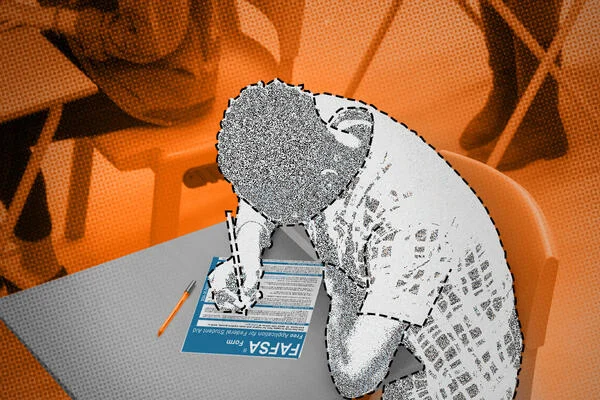
Scammers posing as fake or “ghost” students have stolen millions in federal student aid.
Photo illustration by Justin Morrison/Inside Higher Ed | Caiaimage/Chris Ryan/iStock/Getty Images
Earlier this month, the House of Representatives passed the No Aid for Ghost Students Act, which would require the Department of Education to screen federal aid applications for potential fraud in response to schemes that costs colleges and universities millions of dollars annually.
The legislation, sponsored by Republican Rep. Burgess Owens of Utah, would essentially codify an initiative the department had already launched independently this spring. Dubbed “Real-Time Fraud Detection,” the new Free Application for Federal Student Aid feature screens all applicants in what financial aid experts have called a major win for institutions that have been fighting these schemes alone for years.
The legislation itself has been somewhat more controversial, passing largely along party lines; only 36 Democrats voted with Republicans to advance it. Rep. Bobby Scott, the top Democrat on the House Education and Workforce Committee, said on the House floor that Congress should wait and see how the department’s real-time detection system works before making it permanent.