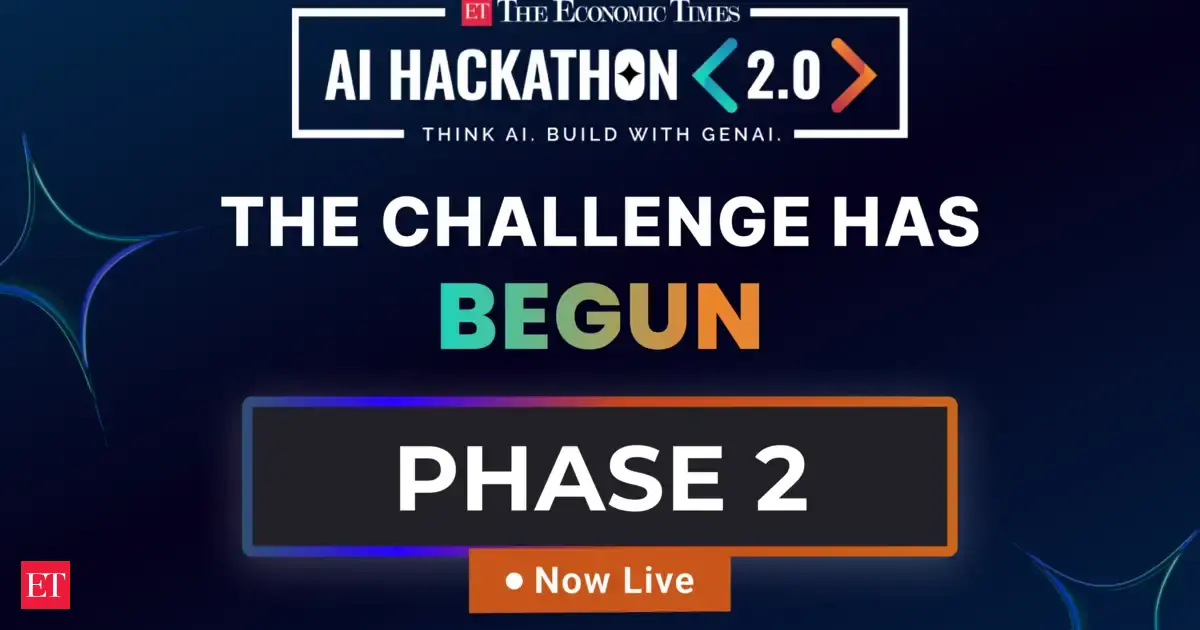
The ET AI Hackathon 2.0 has officially entered Phase 2, marking the transition from assessment to execution as shortlisted participants begin building AI-powered solutions to address real-world challenges.After a competitive first round, participants who successfully cleared the assessment stage will now select from a set of problem statements and develop working prototypes that demonstrate both technical capability and practical impact. The phase is designed to test more than just ideas, it is an opportunity for teams to showcase how effectively they can translate concepts into functional AI applications.As artificial intelligence rapidly moves from experimentation to enterprise adoption, the ability to build solutions that address tangible business and user needs has become increasingly important. Phase 2 reflects this shift by encouraging participants to focus on innovation, execution, scalability, and real-world relevance.The problem statements span diverse domains and are intended to challenge participants to think beyond technology alone. Teams are expected to identify meaningful opportunities, apply AI creatively, and develop solutions capable of delivering measurable value. The prototypes submitted during this phase will form the basis for evaluation and determine which teams advance to the final stage of the competition.Supporting this journey is Octave, the Ecosystem Partner for ET AI Hackathon 2.0. Through its involvement, Octave is helping foster a collaborative environment that brings together aspiring innovators, developers, builders, and AI enthusiasts. The partnership reflects a shared commitment to strengthening India's AI ecosystem and creating opportunities for emerging talent to engage with real-world problem-solving.The ET AI Hackathon 2.0 has evolved into one of India's leading platforms for AI innovation, bringing together participants from across the country to experiment, build, and showcase their capabilities. Beyond competition, the initiative aims to encourage hands-on learning, practical application of AI technologies, and the development of solutions that can contribute to the broader innovation landscape.With Phase 2 now underway, the focus shifts from potential to proof. Over the coming weeks, teams will build, refine, and submit their prototypes, competing for a coveted place in the final round.As the next generation of AI builders gets to work, Phase 2 promises to be where ideas begin to take shape, and where innovation starts becoming reality.
ET AI Hackathon 2.0 enters phase 2, challenging builders to turn ideas into AI-powered solutions
ET AI Hackathon 2.0 has entered Phase 2, where shortlisted participants will transform ideas into AI-powered prototypes by tackling real-world problem statements. The stage focuses on innovation, technical execution, and practical impact, challenging teams to build solutions that address meaningful challenges.
356 words~2 min read