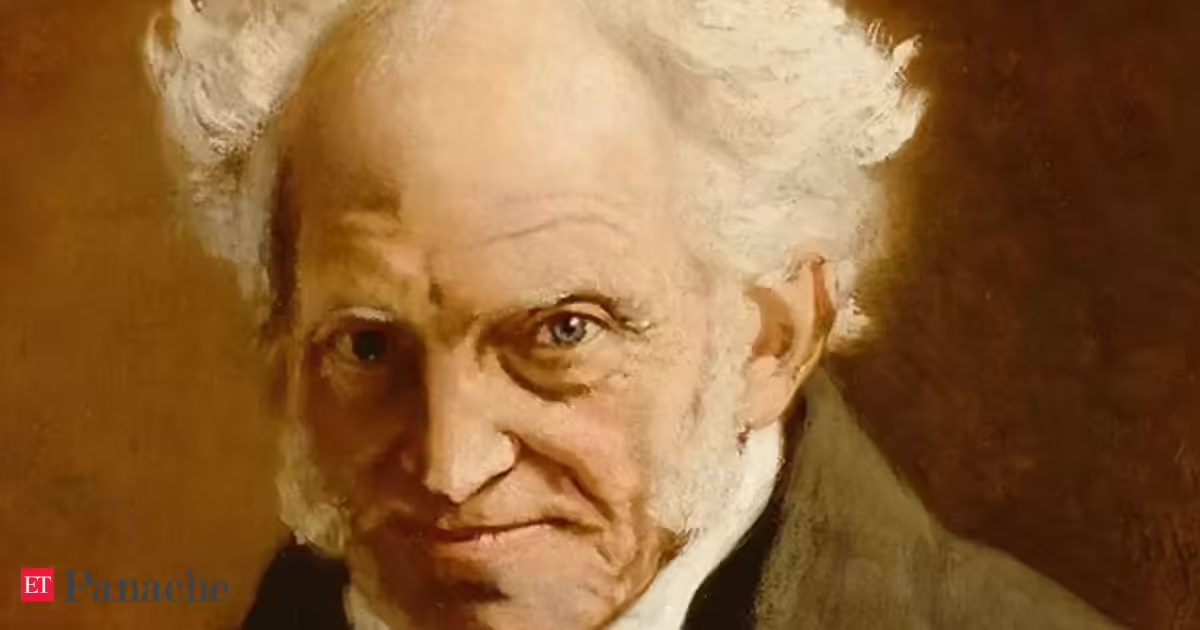
German philosopher Arthur Schopenhauer remains one of the most discussed thinkers in modern philosophy because of his sharp observations about human nature, society and individual existence. Many of his statements continue to resonate today, especially in a world where questions of identity, belonging and personal freedom are frequently debated. One of his widely shared reflections examines how much of a person's identity is assigned at birth rather than chosen by the individual."Five minutes after birth, they decide your name, religion, nationality and sect. And you spend the rest of your life defending what you did not choose."At its core, the quote draws attention to the fact that several aspects of a person's identity are determined before they are old enough to understand them. A newborn does not choose a name, a religion, a nationality or a social group. These decisions are usually made by family, culture or society. Yet, as people grow older, they often become deeply attached to these inherited identities and may spend years defending them, sometimes without questioning why they hold those beliefs in the first place.The statement is not necessarily an attack on religion, nationality or tradition. Rather, it encourages self-reflection. Schopenhauer appears to be asking whether people truly examine the beliefs and labels they inherit or whether they simply accept them because they were given at birth. The quote invites readers to think independently, evaluate their assumptions and understand the difference between personal choice and social conditioning.Arthur Schopenhauer was born on February 22, 1788, in Danzig, then part of Prussia and now known as Gdańsk in Poland. He came from a wealthy merchant family and was initially expected to pursue a business career. However, his interests gradually moved toward academics and philosophy.After studying at the universities of Göttingen and Berlin, Schopenhauer developed ideas that would later shape his philosophical system. His early scholarly work was On the Fourfold Root of the Principle of Sufficient Reason, published in 1813. The book explored how human beings understand explanations, causes and reasoning, and Schopenhauer continued to regard it as an important foundation for his later thinking.His most famous work, The World as Will and Representation, first appeared in 1819. The book became the centerpiece of his philosophy and remains the work most closely associated with his name. Although it attracted little attention when first published, later editions and growing interest in his ideas eventually helped establish his reputation.The idea that shaped his philosophyA central concept in Schopenhauer's thought was the notion of the "will." He argued that beneath the world people experience through their senses lies a deeper force that drives all living things. According to him, human beings are not guided entirely by reason. Instead, much of their behavior is influenced by unconscious desires, impulses and striving.Schopenhauer believed that this constant striving often leads to dissatisfaction. People achieve one goal only to pursue another, creating an endless cycle of desire. Because of this, he developed a reputation as a philosopher of pessimism. However, his philosophy was not solely negative. He also explored ways in which individuals could find relief from suffering through compassion, art, music and contemplation.His ideas drew inspiration from several sources, including the works of Immanuel Kant and Plato. Schopenhauer was also among the first major German philosophers to engage seriously with Eastern thought, including Hindu and Buddhist texts, which he admired throughout his life.A life outside the academic mainstreamUnlike many philosophers of his era, Schopenhauer struggled to gain recognition from academic institutions. He attempted to establish a university teaching career in Berlin but failed to attract large audiences. His lectures were famously scheduled at the same time as those of Georg Wilhelm Friedrich Hegel, one of the most influential thinkers of the period, and few students attended Schopenhauer's classes.Disappointed by the academic world, he spent much of his later life in Frankfurt, where he continued writing and refining his ideas. Recognition arrived relatively late. The publication of Parerga and Paralipomena in 1851 brought his work to a broader audience and helped secure his place in intellectual history.Schopenhauer died in Frankfurt in 1860, but his influence continued to grow after his death. His writings inspired figures such as Friedrich Nietzsche, Richard Wagner, Sigmund Freud, Thomas Mann and Ludwig Wittgenstein.
Quote of the day by philosopher Arthur Schopenhauer: 'Five minutes after birth, they decide your name, nationality and sect. Then you spend the rest of your life defending what you did not choose...' How much of your identity did you actually choose? Father of philosophical pessimism asks
German philosopher Arthur Schopenhauer's quote of the day encourages reflection on the identities people inherit rather than select for themselves. The quote highlights how many beliefs and labels are assigned at birth and invites individuals to think critically about them. Explore the meaning behind the statement and looks at Schopenhauers life, philosophy, major works, and lasting influence on modern thought.
704 words~3 min read