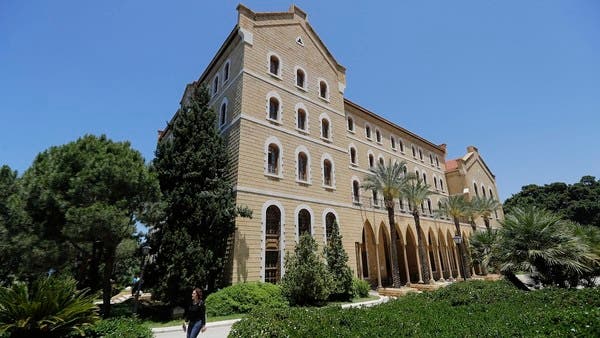
Every few years, Lebanon’s public sphere rediscovers “freedom of expression” with the enthusiasm of a seasonal virtue. It is invoked passionately, defended loudly, and mourned theatrically – until it becomes inconvenient. Then it is quietly reclassified as a risk, a liability, or a “process issue,” deferred to committees, vetting mechanisms, and legal caveats that arrive only once outrage has already done its work.For all the latest headlines follow our Google News channel online or via the app.The recent controversy surrounding Francesca Albanese and the American University of Beirut fits squarely within this pattern. What is striking is not the dispute itself, but the sudden shock it produced among people who otherwise live quite comfortably with the routine disciplining of speech. As if this were the first time expression had been filtered, managed, or constrained in the name of compliance.This, plainly, is what freedom of expression looks like once it becomes relative.In response to the uproar, AUB clarified that no event featuring Albanese had been scheduled and then canceled. Rather, the university stated that, as a private institution operating under Lebanese law and a US charter, it is legally required to vet all invitees against US sanctions lists. Since Albanese is reportedly listed on the Specially Designated Nationals registry, AUB rightly argued that it could not legally host her without exposing itself – and its staff – to serious legal risk.One may object to the politics behind such sanctions, and many should. But pretending these constraints do not exist, or that institutions can simply ignore binding legal frameworks when moral urgency demands it, is either naïve or willfully dishonest. Law, unlike outrage, does not yield to hashtags.Yet the deeper problem is not legal constraint. It is selective indignation.The sudden mobilization around Albanese contrasts sharply with the near silence that accompanied the very public attack on Professor Bashar Haydar not long ago – an episode that raised equally serious questions about academic freedom, dignity, and permissible speech. That incident passed with minimal collegial reckoning or institutional soul-searching. No anguished emails circulated. No broader reflections followed.This asymmetry matters.Because once outrage becomes episodic – activated only when the cause is internationally visible, media-friendly, or ideologically affirming – it stops being outrage and turns into performance. And once freedom of expression is defended only when it is safe to defend, it ceases to be a principle at all.Some have tried to sidestep this contradiction by arguing that US funding is now so scarce, so diminished, that abiding by US legal and political considerations is therefore futile or unnecessary. This claim, too, collapses under scrutiny.AUB does not operate within a US legal framework merely to secure funds. It operates within it as part of a broader soft-power model – one that, for all its flaws, has historically allowed the university to function as a pluralistic space in a deeply illiberal region. This model has enabled people sharply critical of US foreign policy, Israeli power, and Western hegemony to teach, research, and publish at AUB, provided they meet academic and professional standards.To dismiss this framework as irrelevant while continuing to benefit from its protections, prestige, and latitude is not resistance. It is convenience masquerading as principle.The same applies to the moral theatrics surrounding funding. Those who denounce “blood money” while continuing to build careers within institutions sustained by it are not practicing ethical courage. They are outsourcing their discomfort. No one is compelled to accept funding they claim is morally intolerable. Refusal is an option – just not a cost-free one.It is easy to denounce power while cashing its checks. Easy to celebrate courage while delegating its price to “the institution.” And especially easy to rediscover freedom of expression only when it flatters one’s politics.This is not an indictment of a single university, nor a demand for heroic martyrdom. It is a call for intellectual honesty. Either freedom of expression is a value worth defending consistently, even when it is uncomfortable and constrained – or it is a rhetorical ornament we deploy when convenient.Our students are not confused. They are watching carefully. They see how principles are celebrated in theory and negotiated in practice. They observe how silence is rationalized, how outrage is timed, and how moral clarity is selectively activated.Perhaps the real lesson they are absorbing is not about freedom of expression itself, but about its limits – limits defined less by law than by willingness.And silence, as always, remains a choice.
The Albanese affair and the American University of Beirut
Every few years, Lebanon’s public sphere rediscovers “freedom of expression” with the enthusiasm of a seasonal virtue. It is invoked passionately, defended
736 words~3 min read