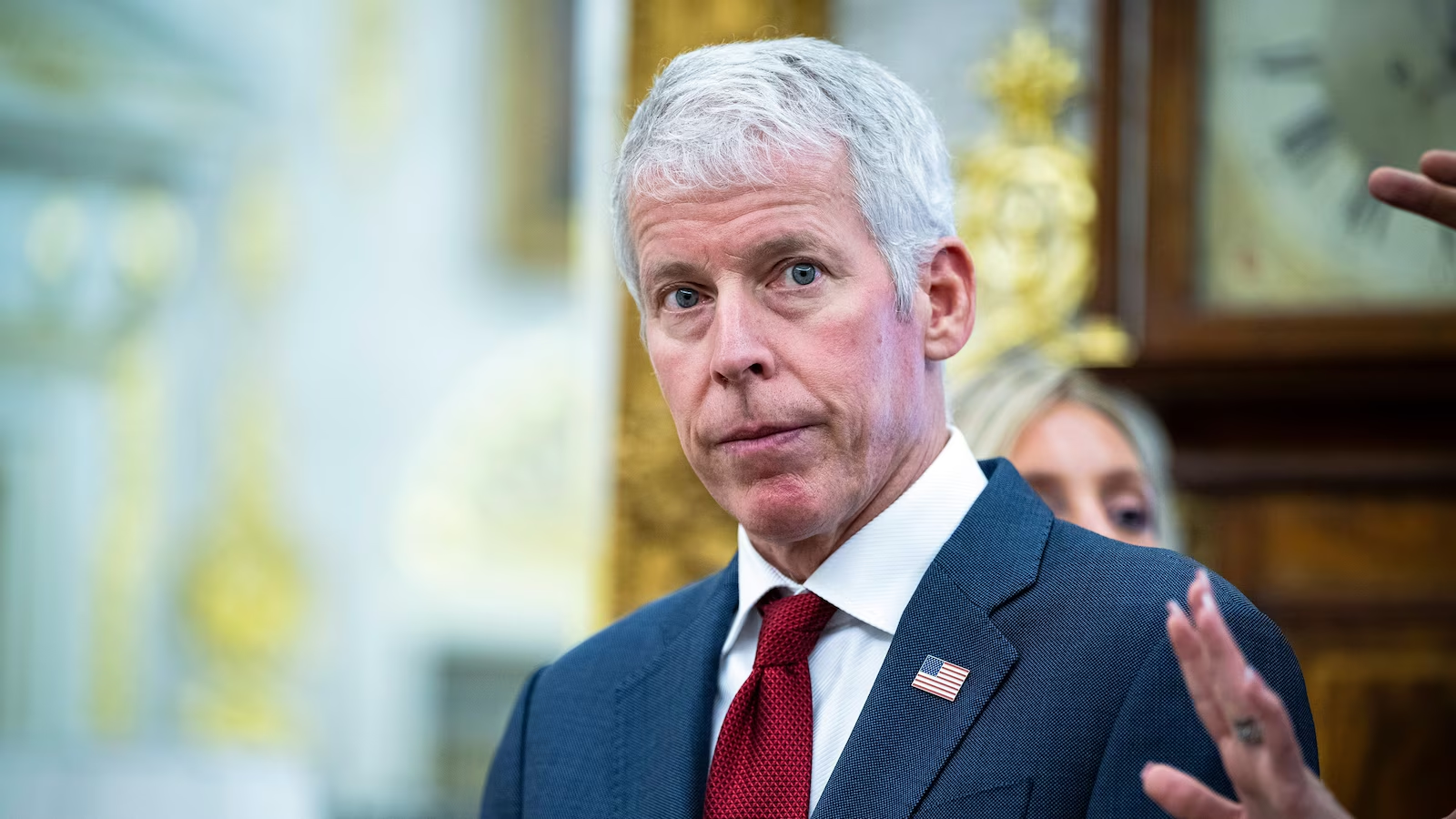
A rush transcript of "This Week with George Stephanopoulos" airing on Sunday, June 21, 2026 on ABC News is below. This copy may not be in its final form, may be updated and may contain minor transcription errors. For previous show transcripts, visit the "This Week" transcript archive.JONATHAN KARL, ABC “THIS WEEK” CO-ANCHOR: And I'm joined now by Energy Secretary Chris Wright.Secretary Wright, thank you for being here.As we sit here now, the vice president is in Switzerland for meetings with the Iranians. What do you expect to come from this first round of talks?ENERGY SECRETARY CHRIS WRIGHT: I think this first candid dialogue will set out what the Iranian goals are and what they think the tradeoffs they might have to make are. We've just never been in this situation before. The U.S. military, both in the actions to destroy the Iranian military capabilities and to force a way through the Strait of Hormuz without any dialogue, have just put the Iranians in a massively different situation. They don't have the leverage they've always had in talks before.KARL: Well, let me ask you about the Strait, because the vice president said the Strait is open, the Iranians said it's closed. And we heard that 55 ships came through yesterday. What is the status? Are we partially opened? Is there really -- when do we get back to the levels that we had before the war?WRIGHT: Well, 55 ships two days ago, as you said, 67 went through yesterday on an oil and oil products volumes about equal to where we were before the war.But there's three channels through the straits. There's the middle normal navigational channel that, unfortunately, the Iranians have mined. So that needs to be de-mined. Then there's a separate route up north by the Iranian islands that they've tried to force ships through. And then there's a southern route that the United States military has been escorting ships through for several weeks.And I think it's that returning flows back towards normal without any cooperation at all from Iran, that's the leverage President Trump used to get the Iranians to come to the table and realize they're going to lose all the cards in their hand. Maybe they can make a deal that brings some benefit to Iran. Maybe they can't.KARL: So we've seen oil prices have come down pretty significantly even before the reopening started. How soon do you expect gas prices to get down to the levels that we saw before this war?WRIGHT: Oh, I've got long out of the business of predicting oil or gasoline prices, but they will continue to head down. Flows of oil and natural gas through the strait have already returned to normal, and they will continue that way, whatever happens with the negotiations with the Iranians. We've got growing American production, surging production in Venezuela. We've got cooperation with all the other energy producers of the world. So I think Americans can expect continued declines in energy prices.KARL: But let me -- the other question is, what happens if it falls apart? You just said, if it falls apart, we'll still see declining prices. But I want to play you something that President Trump said at the G7. He seems to have President Herbert Hoover on his mind.Take a listen.(BEGIN VIDEO CLIP)DONALD TRUMP, PRESIDENT OF THE UNITED STATES: The one president I did not want to be was the late, great Herbert Hoover.Rather than possibly going into a depression, rather than having your favorite president be Herbert Hoover, was always the one I didn't want to be.(END VIDEO CLIP)KARL: I mean, what he's saying there, and he has said a few different times, is that if we go back to a state of war with Iran, we face the risk of global depression. Is that not true?WRIGHT: The president -- no, I don’t -- no, but look, the president has been advised all along, despite the media proclamations, that there was enormous risk to energy flows to engage the Iran’s -- the Iranians on their nuclear program in a military fashion. But he simply was unwilling to leave to his successor in nuclear-armed Iran. That's just, there's just no greater risk to energy prices, to the economy of the world, than in nuclear-armed Iran.He knew he was going to drive up energy prices in the short run. He had the courage to take the action anyway, to destroy their air force, their navy, most of their nuclear program, and a lot of their military-industrial complex. I think it's a massive benefit to future generations.We knew that was a risk to energy prices. We've paid the price with higher energy prices in the midterm. And then we have worked with our military focused on restoring flow with or without the Iranians to reduce their leverage and get to a good answer.But he knows the risk he's playing with. He took those chances and the Americans win by it.Popular ReadsKARL: And he seemed to be saying he didn't want to, he couldn't go further because the risks would have been even greater.But let me move to another thing. He -- when he first engaged in this, when he first launched this war, he said that one of the key objectives, and this was repeated by Marco Rubio several times as well, was to obliterate Iran's missile program. Take a listen.(BEGIN VIDEO CLIP)TRUMP: We are going to destroy their missiles and raze their missile industry to the ground. It will be totally, again, obliterated.(END VIDEO CLIP)KARL: He's saying this.(BEGIN VIDEO CLIP)TRUMP: If other countries have them, it's a little bit unfair for them not to have some. A ballistic missile is not the same thing as what we're talking about, what we talked to earlier. But if Saudi Arabia and Qatar, and they all have some, I would say in relative proportion, I think, it's okay.(END VIDEO CLIP)KARL: So, how did we go from saying that the objective of the war was to destroy their missile program to saying that they've got a right to have missiles? Why the change?WRIGHT: Well, look, I think it's a matter of degrees. We've probably degraded their ability to make missiles by 90 percent. That is a massive -- I think you could call that an obliteration of their missile-making industry.But the president recognizes, if they have -- if they become a normal nation, and they become a citizen of the Gulf community, for them to have a modest amount of missiles, as he said, proportional to their neighbors, that’s not -- that's not an unreasonable end to aim for.But in the meantime, they have been just massively more armed than all their neighbors. They've spent all of their money and their earnings from their energy industry to arm themselves to the teeth. That has been degraded massively.But need it go to zero? No, it probably doesn't need to go to zero, is what the president's saying.KARL: But let me ask you about what critics of this deal say that this is a windfall for the Iranians. I mean, they get to sell their oil now in the open markets using the banking system in a way they haven't been able to do for years. They're going to get frozen assets unfrozen, and they have the possibility of something much, much more if the nuclear agreement comes forward.What do you say, this is really a gift to the Iranians, and they really haven't given up much of anything?WRIGHT: Oh, Iranians have been selling oil most of the last 47 years. The first Trump administration crimped that down to only a half million barrels a day. They exported over one and a half million barrels a day during the entire Biden administration, which is what they're going to rebound to today.That's all they're getting, is the ability to yet sell their oil again. We proved to them for two months we could cease them from selling a drop of oil, and that's important leverage. Now that's going to return back to where it was, but they're not going to get any of the other funds released, their own frozen funds released, unless there's progress, meaningful and provable progress in the nuclear talks.And the large numbers that are thrown around, that's simply the carrot President Trump talks about. They become a normal nation again.Will their neighbors invest to build infrastructure and welcome them to the community? Of course they will, but that's only if they return to a normal nation. They're a long way from today, but you've got to put that carrot out there. That's the aspiration.KARL: All right. Secretary Wright, thank you very much.WRIGHT: Thanks, Jon.KARL: Appreciate it.WRIGH: Thank you. Thanks for having me.KARL: All right, take care. See you around.
'This Week' Transcript 6-21-26: Energy Secretary Chris Wright & Susan Rice
Energy Secretary Chris Wright & Susan Rice were on "This Week" Sunday, June 21. This is a rush transcript and may be updated.
TL;DRAI
Strait of Hormuz reopened to pre-war volumes (67 ships/day) after US military degraded Iranian missile program by 90 percent. This energy stability enables reliable forecasting on cloud and data center costs for enterprise tech leaders in coming years.
1,465 words~7 min read