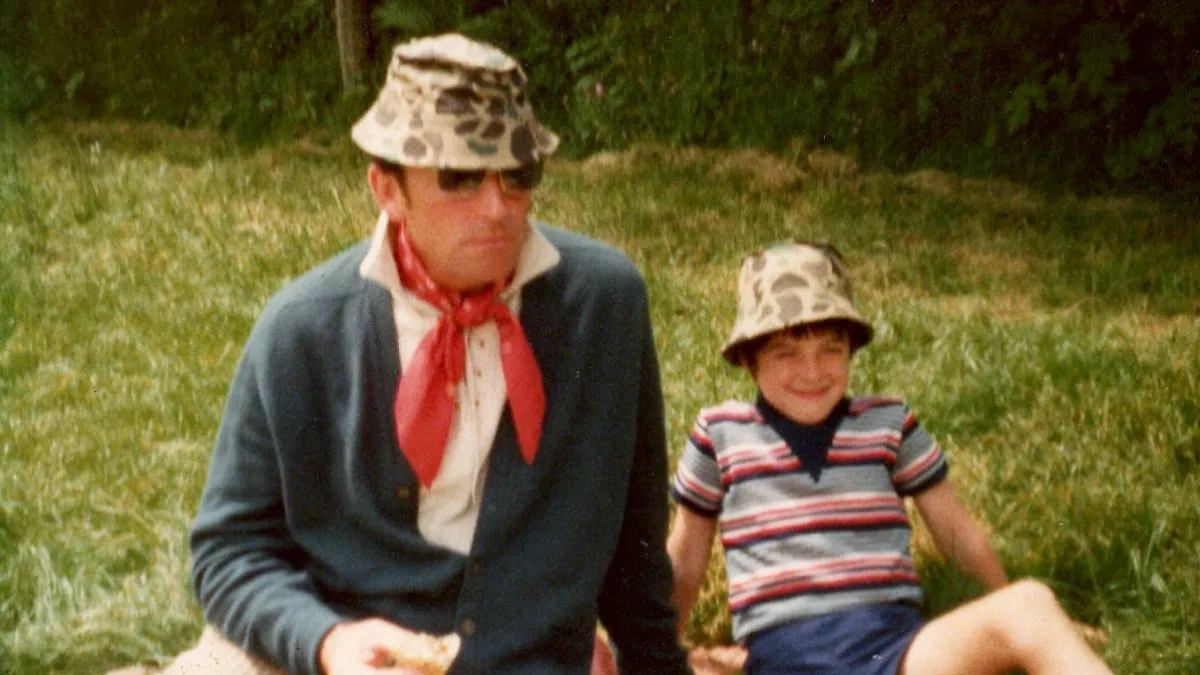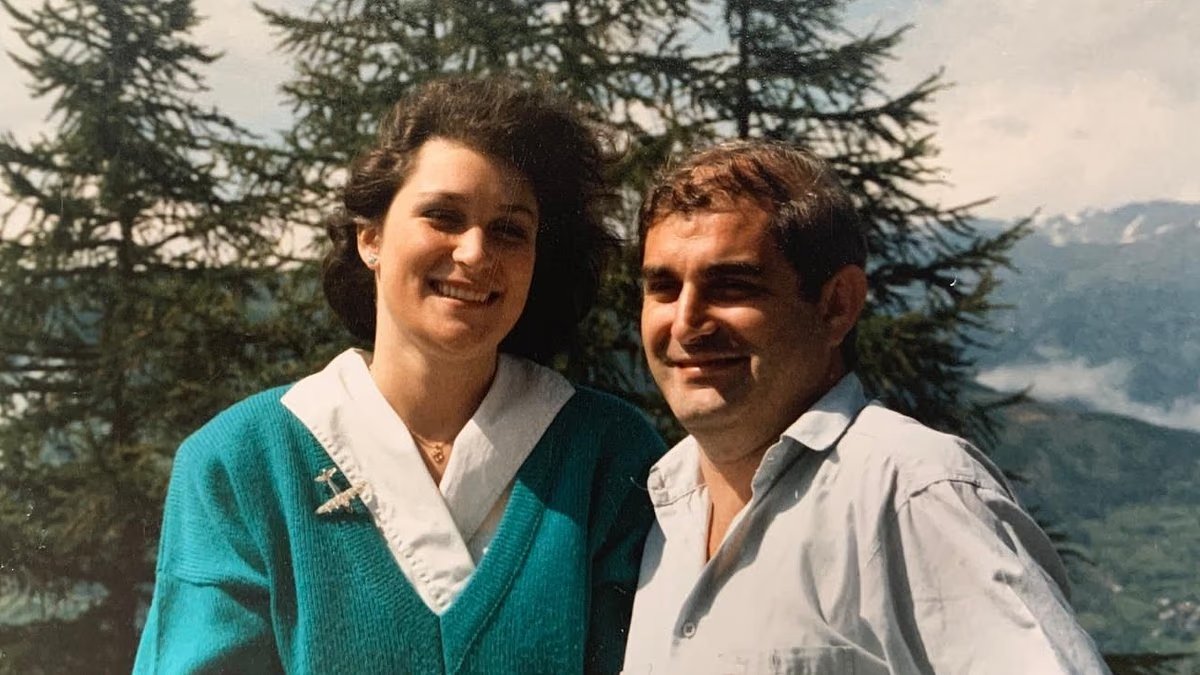
Over the past few days my inbox has been inundated with jaunty marketing emails in anticipation of today, Father’s Day. Normally I find the whole thing rather irritating. But this year is different.This year Father’s Day is not just another excuse for chocolates and Clintons Cards sentimentality, but a moment of authentic reflection. My father, Roger, passed away in the early hours of Wednesday morning, just a few weeks after his 80th birthday.If I’m honest, it came as a blessed relief. The last few years had not been kind to him, and he was not a well man, nor a particularly happy one. Put it this way: He did not bear the vicissitudes of old age with grace. In every aspect of his final weeks on this Earth, he embodied the words of his fellow countryman Dylan Thomas: ‘Do not go gentle into that good night, Old age should burn and rave at close of day; Rage, rage against the dying of the light.’ That he most certainly did, with the kind of dogged determination only an angry Welshman deprived of a decent drink can muster.When the moment finally came, he was not exactly ready (who of us ever is?) but it was undoubtedly overdue. Nevertheless, there is, in the end, a great sadness.I am just grateful that, however imperfectly, I had made my peace with him – and I think he with me.This wasn’t easy. He was a domineering, forceful character, the kind of man who made the weather, if you know what I mean.As a father, he could be affectionate, entertaining and huge fun – but he was also mercurial, irascible and often unnecessarily cruel.Over the past few years, we spoke often and candidly about all this. I even wrote about it in my recent memoir, which shocked and upset some people. But I said nothing in the book I had not already said to his face. I knew the truth, and he knew that I knew the truth. We understood each other.Besides, I could never have been honest about myself without being honest about Roger. He shaped my character more than anyone else in my life, instilled in me whatever strengths I may have, but also my weaknesses and many flaws. Sarah Vine with her father, Roger. He died in the early hours of Wednesday morning, just a few weeks after his 80th birthdayIt was through our conversations about the past that I came to realise it was OK to love him as a father while also feeling deeply ambivalent about him as a human. It was a difficult process, but a fruitful one, and one that I am immensely grateful for. Without it, his death would have left something unresolved deep within me.Instead, I came to see him not as the terrifying ogre of my childhood, but a fellow human who had endured his own set of challenges in life.I may not have liked him, but I did love him. And I think, despite it all, he was fond of me too.And so I find myself grieving not just for the father he was, but also the father he might have been, and now will never be. I had hoped his old age would give him time to reflect and heal, but it was not to be. That’s the thing about death, it is not just the end of life, but the end of hope. Foolish hope, perhaps, but hope nonetheless.As a young man, my father was a dead ringer for George Best, and was similarly gifted: Handsome, athletic, charismatic. He played tennis like a fiend, effortless and elegant, and even into his 50s could beat men half his age (usually with a gin and tonic and half-smoked stogie courtside). He even got to Junior Wimbledon one year – but crashed out because of a broken racket that his father refused to replace, presumably to teach him some sort of life lesson.It was a story he often repeated with deep hurt and bitterness, and that cruel crushing of his childhood dream clearly scarred him for life.He was also a gifted violinist, winning a coveted place at the Royal College of Music at a young age. But his father made him turn it down. He was not, he argued, good enough to be a principal. And there was no point, he added, in playing second fiddle. Quite what drove my grandfather to be so unnecessarily brutal towards my young father I cannot say – post-war pragmatism, perhaps. The family was by no means well-off, and money was an issue.In those days there was not a lot to be made from tennis or music, and perhaps he simply didn’t want his son to end up poor. The result seems to have been that Roger, this intelligent, sensitive child with an artistic soul, came to believe that money was the only measure of a person’s success. I may not have liked him, but I did love him. And so I find myself grieving not just for the father he was, but also the father he might have been, and now will never be, writes Sarah VineThis he applied to himself as much as to everyone else around him. As he said, when recounting the Wimbledon incident: ‘I promised myself from that day on I would never be in a position not to be able to buy my own racket.’ The experience hardened him. In that respect, he realised his ambition.He set aside his art and his sport and turned his talents to the Temples of Mammon. With a bit of luck and a lot of hard work and cunning, he succeeded.In his pomp he drove Ferraris, took private jets and dined in the finest restaurants.And yet, happiness evaded him. Like the Rolling Stones song (he adored the Stones for their brash unconventionality and the fact that they were grammar schoolboys made good, like him), he just couldn’t get no satisfaction. He was restless, nothing was ever enough, he always wanted more.This was what drove him, but it was also his downfall. He could never just bank the win, there always had to be a better deal around the corner. He lived for the moment, the rush, the high. He never thought he would grow old, and he never thought he would die.He didn’t even write a will. In the end, there was no need. He’d burnt through it all.His was, in all aspects, a life lived larger than most. Which is why it feels so odd to be typing this in my parents’ house in Spain, where he has just been delivered to the front door by the manager of the local crematorium.My father is much smaller now – physically, at any rate – all neatly sealed in his brand new eco-friendly biodegradable urn (he would have hated that, he hated anything that smacked of virtue signalling). It sits in a cardboard box on the chair where he sat, day in, day out, these past few years.That’s where I placed him, somewhat gingerly, after the very kind undertaker delivered him. It seemed only right. After all, where else was I going to put him? Since he left, the chair has been occupied by my brother’s elderly cat, Sony, who now sits watchfully by, his whiskers somewhat out of joint.Roger never liked animals, least of all cats. I sense from Sony the feeling might have been mutual. Nevertheless, my mother takes comfort from Sony’s newfound fondness for Roger’s cushion. She tells me that Sony is escorting him to the afterlife, across the River Styx, or wherever it is he’s going. I hope so. I hope at the end of his journey a nice glass of good Nebbiolo awaits him together with one of his favourite Cohiba cigars.On the night I arrived, just hours after he passed away in his sleep that morning, I woke to the noise of Sony miaowing loudly, a haunting, plaintive sound, most unsettling. I went back to sleep, only to be woken again just before 5 am by all the lights in the house coming on at once.A final farewell? Or perhaps just dodgy Spanish wiring. Either way, Godspeed, Roger. And happy Father’s Day.
SARAH VINE: How I found peace before my mercurial father died
This year Father's Day is not just another excuse for chocolates and Clintons Cards sentimentality, but a moment of authentic reflection. My father, Roger, passed away in the early hours of Wednesday.
TL;DRAI
Roger Vine died at 80 after abandoning artistic talents to pursue wealth, never finding fulfillment. His reconciliation with Sarah shows how prioritizing financial success over personal fulfillment creates intergenerational cycles of dysfunction.
1,368 words~6 min read