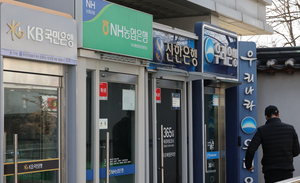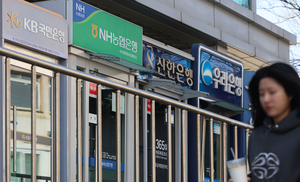
Lenders see limited earnings impact, but analysts warn policy-driven support could draw investor scrutiny ATMs of South Korea's major banks line a street in Seoul in April. (Newsis) Korean banks are ramping up debt relief for troubled borrowers as Seoul intensifies its inclusive-finance push, prompting closer scrutiny of how far lenders will be expected to shoulder social policy objectives.According to industry estimates Sunday, the five major commercial banks carried out over 4,600 in-house debt restructuring cases in the first four months of this year, nearly quadruple the 1,180 cases recorded a year earlier. The amount more than tripled to 35.9 billion won ($23.5 million), on a principal basis, from 10.5 billion won.The push comes as policymakers press financial firms to play a larger role in helping borrowers who have fallen behind on repayments, including through debt restructuring, interest relief and the cleanup of long-delinquent personal loans.Inquiries by The Korea Herald to major lenders also suggested the trend has continued into the latest months. KB Kookmin Bank, Shinhan Bank, Hana Bank, Woori Bank and NH NongHyup Bank have each implemented, announced or reviewed support measures, ranging from debt restructuring and write-offs to interest relief and suspension of collection activities.Banks say the measures should have limited impact on profitability, capital management and shareholder returns because they largely involve long-delinquent claims that had already been written off or fully provisioned for, making them more of a cleanup of low-recovery assets than a fresh hit to balance sheets."Rather than continuing to hold and collect claims with little chance of recovery, helping vulnerable borrowers who have effectively lost repayment capacity return to normal financial and economic activity could benefit both customers and financial institutions in the long run," a banking official said, requesting anonymity.The issue is drawing closer investor attention as Korean banking groups navigate a growing policy burden. Alongside inclusive finance, the government has also been pressing lenders to expand productive finance, or financing for sectors seen as strategically important for economic growth.For investors, the question is whether such initiatives remain manageable policy programs or become recurring costs that affect banks' return on equity, capital allocation and shareholder returns.Rena Kwok, an analyst at Bloomberg Intelligence, said the local government's policy initiatives are pushing major banks further into policy-driven lending and borrower support, but the impact on their credit profiles should remain modest."While government-led inclusive finance initiatives and productive finance policies actively steer the big South Korean banks into riskier corporate lending and support frameworks for weaker borrowers, the underlying credit risks remain modest," Kwok said.She said banks' asset quality is expected to stay resilient through the second half of this year, supported by active nonperforming-loan management, solid underwriting and risk control. Preemptive provisions built last year should also help keep credit costs steady, she added.Still, some experts warn repeated policy-led debt relief could raise longer-term questions over risk pricing, fairness and the credibility of Korea's financial system.Kim Sang-bong, an economics professor at Hansung University, said the latest push appears to be driven more by policy pressure than by banks' own risk-management needs, although it could help some vulnerable borrowers."Clear standards are essential," Kim said. "Debt relief for borrowers who used loans for living expenses should be treated differently from relief for losses from investment or gambling. Otherwise, it raises a serious fairness issue for those who continued to repay their debts."He said foreign investors may see the trend as another sign of policy intervention in Korea's banking sector, particularly as the definition of inclusive finance remains unclear."I am not sure anyone can clearly define what inclusive finance means if it simply ends up making banks write off debt," Kim said. "Investors are likely to monitor this closely, as such moves could ultimately be booked as losses for banks."
Investors weigh cost of Korea's inclusive finance push
Korean banks are ramping up debt relief for troubled borrowers as Seoul intensifies its inclusive-finance push, prompting closer scrutiny of how far lenders wil
625 words~3 min read