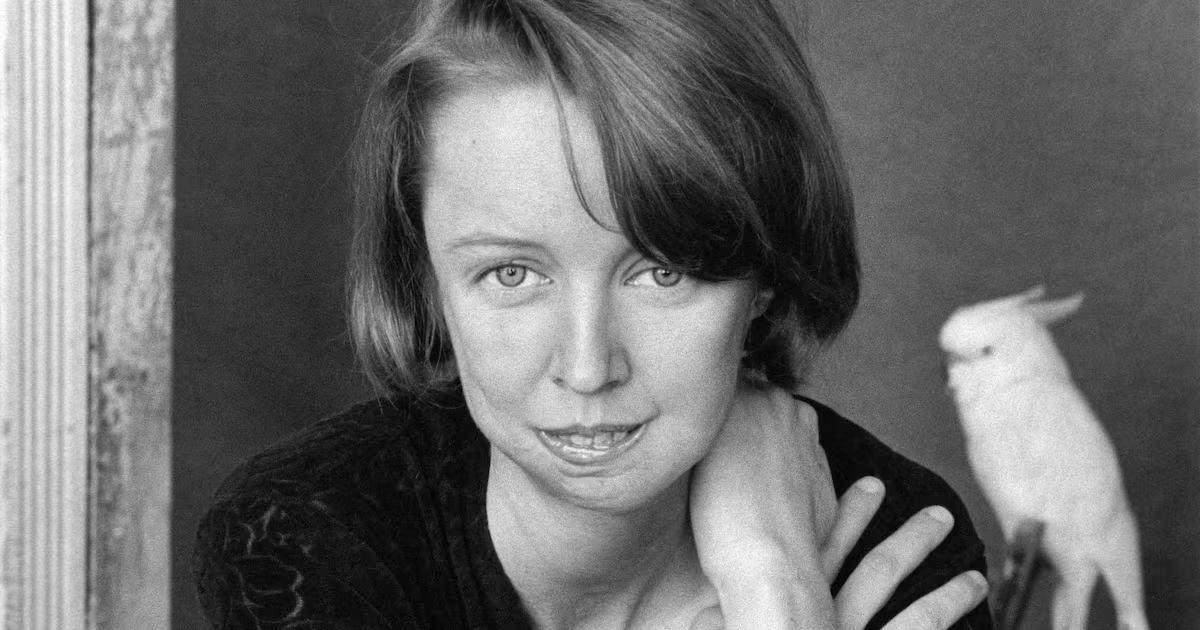
Autobiography of a Face Author: Lucy Grealy ISBN-13: 978-1399613880Publisher: Weidenfeld & NicolsonGuideline Price: £12.99Sometimes a book enters your life with such force that you wish you’d found it sooner. My teenage years were spent in and out of hospital having multiple surgeries and orthopaedic procedures. This landscape was filled with medical hardware: drains, casts, IV drips. The days were long, bookended by pain and boredom. Until I read Lucy Grealy’s Autobiography of a Face in my twenties, I had never seen the experience of hospital articulated so viscerally and with such accuracy. Our situations were not the same – Lucy’s illness, in complexity and duration, was far worse than mine – but the sense of recognition was powerful. Her writing resonated deeply on a personal level but also illuminated a way to write about – as I was trying to do – the body, the disruption of illness and the encapsulating fear that goes with it. Even as a hardened reader of bodily narratives, this book is not an easy read. Grealy is an immersive, unflinching narrator – pain rises off every page – and the reader feels her medical experience acutely.Lucinda Margaret Grealy was born in Dublin in 1963, one of five children. Her father, Desmond, a UCD graduate from Donegal, was head of news at RTÉ. Her mother Trena stayed home to raise Lucy and her four siblings. In 1967 the family emigrated to Spring Valley, New York, where Desmond worked in TV news for CBS and ABC. On arrival in the US, Lucy was teased about her accent but the family slowly acclimatised. Aged nine, a persistent toothache turned out to be Ewing’s Sarcoma, a rare bone cancer. Her lower jaw was removed and thus began a relentless, nightmare journey through years of surgery, self-consciousness and what she refers to as “the deep bottomless pit of grief called ugliness”. Inverting Oscar Wilde’s assertion that “A man’s face is his autobiography. A woman’s face is her work of fiction”, provides the indelible story of Grealy’s life. The gruelling treatment involved chemotherapy five times a week followed by radiation. The problem was that while this eradicated the cancer, it consistently dissolved most of her jaw. Over the next 18 years doctors made multiple attempts at facial reconstruction using grafts from her back, stomach and legs, but each time the graft would be reabsorbed by the irradiated tissue. The invasiveness of each procedure is horrifying enough, but the cyclical nature of dashed hope makes for even more difficult reading. Initially, Grealy enjoys the attention. Illness brings gifts and time off school, but the weeks soon roll interminably into one another. With time to reflect on this catastrophic event, Grealy begins to realise that her life – and her face – will never be the same: “This singularity of meaning – I was my face, I was ugliness – though sometimes unbearable, also offered a possible point of escape. It became the launching pad from which to lift off, the one immediately recognisable place to point to when asked what was wrong with my life. Everything led to it; everything receded from it – my face as personal vanishing point.”[ Friends indeedOpens in new window ]No other author writes more evocatively about the airlessness of hospital, the mundanity of pain and of discomfort itself. Grealy astutely captures the loneliness of a missed childhood; the sense of being in a friendless hinterland. Once, when her parents leave the hospital as she’s about to have a bone marrow test, she realises: “It was the moment when I understood unequivocally: I was in this alone.”School absences are frequent and prolonged, and when Grealy manages to attend, she is teased mercilessly (notably, only by boys, who call her “dog girl”). Her only source of solace is a part-time job taking kids for pony rides; but even that offers no escape from the burden of curious gazes. Children can be vanguards of a particular kind of cruelty, “almost startling in its precision”. Grealy learns diversionary tricks: looking down, using her hair as a curtain. These kinds of details haunt the book: she lies down in the rain hoping to get a fever and therefore miss chemo; winter and Halloween are her favourite seasons because it’s acceptable to wear a scarf or mask to hide the face. Always though, there is the recurring and painful realisation: “there was only the fact of me, my face, my ugliness.” Autobiography of a Face is a coming-of-age memoir. In parallel, it is an existential examination of the body, and of the inescapable state of solitude that illness is. You don’t need to have experienced sickness – and certainly not to have been as unwell as Grealy continuously was – to relate to what she endures. Because her illness begins as a child, Grealy has, until her teens, escaped objectification. The Damascene moment in every girl’s life when she realises she is being looked at, often through a lens of assessment and judgment; her body a site of examination and – if deviates from what is considered “normal” – of shame. When awareness of the male gaze hits Grealy, it’s followed closely by the more damning realisation that society prizes attractiveness, and that people who default from its narrow, heteronormative spirit level are often othered and excluded. The reader can only watch this dawning self-consciousness; the transformation of a girl once fearless when faced with multiple complex surgeries, to one who is so distressed by stares and hurtful remarks. In her teens and early adult years, men on the street catcall – until they see her face.At home, there are other issues. Illness, with its chaotic schedule, leads to reliance on her mother, a relationship that is both troubled and touching. Grealy’s mother warns her daughter not to cry in front of doctors but also tries to buy her a wig to hide her post-chemo baldness. When her father loses his job, which impacts on her healthcare coverage, there are fights over money and bills. Grealy feels guilty: “I was personally responsible for a great deal of my family’s money problems: ergo, I was responsible for my mother’s unhappy life.” Pre-Medicaid and the ACA (Affordable Care Act), the book is an infuriating account of navigating the US healthcare system as a patient. Inequality and materiality certainly impacted on Grealy’s care, an echo of what writer Anne Boyer calls “the capitalistic carcinogenosphere”, ie the uneasy alliance between money and medicine. At 18 Grealy enters Sarah Lawrence College and finally makes good friends. Here, she starts to write, declaring: “Poetry became a religion for me.” In 1987 she joined the prestigious creative writing MFA at the University of Iowa, where her roommate is future writer Ann Patchett (who later wrote a memoir, Truth & Beauty, about their friendship). There is much acclaim, many lovers, more bodily confidence, but still the persistent sense that all her problems – and future prospective happiness – is linked to one thing: “When my face gets fixed, then I’ll start living.”Despite these ingrained thoughts, Grealy taught at Bennington College and New School University. After college, Grealy moves to Europe, and while living in London her sister hears about a doctor offering pioneering tissue surgery in a Scottish hospital. It feels like a last throw of the dice. Weighing up the options, despite the years of disappointing results, she asks: “How could I pass up this chance to fix my face, fix my life, my soul?”Throughout decades of medical intervention, it’s striking that Grealy is never asked how she is personally. Doctors fixate solely on surgery, which becomes increasingly more macabre, and there is little sense of pastoral care. Autobiography of a Face was written long before the wider spread of medical humanities programmes and patient-centred care initiatives such as “Hello My Name Is”. This book is a vital for survivors of surgery, cancer and medical trauma, but it should also be required reading for all medical professionals.Grealy’s harrowing story might deter some, but her writing transcends the subject matter. As a poet her sentences sing and for a writer not known for fiction, the book feels very novelistic. Grealy knows how to tell a story in stark, musical prose. On its publication in 1994 it was a bestseller, published internationally and placed on high school and college curriculums. In an interview with People Magazine after publication, she deadpanned: “Great, I’m getting famous for being ugly.” Writing, or fame, was never enough, though. After further surgeries, Grealy became addicted to OxyContin and later heroin, and died in 2002 at just 39 from a heroin overdose. She had endured more than 30 failed surgeries, constant pain and a haunted self-reckoning. Through her deft, poetic words, she evoked the physicality of scars, of imperfection, the experience of hoping for a life, a face, that was out of reach. Grealy left behind a small body of work – Everyday Alibis, a chapbook of poems, and the 2002 essay collection, As Seen on TV: Provocations. Autobiography of a Face is a landmark in life writing and one of the most important patient narratives ever written. It’s an act of reclamation, both in how it lobbies for the sick to be heard, and as a tender, furious work of advocacy for those who have suffered. Sinéad Gleeson is the author of the essay collection Constellations: Reflections from Life and the novel Hagstone.Further readingThe Undying by Anne Boyer, the US writer on her experience dealing with triple-negative breast cancer in the American healthcare system.Mind on Fire by Arnold Thomas Fanning, a frank and gripping account of mental illness and recovery.The Cancer Journals by Audre Lorde, a non-fiction memoir about Lorde’s cancer diagnosis and how it intersected with her feminist, LGTB and race activism.Pain Woman Takes Your Keys, and Other Essays from a Nervous System by Sonya Huber. A broad-ranging memoir about pain and its universality. In Your Face by Lia Mills, a brilliant, probing work about a diagnosis of mouth cancer.
How Lucy Grealy created one of the most powerful patient narratives ever written
Autobiography of a Face details with visceral accuracy one woman’s experience of living with rare bone cancer
1,666 words~8 min read