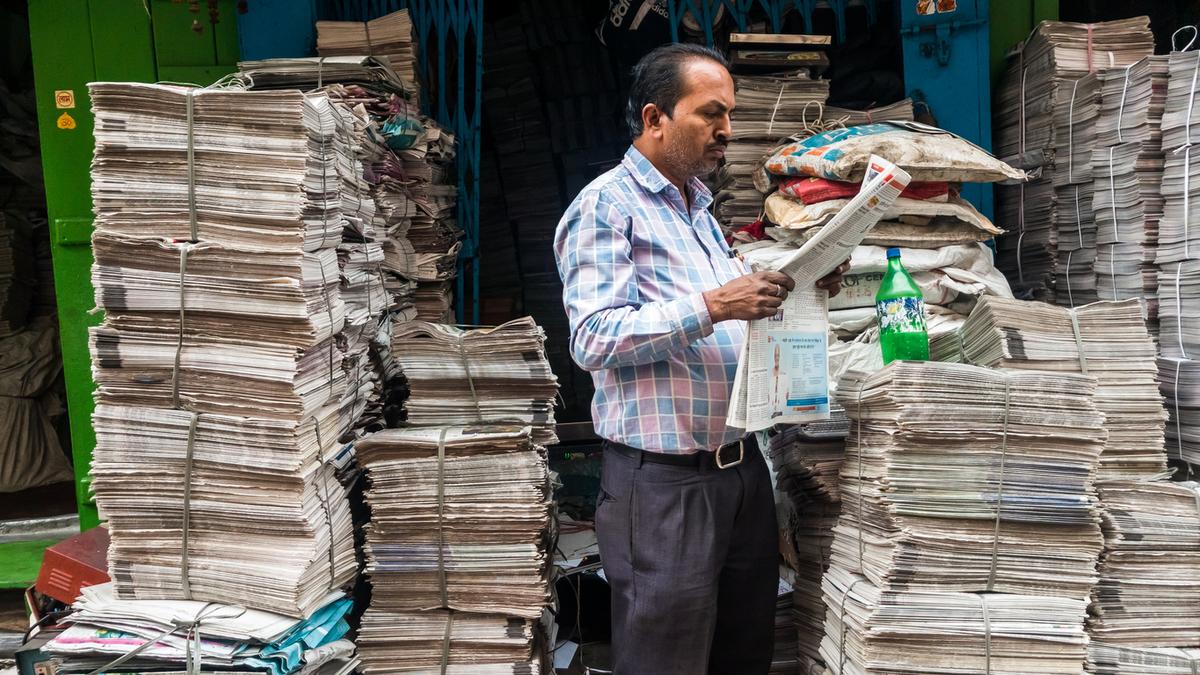
A store that buys old newspapers.
| Photo Credit: Getty Images
The 14-year-old mobile number that I had from college days has become oversubscribed with telemarketing calls, each pleasantly coercing me to buy a new credit card. Between their targets and my temptation, our motivations aligned with my wallet swelling up with colourful chips, each carrying its own grand cashback promise.Every purchase, physical or digital, has now became an exercise in permutation and combination in the pursuit of the elusive cashback promise. Some fetched 2%, others 5% or if I was in the mood, I would indulge the cards to compete among themselves to discover the best deal of 6%. By now, I had begun to take considerable pride in my ability of earning cashback for nearly every transaction. And I wasn’t alone. Cashback, after all, has become our generation’s most respectable collective obsession — tiny percentages capable of delivering disproportionately large happiness. But these days, I wonder whether cashback was even more lucrative before these colourful plastic chips entered our wallets. The 1990s kids, I suspect, may relate.We all grew up reading physical newspapers, and despite repeated predictions of their extinction, they continue to make way to our home with admirable discipline. Digital newspapers may save time, but the physical newspaper belonged to that rare category of products with immense “positive externalities”. Long after the news expired, the newspaper continues to contribute to household GDP: lining cupboards, assisting in kitchen operations, cleaning car mirrors, wrapping fragile items, and occasionally serving as emergency table mats. Its post-journalism career was remarkably diverse.Naturally, the economist in me feels obligated to acknowledge the environmental debate here, but for the moment, let us focus on cashback. Back in the 1990s, a Hindi daily cost roughly ₹2.5 a copy. A committed reader subscribing throughout the month — along with those gloriously overweight weekend editions — would comfortably accumulate nearly 2 kilograms of newspaper. The monthly bill may have been around ₹75 then, perhaps closer to ₹200 today, but unlike modern subscriptions, this one came with a surprisingly liquid exit option.Naturally, when it came to pay the newspaper bill, I reached for one of the many colourful chips in my wallet — specifically the one promising 5% cashback on utilities. In my head, I was overjoyed with the cashback of ₹10. Unfortunately, my newspaper vendor had not yet integrated himself with the technology around, I paid the full amount in cash. This continued for a few months before I was nudged towards a digital subscription carrying far more “lucrative” offers. I finally decided to dispose of my monthly 2-kilogram archive and visited a small raddi shop — the one untraceable with Google Maps. Here, finally, was the most efficient cashback transaction of my life. A five-minute negotiation — still considerably shorter than the time I routinely spent comparing credit-card offers — earned me ₹30 for old newspapers and another ₹5 for the cardboard box safeguarding my 2 kilogram archive. On a monthly newspaper bill of ₹200, this meant a neat 15% return, with a bonus 2.5% thrown in for good behaviour. No minimum spend, no redemption window, no suspense-filled waiting period for reward points to “reflect” in my account.We spend hours optimising digital payments for fractional cashback, carefully decoding terms and conditions often running into pages while the neighbourhood raddi shop quietly runs the finest reward systems ever designed. Yesterday’s news returns today’s money — immediate settlement, no questions asked. Perhaps value was never absent; it merely lacked a user interface. Somewhere in our enthusiasm and chase for glowing screens and fringe percentages, we may have underestimated the analogue efficiencies quietly operating around us. The cards in my wallet still promise smarter cashback every month. Yet the most efficient return I ever received came from selling old newspapers to a man who never once asked me to drop a five-star review.abhinav.banka@gov.in Published - June 21, 2026 04:46 am IST