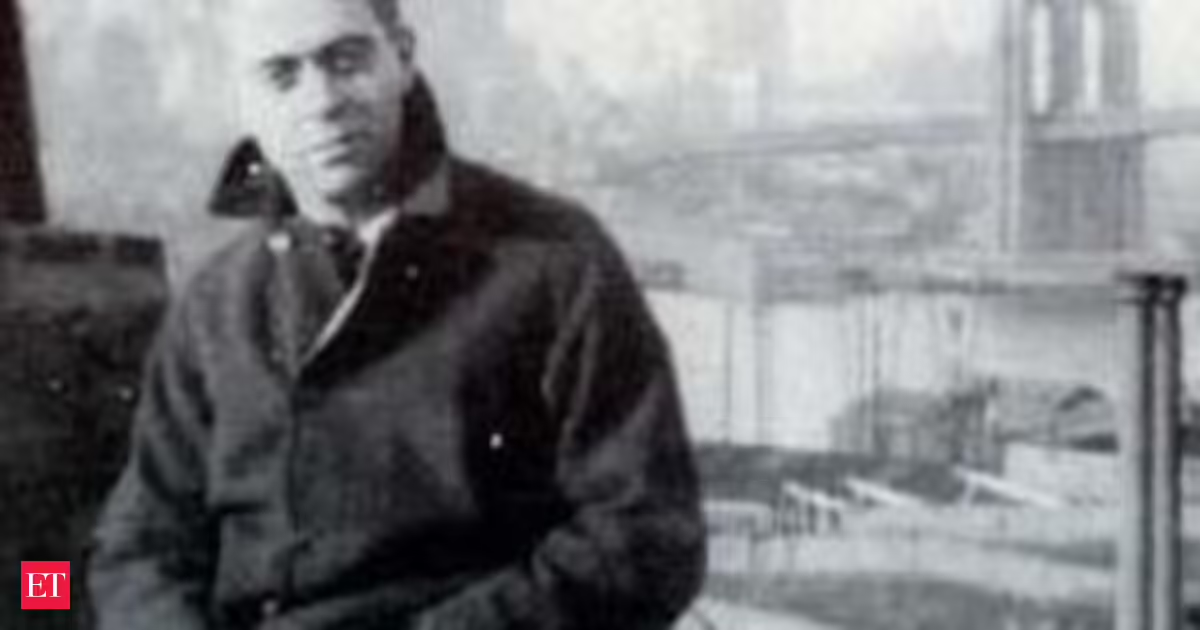
Quote of the day by Hart Crane: For anyone who has ever struggled to find the right words, writing can often feel both deeply rewarding and incredibly frustrating. Ideas may come easily, yet expressing them clearly and beautifully is another challenge altogether. Writers, poets, journalists, and storytellers frequently discover that strong writing rarely appears out of nowhere. Instead, it is shaped by years of reading, observing, listening, and engaging with language in all its forms. In an age dominated by short messages, fast content, and constant distractions, the value of immersing oneself in language can sometimes be overlooked. Quote of the Day: Hart Crane on Why Great Writing Begins With Immersion in WordsHart Crane said, "One must be drenched in words, literally soaked in them, to have the right ones form themselves into the proper pattern at the right moment," as per Goodreads.What Hart Crane's Quote MeansCrane's quote suggests that effective communication is not simply the result of talent or inspiration. Instead, it comes from constantly surrounding oneself with language. By being "drenched" or "soaked" in words, Crane implies that writers must read extensively, listen carefully, and remain engaged with language in everyday life.The quote also highlights the importance of preparation. The "right words" rarely appear by chance. They emerge naturally when individuals have absorbed enough language through reading, writing, and reflection. In this sense, strong expression is built gradually over time rather than produced instantly.Crane's observation extends beyond literature. Whether someone is writing an article, delivering a speech, or expressing personal feelings, language skills improve through regular exposure and practice. The more people engage with words, the more confidently and precisely they can communicate.You Might Also Like:Quote of the Day June 21: Why Reading Matters for Better WritingThe quote serves as a reminder that reading and writing are closely connected. Those who wish to write well often benefit from reading widely across different styles, genres, and perspectives. Exposure to diverse voices expands vocabulary, sharpens understanding, and helps individuals discover their own unique way of expressing ideas.Crane's words suggest that language becomes part of a person's inner life. When people immerse themselves in words, expression can become more natural, authentic, and meaningful. His insight teaches that great writing is rarely accidental. It grows from curiosity, practice, and a lifelong relationship with language.Who Was Hart CraneHart Crane was an American poet known for his visionary and imaginative poetry. Born on July 21, 1899, in Garrettsville, Ohio, he is best remembered for The Bridge (1930), an ambitious work that attempted to capture the American experience. Many of its individual poems are considered among the finest in 20th-century American literature, according to Britannica.Hart Crane's Early Life and InfluencesCrane grew up in Cleveland and was deeply affected by his parents' troubled marriage and divorce. Mostly self-taught, he worked various jobs before settling in New York City in 1923, where urban life strongly influenced his writing.You Might Also Like:He drew inspiration from writers including Walt Whitman, Ralph Waldo Emerson, T.S. Eliot, Percy Bysshe Shelley, and James Joyce, as per the Britannica report.Hart Crane's Major Works and LegacyCrane's first poetry collection, White Buildings (1926), included "For the Marriage of Faustus and Helen." He later completed The Bridge, inspired in part by the Brooklyn Bridge.In 1931, he received a Guggenheim Fellowship and traveled to Mexico, where he wrote "The Broken Tower." Crane died in 1932 at the age of 32 during his voyage back to the United States, as per the Britannica report.Famous Quotes by Hart CraneHere are a few more quotes by Hart Crane.You Might Also Like:“Love: a burnt match skating in a urinal,” as per Goodreads.“O sleepless as the river under thee, / Vaulting the sea, the prairies' dreaming sod, / Onto us lowliest sometime sweep, descend / And of the curveship lend a myth to God,” as per Goodreads.“There are no stars tonight but those of memory,” as per Goodreads.“It is as though a poem gave the reader as he left it a single, new word, never before spoken and impossible to actually enunciate, but self-evident as an active principle in the reader’s consciousness henceforward,” as per Goodreads.
Quote of the day by Hart Crane: 'One must be drenched in words, literally soaked in them, to have the right ones form...' - The Brooklyn Bridge and White Buildings' poet revealed the one habit that can make you a great writer
Quote of the day by Hart Crane: Explore Hart Crane's insights on the importance of being immersed in words for effective writing. Discover how reading and engagement with language shapes expression and creativity.
684 words~3 min read