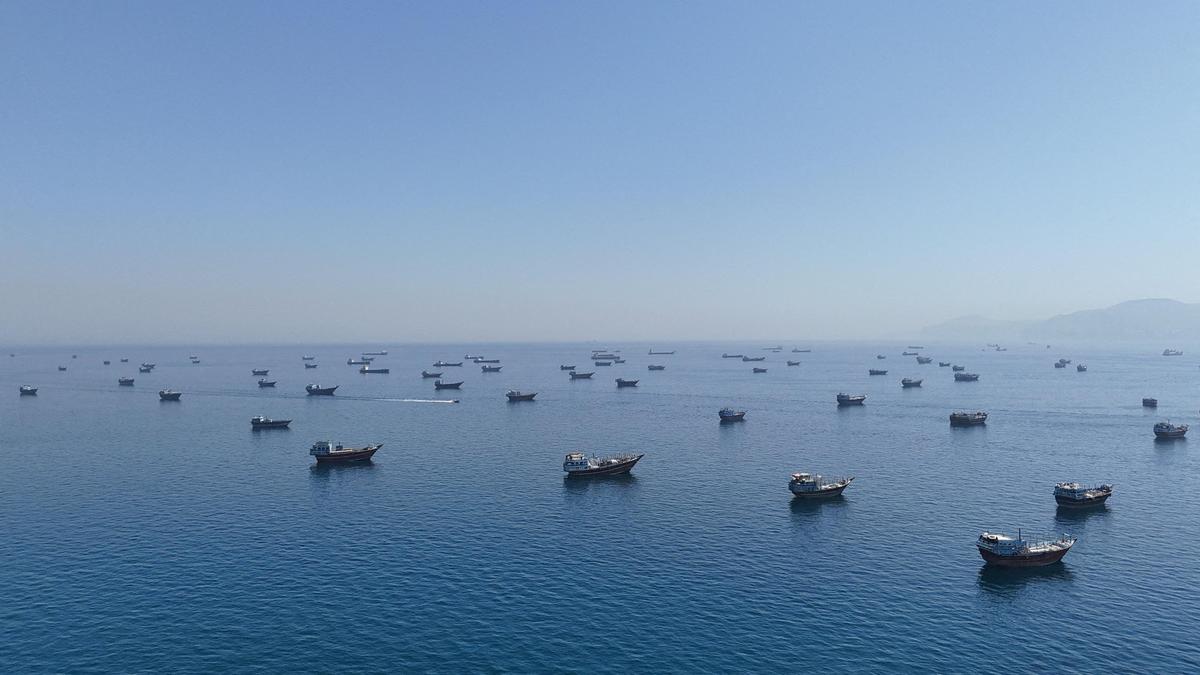
Of the 488 vessels deployed on these routes before the conflict, only 18 remain in the region today, while 470 ships have been diverted across global networks.
| Photo Credit:
Amirhosein Khorgooi/ISNA
The disruption to global shipping caused by the West Asia conflict has sent container freight rates soaring across major trade routes, including lanes that do not directly transit the Strait of Hormuz, underscoring the ripple effects of the crisis on global supply chains.According to data from Xeneta, the Denmark-based ocean and air freight intelligence platform, spot rates from the Far East to the US West Coast rose 192 per cent between February 28 and June 19, increasing to $5,493 per forty-foot equivalent unit (FEU) from $1,879.Rates from the Far East to the US East Coast climbed 158 per cent to $6,850 from $2,652, while those from the Far East to Europe more than doubled, rising 106 per cent to $4,572 from $2,200. In these important trade lanes, Indian cargo is sent through large mother vessels.The pace of increase has accelerated in recent days. In the past week alone, rates jumped 29 per cent on the Far East-US West Coast route and 25 per cent on the Far East-US East Coast route, said Peter Sand, Chief Analyst at Xeneta.“Spot rates will keep climbing for as long as the Strait of Hormuz is not fully open,” Sand said. “That could be four more weeks or longer depending on how complex the de-mining operation turns out to be. Shippers should plan for a peak around the point the strait formally reopens, followed by a gradual easing.”Xeneta’s analysis highlights the scale of disruption. Before the conflict, 99 container services operated in or transited the Arabian Gulf, deploying 3.2 million TEUs, or about 10 per cent of the global container fleet. Following the blockade, only 11 services remain active, representing a total of just 74,000 TEUs of capacity. Of the 488 vessels deployed on these routes before the conflict, only 18 remain in the region today, while 470 ships have been diverted across global networks.Wait & watchIndustry experts believe freight markets will remain elevated even after shipping resumes through Hormuz.“The reopening of Hormuz removes a major risk to global container trade, but freight rates are unlikely to revert to February 2026 levels anytime soon,” said Jagannarayan Padmanabhan, Senior Director and Global Head-Consulting, Crisil Intelligence. Elevated insurance costs, network rebalancing requirements and continued diversification of cargo routing will keep logistics costs above pre-crisis levels, he added.According to J Krishnan, Partner at S Natesa Iyer Logistics LLP, the Indian container trade remains heavily dependent on foreign shipping lines. “For supply chain efficiency to bounce back, Suez transit is vital. The opening of Hormuz if it sustains is the first step to the Suez route normalisation,” he said, adding that war-risk premiums would decline only gradually as confidence returns.Sand said that even under a best-case scenario, global shipping networks may not fully recover until mid-September. “Even if the ceasefire holds, around 10 per cent of global container shipping capacity is impacted by the blockade and freight rates are spiralling across major trades. This scale of disruption and market volatility cannot be reversed overnight.”For India, the significance of the US-Iran agreement lies less in the reopening itself and more in the prolonged lag between reopening of the strait, gulf ports and normalization in the trade lane. Indian exporters surely will hope that any breakthrough would quickly ease freight pressure, but in reality the opposite happens such as vessel dislocation, equipment shortages and higher freight rates which are likely to continue in the upcoming months as well, said Vivek Raja of Pearl Shipping, Thoothukudi.India’s container trade is closely linked to the same East-West networks that have absorbed the shock of the Hormuz disruption. Even though Indian cargo is not entirely dependent on Gulf calls, Indian shippers will continue to face higher transportation costs, longer lead times and tighter vessel space until carriers fully restore network balance. The major news for Indian trade is that the agreement removes a geopolitical risk, but it does not immediately remove the commercial consequences of four months of supply chain disruption as the ripple effect will continue to have its own impact before it subsides, he added.Published on June 20, 2026