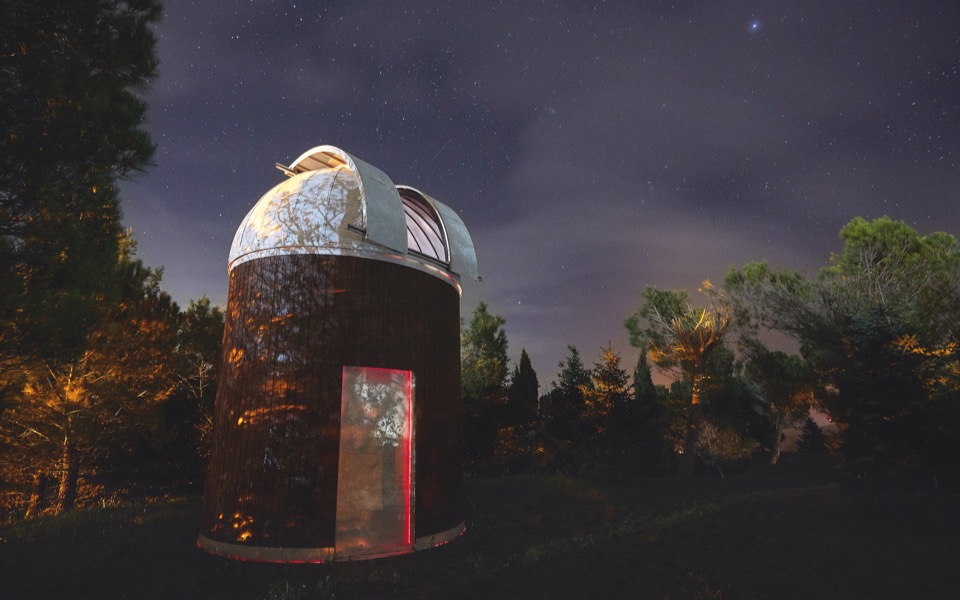
We switch off the flashlights on our phones and sit as still as we can as the dome rotates until its opening reaches the patch of sky where we can observe the Orion Nebula, or Messier 42 (M42). Dimitris and Konstantinos ask us to be patient and hold our positions a bit longer while our eyes become accustomed to the darkness and we get our bearings. A mechanical sound breaks the silence; it’s the buzz of the robotic mount holding the telescope.
We are not at Greece’s famed observatories on Mount Penteli or Thiseio in Athens; we are in Asea, a small village in the central Peloponnese, just a few kilometers southwest of Tripoli. One of a handful of private observatories in Greece, it has stood on a hill just outside the village since July 2017. The facility was not built for research, but to introduce the public to the sciences of the skies above. Dimitris Dimopoulos and Konstantinos Anastasiou are among the founding members of the Asea Association of Astrophysics, Astronomy and Engineering, which built the observatory and is responsible for running it.
Amateur astronomers
What is Asea’s connection to astrophysics and astronomy? There isn’t one – at least not until a group of youngsters spending their summers in their ancestral village started meeting up to watch the starry sky.