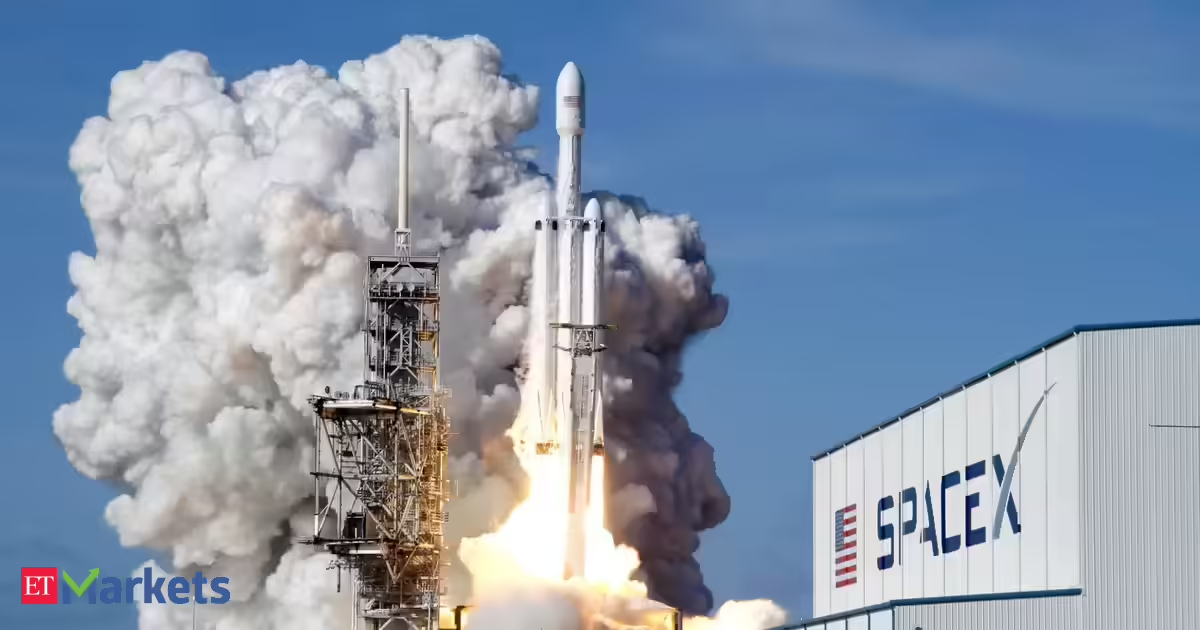
After Elon Musk's SpaceX completed its market debut, veteran valuation expert Aswath Damodaran has warned that the company’s soaring valuation rests heavily on uncertain assumptions around artificial intelligence (AI), even as its core businesses remain relatively niche.“If you look at SpaceX, it started as a space launch business… but even after they got their feet on the ground, it’s not a big business,” Damodaran said, noting that despite its technological edge, the market for satellite launches remains limited.The real shift, he argued, came with the addition of Starlink and, more recently, AI ambitions following the integration of xAI. “That business is now at the core of the revenue… but if you stop right there, this would be a very good business, but it would be a niche business,” he said.The comments came as SpaceX debuted on Nasdaq in the largest IPO ever. The stock opened at $150 under the ticker SPCX, 11% higher than its IPO price of $135. The company’s valuation has already crossed the $2 trillion mark, making it more valuable than Musk's automotive company Tesla, which was worth about $1.2 trillion.The trillion-dollar narrative, according to Damodaran, is driven almost entirely by AI. “The market is huge… that’s what’s driving the trillion, 2 trillion, 2.5 trillion pricing. But the business is really not a business yet,” he cautioned.Its Starlink satellite communications network offers internet service to individuals and organisations, with more than 9,500 satellites deployed since 2019 to service more than 9 million users globally. Starlink generates 50%-80% of SpaceX's revenue, per a report by Reuters in April.Concerns surrounding AIDamodaran highlighted fundamental concerns around AI economics, pointing to high costs and weak margins. “The unit economics right now are not great… it’s going to stay, in my view, a low gross margin business because of the nature of the business,” he said. He added that high-end AI services remain prohibitively expensive, making scalability uncertain.SpaceX acquired xAI in a transaction that valued SpaceX at $1 trillion, and xAI at $250 billion, according to Reuters.xAI reportedly posted a net loss of $1.46 billion for the September quarter, compared with a loss of $1 billion in the previous three months. Revenue nearly doubled sequentially to $107 million in the period ended September 30, 2025.Mounting pressures for SpaceXHe also flagged a strategic contradiction in SpaceX’s approach. “We’re going to compete… win a significant market share of the AI market. But in the same breath, you’re also saying we’re renting out space in our data centres to our biggest competitors,” he said, calling it a tension that “will have to gel”.More broadly, Damodaran cautioned investors against equating growth with value. “We make this mistake of assuming growth is always good… growth with huge reinvestment and substandard margins… might not just be neutral to value but actually be value destructive.”Ultimately, he stressed that even the most compelling narratives must align with financial reality. “The best investment stories still have to connect to the numbers,” he said.SpaceX’s listing also made Elon Musk the world’s first trillionaire, with the Bloomberg Billionaires Index estimating his net worth at roughly $1.05 trillion.
SpaceX valuation hinges on uncertain AI economics, says Professor Aswath Damodaran - The Economic Times
SpaceX's massive market debut, reaching a $2 trillion valuation, is largely fuelled by AI ambitions, according to valuation expert Aswath Damodaran. While Starlink contributes significantly, he cautions that the AI business is nascent with uncertain economics and high costs. Damodaran warns against equating growth with value, emphasising that even compelling narratives must align with financial realities for sustainable investment.
SpaceX's $2 trillion IPO valuation is almost entirely driven by AI (xAI acquisition), despite core businesses (launch, Starlink) being niche. Damodaran warns xAI has poor unit economics ($1.46B quarterly loss, low margins) and strategic tensions (competing in AI while renting to competitors)—growth divorced from financial reality.