This Week in Science: A world first, a strange human pattern, and much more!We start with something you might do every day without much thought: walking.It turns out humans may not move quite as randomly as we assume. Across multiple experiments in Spain and Japan, researchers discovered a measurable preference for turning in one specific direction.Also, physicists have built the world's first working nuclear clocks, powered not by electron transitions but by changes within atomic nuclei.What makes this news even more exciting is that it has been achieved twice, by two independent teams of scientists, in Europe and China.The new devices do not yet outperform the best atomic clocks, but they show that nuclear clocks are no longer just a theoretical dream.And in a powerful medical breakthrough, a brain implant has allowed a man with severe ALS to communicate in a digital version of his own voice.Watch the video below for all the details, and read on for even more in science news!
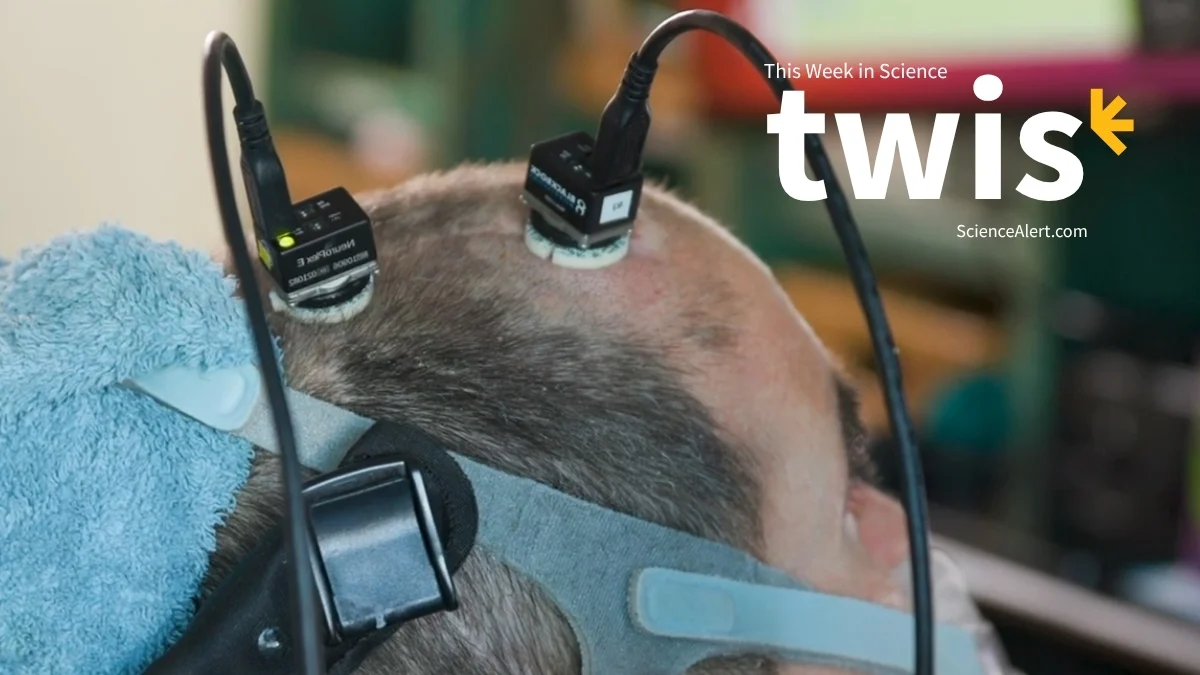
Scientists Discover a Strange Global Pattern in The Way Humans WalkA still image from one of the experiments, showing the position of people (red dots) and recent movement (the orange lines). (Echeverría-Huarte et al. CC-BY-ND)A surprising pattern has emerged in the way humans move through space.In experiments across different countries, settings, and age groups, researchers found that people showed a modest but statistically significant preference to turn counterclockwise."This was completely unexpected," says engineer Claudio Feliciani.A tendency for us to go left rather than right might sound like a minor quirk, but the finding could eventually help design public spaces, manage crowds, and plan emergency evacuation routes.The cause of this bias remains uncertain, though the researchers have some ideas.Read the full story here.Success! Physicists Build The World's First Clocks Powered by Atomic Nuclei(koto_feja/Getty Images)Atomic clocks are already some of the most precise devices humanity has ever built. Now physicists have taken a major step beyond them.Two independent teams have built working clocks based on the energy shifts of atomic nuclei, using thorium-229.Unlike ordinary atomic clocks, which track electron transitions, nuclear clocks track changes deep within the atom's nucleus.That could make them less vulnerable to outside interference and useful for phenomena such as investigating dark matter and possible changes in fundamental constants.Read the full story here.Brain Implant Lets Man With Severe Paralysis Speak in His Own Voice AgainCasey Harrell using a brain-implant interface, with his wife and daughter nearby. (UCD)Casey Harrell has an advanced form of amyotrophic lateral sclerosis (ALS), which makes his natural speech very difficult for others to understand.For nearly two years, he has used a continuously running brain-to-text decoder, allowing him to express more than 183,000 sentences and close to 2 million words.The system detects brain activity when Harrell tries to speak. His thoughts can then be verbalized in a digital voice designed to sound like his own.The technology lets him continue working, and, perhaps most importantly, communicate with his loved ones.The outcome has been life-changing, and we know that because Harrell has told us so.Read the full story here.Geologists Went Looking For Gold. They Found Something Far Rarer.(Alberfb/iStock/Getty Images Plus)When geologists went looking for gold in Western Australia, they found a different kind of treasure.Hidden beneath the desert, the researchers uncovered signs of an ancient meteorite impact that was powerful enough to melt rock, deform crystals, and blast gold-bearing debris into the air.The buried structure, temporarily named Ora Banda, is especially rare. It's only the second confirmed impact structure known to have formed entirely within Archaean greenstone, some of Earth's oldest rock formations.Time erases many impact scars, so the discovery could help scientists better understand how to spot ancient collisions that are almost invisible at the surface.Read the full story here.Scientists Finally Discover How Venus Flytraps Snap Shut So Fast Venus flytraps (Dionaea muscipula) can act fast enough to catch flies. (marcouliana/iStock/Getty Images Plus)Venus flytraps do something plants are not supposed to be good at: Move fast.Now scientists say they have identified how the famous carnivorous plant snaps shut quickly enough to trap insects and arachnids.The key appears to be rapid softening in the cell walls of the trap's outer skin. That lets the outer surface expand more easily than the inner surface, bending the leaf until it reaches a tipping point and snaps closed.The discovery could lead to new kinds of soft, bioinspired devices. It also raises a bigger evolutionary question.Read the full story here.Scientists Identify 2 Distinct Subtypes of Autism in The Brain(Discovery Access/Getty Images) Autism varies widely from person to person, and researchers trying to understand its complexity may have just had a breakthrough.A new study involving both humans and mice has identified two brain-based subtypes of the neurodevelopmental condition.One subtype was linked to reduced brain connectivity and genes involved in the junctions that allow brain cells to communicate. The other was linked to increased brain connectivity and immune-related genes.The findings do not capture every aspect of autism. But if the subtypes can be confirmed, they might help us move away from a one-size-fits-all approach.Read the full story here.