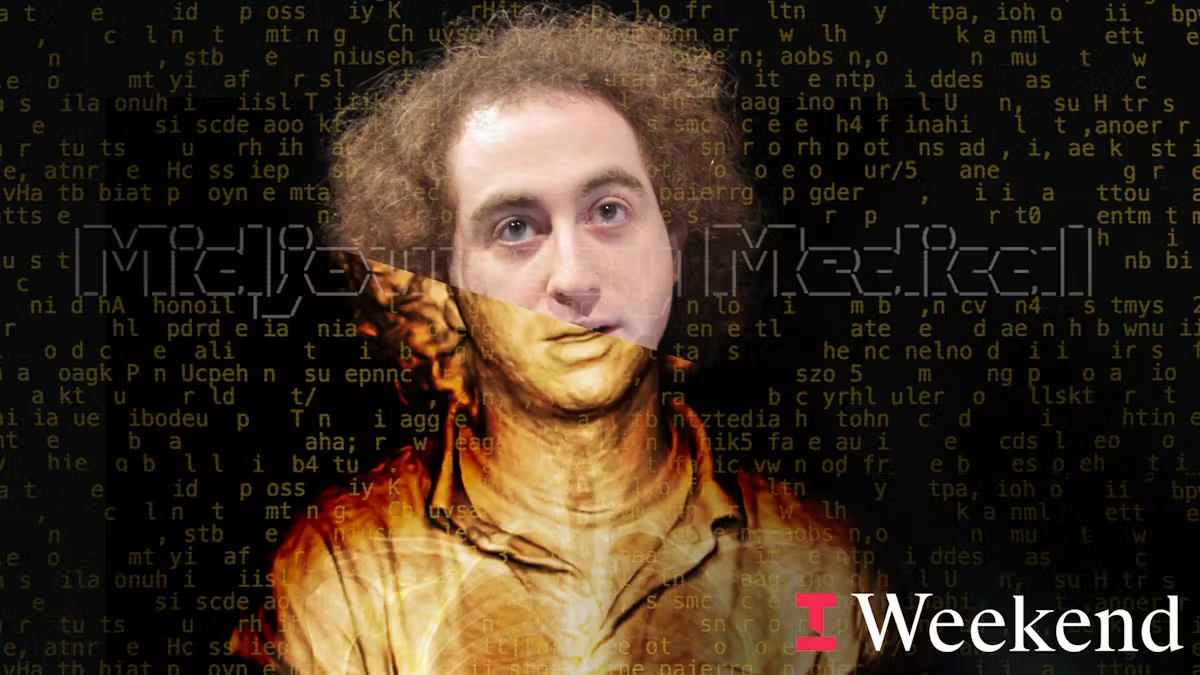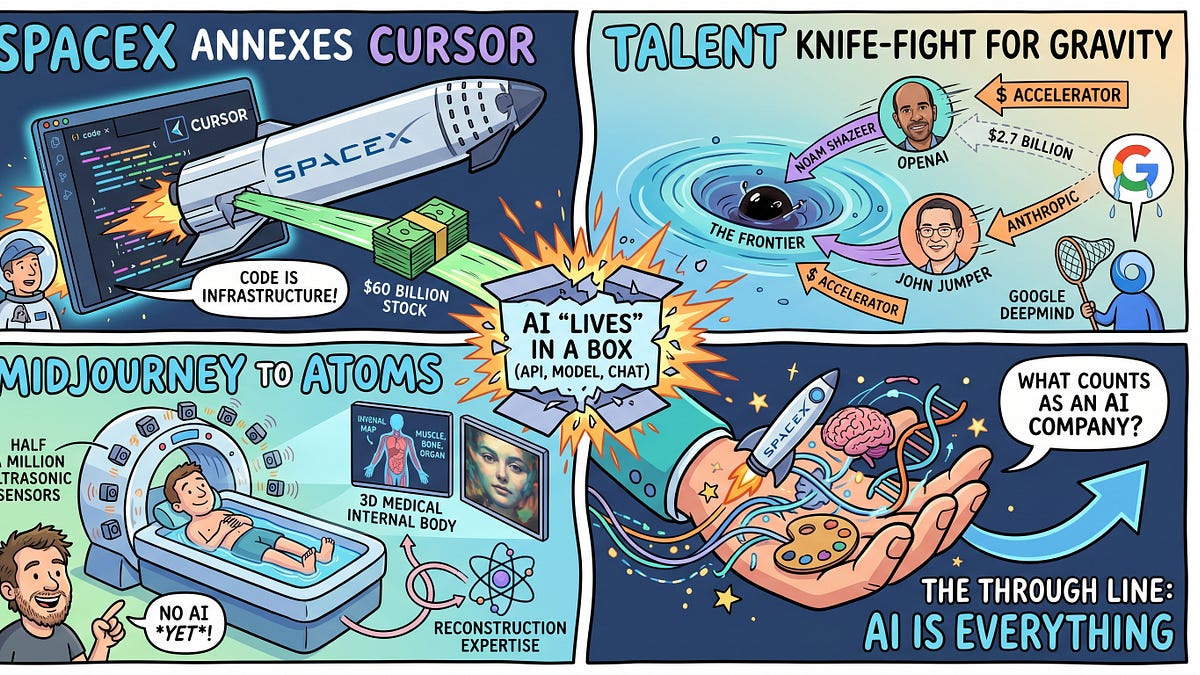
We start a new series about distillation where we are going to cover all the cool techniques in the space. In the AI of the week, we are going to cover Alibaba’s new models for robotics. The opinion section, I would like to dive into this fascinating concept of self-driving labs. I keep a mental map of where AI “lives.” For most of the last decade it lived in a box: a model, an API, a chat window. This week the box broke open in four directions at once, and the interesting part is that none of the breakouts rhyme with each other. They only rhyme structurally.Start with the one that reads like a typo. SpaceX agreed to acquire Cursor for $60 billion in stock. Sit with the category error for a second. A rocket company is buying a code editor. The clean story is that SpaceX absorbed Cursor to feed its struggling xAI division, but the deeper signal is that AI tooling has become strategic infrastructure on par with launch capacity. Industrial conglomerates no longer partner for AI; they annex it. When the people who build reusable rockets decide that an autocomplete-for-engineers is worth the GDP of a small country, the implied claim is that the model layer is now load-bearing for everything else.Then the talent map redrew itself in 48 hours. Noam Shazeer—co-author of “Attention Is All You Need,” the paper every one of us has read until the margins are gray—left Google for OpenAI. A day later John Jumper, who shared a Nobel for AlphaFold, left Google DeepMind for Anthropic. Google paid roughly $2.7 billion two years ago to bring Shazeer back. That is the part worth dwelling on: acqui-hires buy retention windows, not loyalty, and when the window closes the most valuable asset simply walks out the door. The frontier is consolidating into a two-body problem, and the bodies are not the ones with the most compute. They are the ones with the most gravity for researchers. Talent, it turns out, is the scarcest accelerator.And then there is Midjourney, which decided that text-to-image was insufficiently ambitious and announced a full-body medical scanner. Lower a person into a pool ringed with half a million ultrasonic sensors, fire sound through them from every angle, reconstruct a 3D map of muscle, fat, bone, and organ in—eventually—sixty seconds. They call it ultrasonic CT. Holz cheerfully noted there is no AI in the imaging pipeline yet, which is the most honest sentence in the announcement. The prototype takes twenty minutes and has scanned about a dozen people. Treat the sixty-second, fifty-thousand-scanner figure as a North Star, not a spec sheet. But the move is the message: a generative-image lab now believes its reconstruction expertise transfers to atoms.Here is the throughline. For years we argued about which company would win AI. This week the more interesting question quietly replaced it: what counts as an AI company at all? A rocket builder, two model labs in a talent knife-fight, an image startup reaching into your body. The substrate is leaking out of the box—into hardware, into biology, into the cap tables of firms that build physical things.Let’s dive in. AI Lab: OpenAI and Tacit LabsSummary: LifeSciBench introduces a dataset of 750 expert-authored tasks designed to rigorously evaluate language models on practical, real-world life science workflows rather than simple factual recall. Although GPT-Rosalind achieved the highest performance among evaluated models with a 36.1% task pass rate, the benchmark remains far from saturated, highlighting its utility as a high-resolution tool for measuring scientific reasoning.AI Lab: Unspecified (Shaoqiu Zhang et al.)Summary: FastContext introduces a specialized, on-demand exploration subagent that separates repository exploration from code solving to preserve token budget and reduce context pollution (Zhang, n.d.). When integrated into coding agents, it improves end-to-end resolution rates while significantly reducing token consumption with only marginal overhead (Zhang, n.d.).AI Lab: Qwen TeamSummary: Qwen-RobotWorld presents a language-conditioned video world model for embodied intelligence that uses natural language as a unified interface to predict future visual trajectories across various robotic and navigation tasks (Zhang, n.d.). This unified approach enables synthetic data generation, scalable virtual environments, and language-guided planning for downstream control (Zhang, n.d.).AI Lab: FAIR at Meta, Columbia University, Mila Québec AI Institute, McGill University, and Université de Montréal Summary: Discriminator-Guided RL (DRL) corrects structural failures in flow- and score-matching models by utilizing a discriminator in a pretrained representation space to estimate the density ratio between data and base-model distributions. This logit serves as a reward without needing human preference data, successfully reducing the distributional gap across various architectures to yield sharper, more coherent image generation.Alibaba released three new foundation mdoels for embodied intelligence. Liquid AI released two multilingual retrieval models for effective searches across 11 languages. Gemini co-lead and “Attention Is All You Need” co-author Noam Shazeer is leaving Google for OpenAI less than two years after Google reportedly paid $2.7B to bring him back via the Character.AI deal, with Sam Altman publicly welcoming the hire.Inference startup Baseten is reportedly close to raising a $1.5B round at a $13B valuation (split-priced, with some investors at $11B), just five months after its $300M Series E.Medal spinout General Intuition, which builds world models that teach agents spatial-temporal reasoning, is in talks to raise ~$300M at a ~$2B valuation, with backers reportedly including Jeff Bezos and Eric Schmidt.World-model lab Odyssey raised a $310M Series B at a $1.45B valuation led by Natural Capital, naming AWS its preferred cloud provider and committing to Trainium chips.Pramaana Labs raised a $27M seed led by Khosla Ventures to apply formal verification (LEAN-style proofs) to high-stakes AI domains like tax, law, and drug discovery.SpaceX agreed to acquire AI coding startup Cursor for $60B in stock to bolster its xAI-based AI division, with the deal expected to close in Q3.India’s Sarvam became the country’s newest AI unicorn after raising a $234M Series B first close at a $1.5B valuation (of a planned $300M), led by a $150M strategic investment from HCLTech.Nobel laureate and AlphaFold lead John Jumper is leaving Google DeepMind after nearly nine years to join Anthropic (following a break).Swiss startup Prem AI, which runs AI models on customers’ own private/air-gapped infrastructure for hedge funds and law firms, is raising a $100M Series A targeting a $500M+ valuation, expected to close in Q3.Midjourney unveiled “Midjourney Medical” and the Midjourney Scanner, a full-body “ultrasonic CT” device (built on licensed Butterfly Network chips) that CEO David Holz claims will eventually image the whole body in 60 seconds.No posts
The Sequence Radar #880: Last Week in AI: A $60B Cursor Deal, Google's Brain Drain, and Midjourney's Body Scanner
A week of really unexpected turns in the AI market.
TL;DRAI
SpaceX acquired Cursor for $60B, elevating AI tooling to strategic infrastructure. Google lost Attention co-author Shazeer to OpenAI and AlphaFold laureate Jumper to Anthropic within 48 hours—talent is the scarcest accelerator, concentrating around two frontier labs.
1,078 words~5 min read