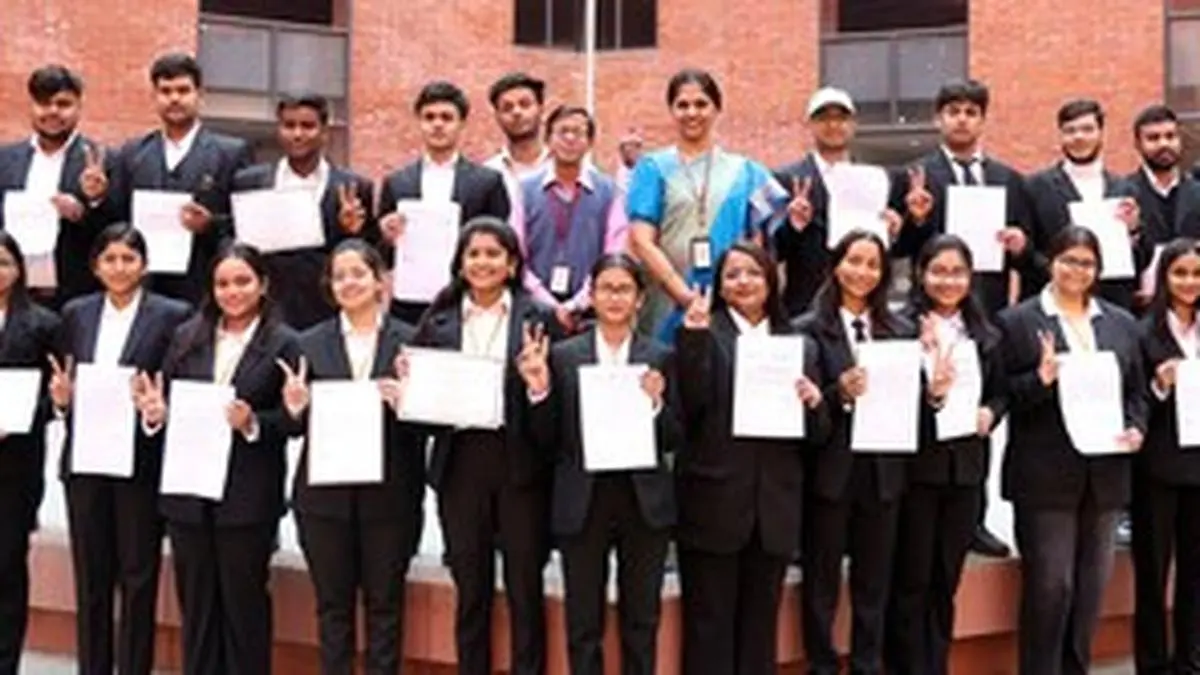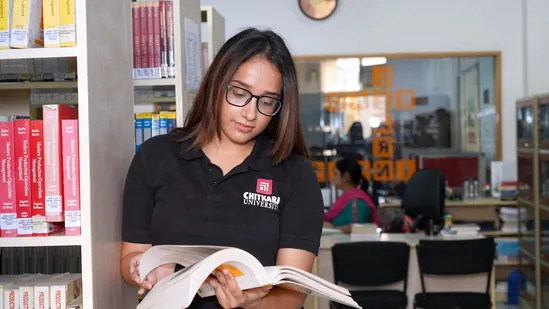
Every year, lakhs of humanities students prepare for competitive examinations. But what happens if they do not clear them? The real question is whether colleges are preparing them for careers beyond the examination at all.Chitkara University offers a BA programme in public policy and governance, developed in knowledge partnership with ALS IAS, one of India’s most recognised civil services mentoring institutions. (Photo: HTCS)Consider what the country asks of its most driven young people. It tells them to learn the Constitution, the budget, the welfare system, the history of the republic and the ethics of public life. Then it sets things up so that, unless they clear one examination that almost everyone fails, the job market treats all of that knowledge as if it were worth nothing. Lakhs of students join the queue anyway. They are neither foolish nor lazy. They are responding sensibly to a country where a government job still means security, respect and a salary that the private market rarely offers an arts graduate. The problem is not their choice. It is that we have left them no other door.The shortage is not of drive. It is of well-designed pathways through which drive becomes productive work. At the undergraduate level, Arts is the single largest stream in Indian higher education, forming its broad base rather than a marginal corner. Yet many humanities degrees remain only loosely connected to the careers students eventually hope to pursue in governance, policy, research, consulting and development. The result is a generation that leaves college with a degree but without a clear professional identity.The quiet cost of ‘preparing’Listen to the language families use, because it tells the real story. The son is not unemployed; he is preparing. The daughter has not left the job market; she is studying for the IAS. The words are gentle, and that is the danger, because they hide a cost. Three to five years slip by quietly. By the time many aspirants step out of the cycle, their classmates have accumulated work experience, internships, skills and contacts — the kind of assets that grow in value over a career.And the gate is narrow by design. Every year, the civil services examination draws lakhs of candidates for roughly a thousand vacancies, and only a tiny fraction make it through. This is not an argument against the examination itself. A democracy needs a serious and fair way to choose its senior officers. The argument is about 99 out of every 100 who do not succeed, and what the system does with everything they have learned.This is, at heart, a failure of translation. The aspirant genuinely learns a great deal about the state, the economy, welfare, rights and the wider world, but India has locked that knowledge inside a high-risk lottery, where it counts for something only if the examination is cleared. Knowledge has not been turned into skill, and skill has not been turned into a job.A degree is no longer enough on its ownThe wider evidence makes the concern sharper. Educated young people now make up a growing share of those looking for work, and a degree on its own no longer guarantees a place in the job market. This is especially true for the humanities, which in most colleges remain heavily focused on theory and examinations.Political science teaches the state but not how policy is implemented. Sociology teaches inequality but rarely how to design a field survey. Economics teaches models but often leaves students uncomfortable with real data. Public administration teaches how bureaucracy works but not how to manage a programme at the district level. The answer is not to abandon the humanities, which India needs more than ever. It is to make them practical.Three questions a good degree must answerA well-designed degree should answer three questions, not one: What can the student understand? What can the student actually do? And where can the student work if the examination route does not work out? Most degrees answer only the first.Here, a real experiment is worth more than a long argument, and one is now underway. Chitkara University offers a BA programme in public policy and governance, developed in knowledge partnership with ALS IAS, one of India’s most recognised civil services mentoring institutions. The programme places civil services preparation within a proper credit-bearing degree rather than leaving it to a separate and informal coaching.The preparation is woven into a full degree covering governance, the Constitution, administration, history, society, the economy, ethics and public policy. Examination readiness is treated as one outcome of a good education, not as a replacement for one.What makes the Chitkara University programme interesting is that the skill itself is taught and graded, rather than left to luck. A student writing answers every week learns how to build a clear argument. One drafting policy notes learns how to communicate in the language of government. The work is assessed, mentored and improved through steady practice and feedback, which is the only way real competence is built. Because the university’s assessments are aligned with the realities of civil services preparation, the degree and the preparation move forward together.Careers go far beyond the IASThe strongest part of the case rests on a simple fact about the governance economy: it is growing well beyond the IAS. Graduates in public policy and governance today find opportunities across policy consulting firms, think tanks, development organisations, CSR teams, legislative research bodies, governance technology companies, public affairs divisions and public-sector projects.A graduate who can read a budget, work with data, write a clear report and hold their own in the field is employable whether or not they clear the UPSC.This is where a degree of this kind earns its value. A student who spends three years at Chitkara University learning to think about justice, power and institutions, while also learning to draft, analyse, evaluate and communicate, leaves with two things at once. They leave prepared to attempt the civil services with discipline behind them and equipped with skills that the wider world of policy, research and public management actually pays for. The aspiration remains intact, but the downside shrinks considerably.A word of caution is necessary, and it applies to every programme of this type. Such a degree must never become coaching dressed up with a respectable label. The promise holds only under three conditions: the curriculum must remain academically rigorous, the practical training must remain genuinely practical, and every student must receive proper career guidance beyond the UPSC from the first year. The real test is not the brochure. It is where the graduates actually end up.Redesigning ambition, not reducing itThis dissolves a tired old choice. The idea that one must choose between a liberal education and a useful one is false. The best public policy education is both. It teaches young people to reason about fairness, power and institutions, while also teaching them to write, analyse, deliver, evaluate and communicate. A large democracy is not served by a thin layer of officers alone. It needs a wide base of public-minded professionals who can make institutions actually work.The real reform, then, is not to lower ambition but to redesign it. A young Indian who wants to serve the country should not have to choose between a degree without skills and coaching without a degree. A programme such as the BA in public policy and governance at Chitkara University points to a sensible middle path — one that keeps the dream of public service alive while removing its all-or-nothing risk.That is the direction Indian higher education needs to take in the coming decade: from humanities as passive knowledge to humanities as public action, and from a certificate that merely proves something to an education that expands what a young person is actually free to do.The author of this article is dean, economics and data science, Chitkara Business School. (*Partnered content)
India doesn't have an ambition problem; it has a translation issue
Chitkara University's innovative BA in public policy merges academic learning with civil services training, equipping students with necessary skills
1,305 words~6 min read