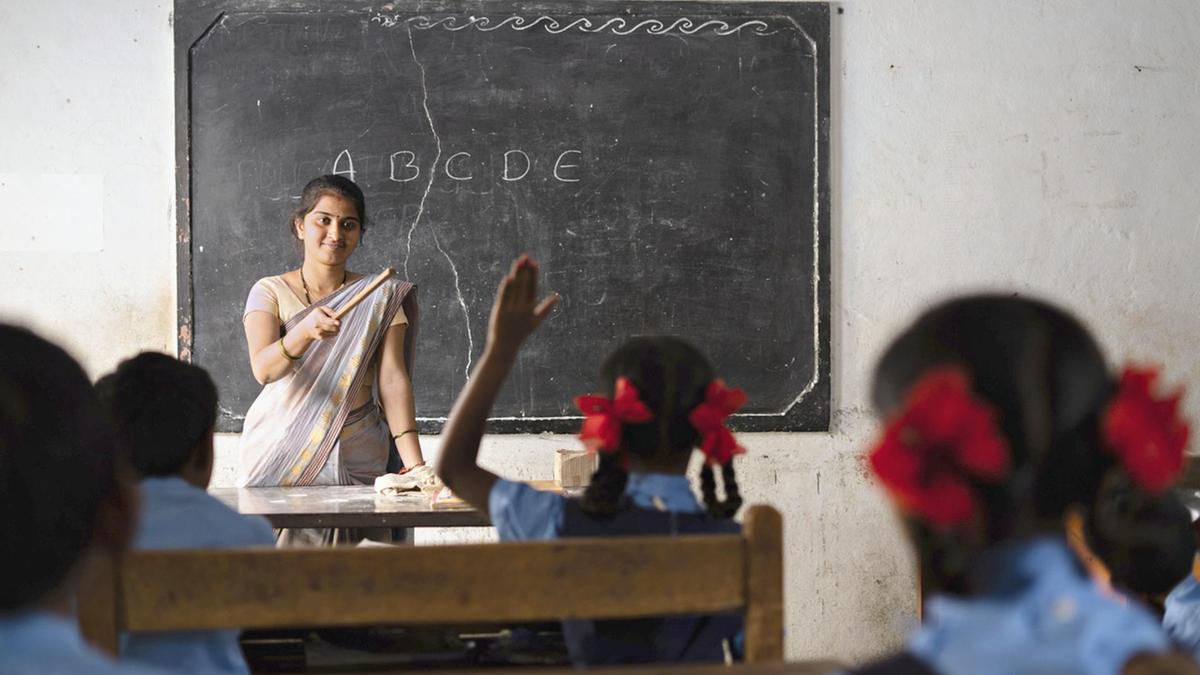
The myth of learner learns what teacher teaches has been debunked.
| Photo Credit: Getty Images/iStockPhoto
“Attending classes is a waste of time. What I learn in a one-hour lecture, I can grasp in five minutes from YouTube. I am better informed of the latest trends in a flawless and fluent presentation.” This statement from my college-going son during a conversation disturbed me deeply.While the claim may be true in his case, it gave rise to a nagging question: ‘Why do learners remain at the same level of academic competence throughout the 12 years of schooling?’ This led to a close observation of the performance patterns of students passing through our system.Even if we categorise students as advanced, average and mediocre, ideally, as they progress through the educational ladder, their capabilities should be enhanced as a result of the teaching-learning processes. But their performances remain static, especially in the latter two categories. This leads to the question: Does the teacher-learner interface really make any difference?Mismatch existsSeveral pedagogical methods — inquiry-based, project-based, and activity-based learning — were adopted to make learning effective for all. Further, shifts to learner-centric and communicative approaches were trumpeted as leading to a better learning ecosystem. Despite all this, the mismatch between teaching and learning exists, which is evident as the three categories of learners largely continue to persist.The myth of learner learns what teacher teaches has been debunked. Following textbooks and attentively listening doesn’t automatically result in learning. The oft-quoted, “If they can’t learn the way we teach, we need to teach the way they learn” demands an urgent transformational trajectory.At the high-school level, students must be made aware of what learning is and how to learn. They must be steered to reflect metacognitively and identify whether they are visual learners, auditory learners, reading/writing learners, or kinesthetic learners. This shift calls for teachers to use multi-modal approaches, even within a 40-minute class period, alongside the prescribed text. Other print texts such as excerpts from newspapers and magazines, e-texts in multiple formats such as blogs, vlogs, infographics, videos, film clips, reels, and music must feature in every class to keep all the learners hooked. Such a practice validates Howard Gardner’s concept of multiple intelligences and facilitates different learners benefitting from the varieties of texts, clubbed with multiple activities.The architecture of educational institutions with rows of classrooms, each stacked with benches and desks, scarcely provides any space for learner-centred engagements. It is solely designed for teacher-centric modes. Yet, the open spaces within campuses allow us to adopt Tagore’s visionary model of Santiniketan. The availability of classrooms need not restrict students, as they eagerly welcome activities conducted outdoors.Linguistic skillsThere is also the issue of acquisition of linguistic skills: speaking can be learnt only by speaking, writing only writing, listening by listening and reading by reading. The lament of poor English-speaking skill is rooted in dual realities: the rarity of speaking activities in classes and the emphasis on formal presentations. Instead, if students could be divided into pairs, triads or small groups and speaking activities conducted outdoors, with a stress on informal communication, could lead to mastering the skill. The informal communicative competence gained in this manner is sure to help them perform better in formal contexts and not vice versa. Likewise, other skills could be mastered by resorting to the same principle.Yet another significant aspect to trigger learning among students is employing different classroom strategies such as challenge, persuasion, competition, praise, reward, embarrassment, stimulation, and goal-setting. These must vary with individuals and even with the same student over time. If we were to cultivate the habit of productive learning in every student, a paradigm shift from generic delivery to an individualised mode is a must. Only such an approach can elevate average and mediocre students to higher levels, transforming classroom dynamics and the nature of learning. For the classroom interface to become purposeful, the central concern ought to be not how teachers teach but how learners learn.The writer is a retired Professor of English, Anna University, and Chief Executive Chair of English Language Teachers’ Association of India (ELTAI). Published - June 20, 2026 01:26 pm IST