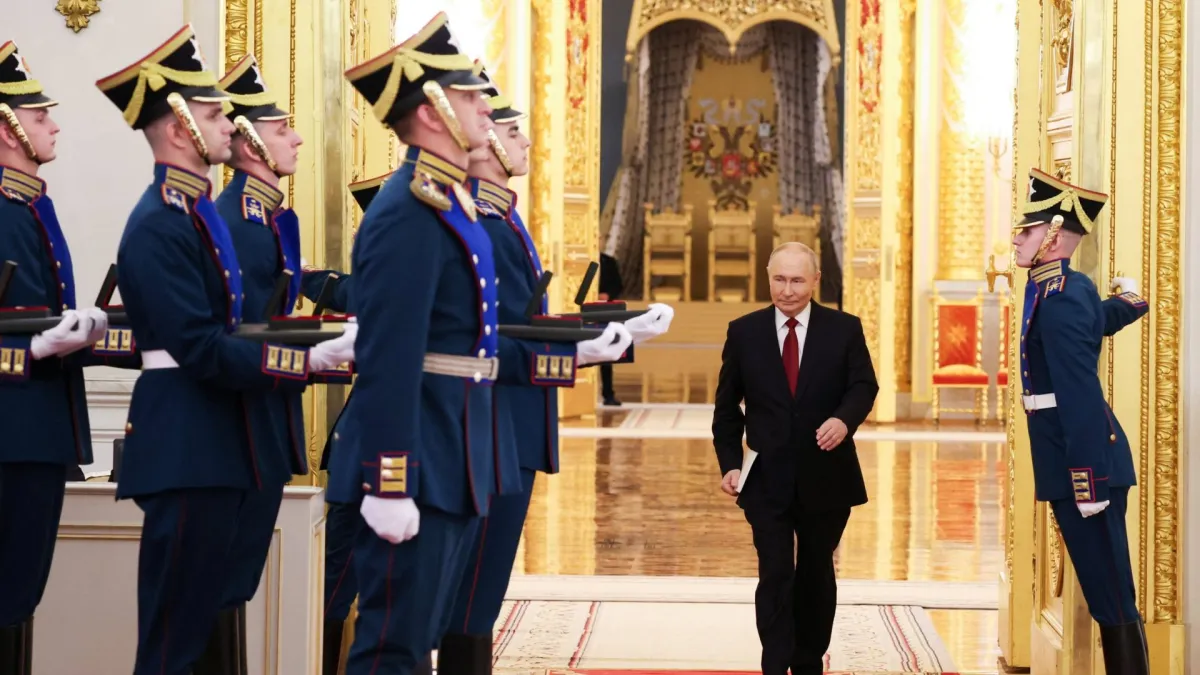
When Western observers discuss threats to Vladimir Putin’s regime, they usually focus on two scenarios: an elite split and the disintegration of Russia.
Both are highly unlikely today. The elite remains consolidated around Putin, while Western sanctions have left its members with few alternatives. As for Russia’s many regions, the Kremlin combines tight control over local elites with well-tested mechanisms for responding rapidly to periodic crises. The regime itself remains resilient, adaptive and capable of reallocating resources when necessary.
The regime’s Achilles’ heel lies elsewhere. As a long-time watcher of the Russian elites and a former adviser to the Russian Parliament, government and presidency, I have studied how Putin has transformed, centralised and bolstered his rule, particularly since his full-scale invasion of Ukraine.
The true weakness of his regime lies in its dependence on manual control and its inability to reproduce itself. Putin’s system of governance and elite recruitment lacks an embedded mechanism of succession and renewal. It is essentially a one-off model. As long as Putin can personally allocate resources, balance competing interests and make key decisions, and as long as the layer immediately beneath him consists of associates he has known for 20-30 years and more, the system remains functional. The problem is that both Putin and most of his closest associates are now in their seventies. Some senior figures, including two consecutive chairpersons of the Supreme Court, have died in office.