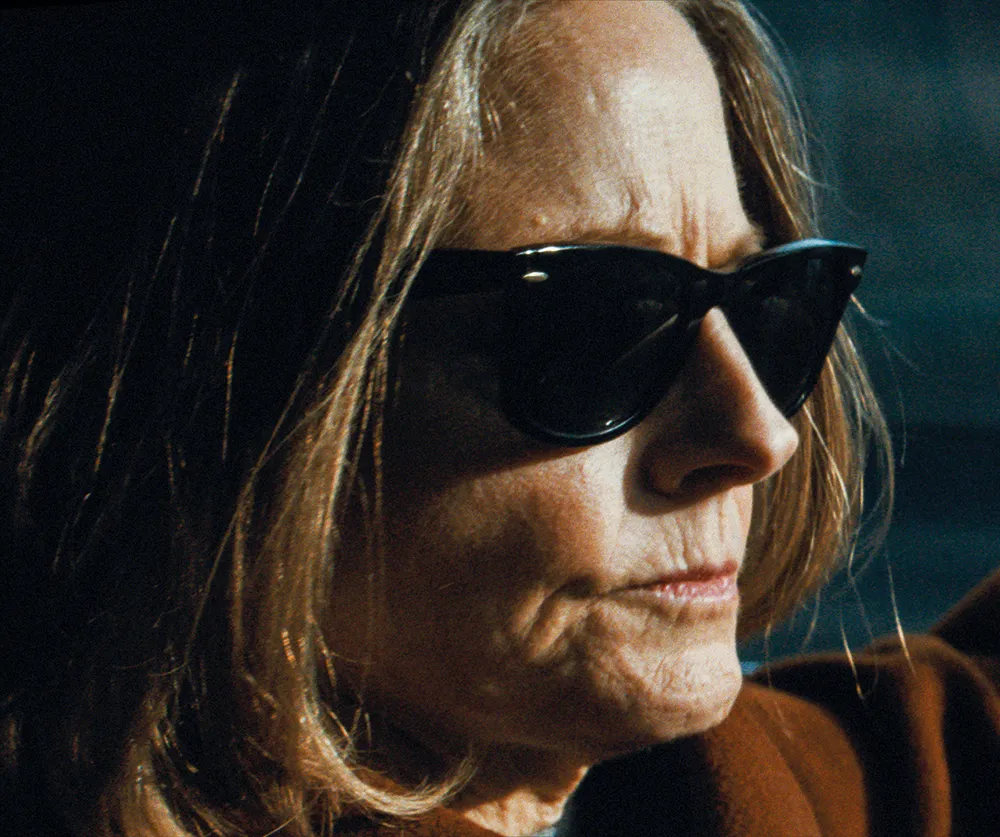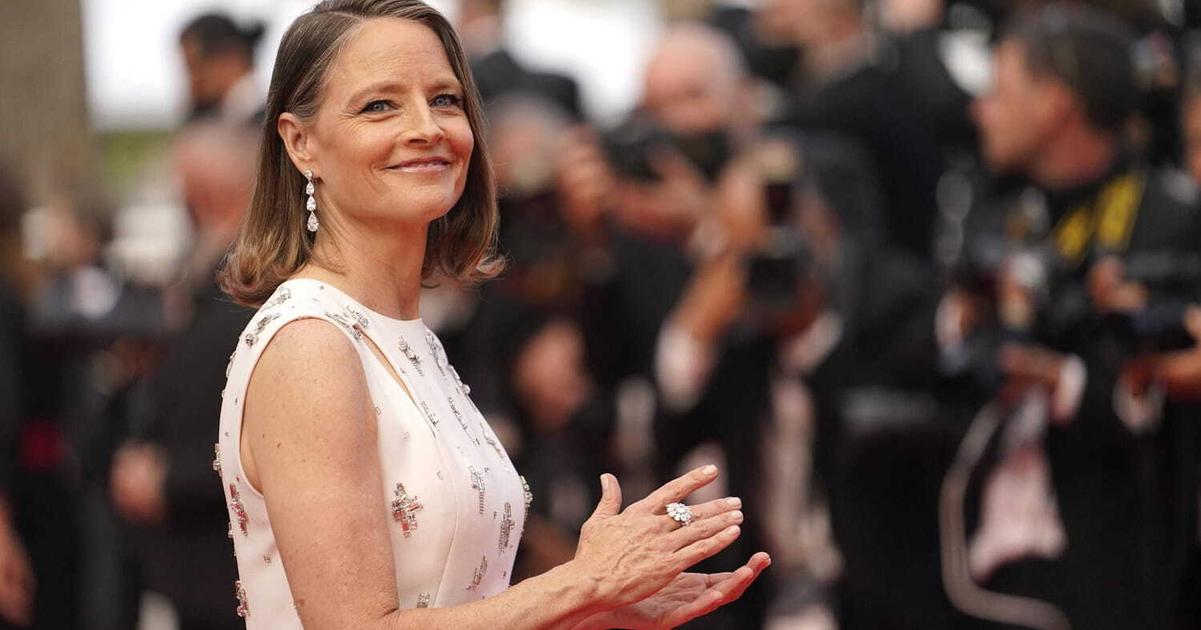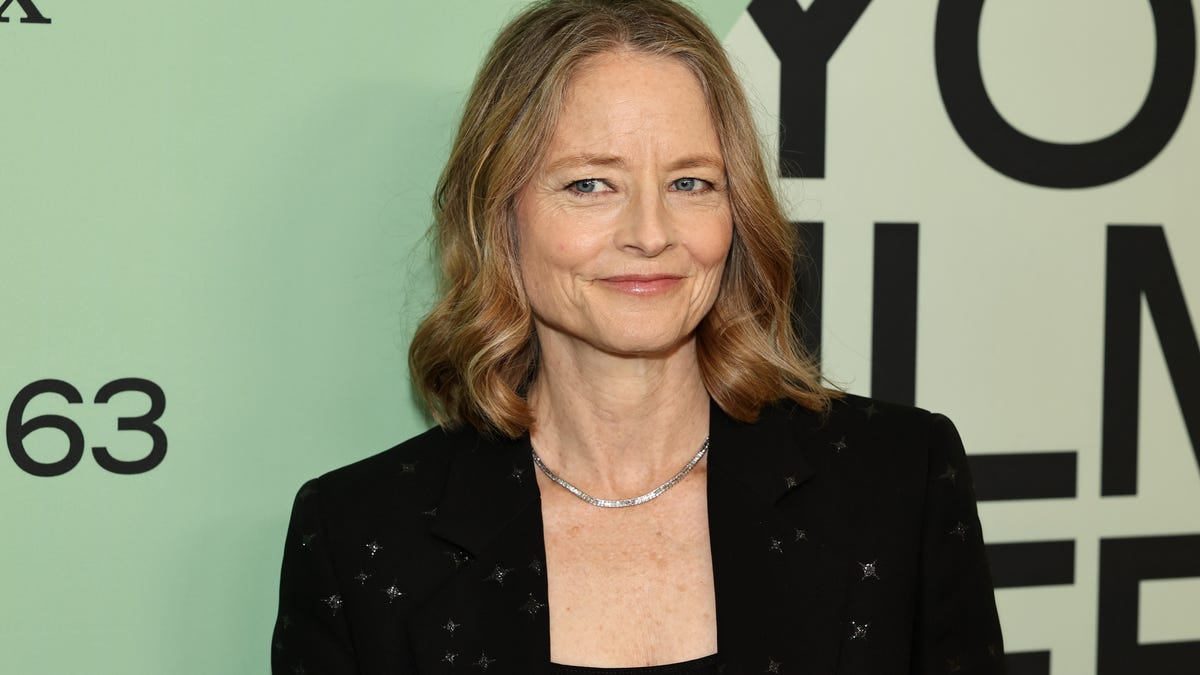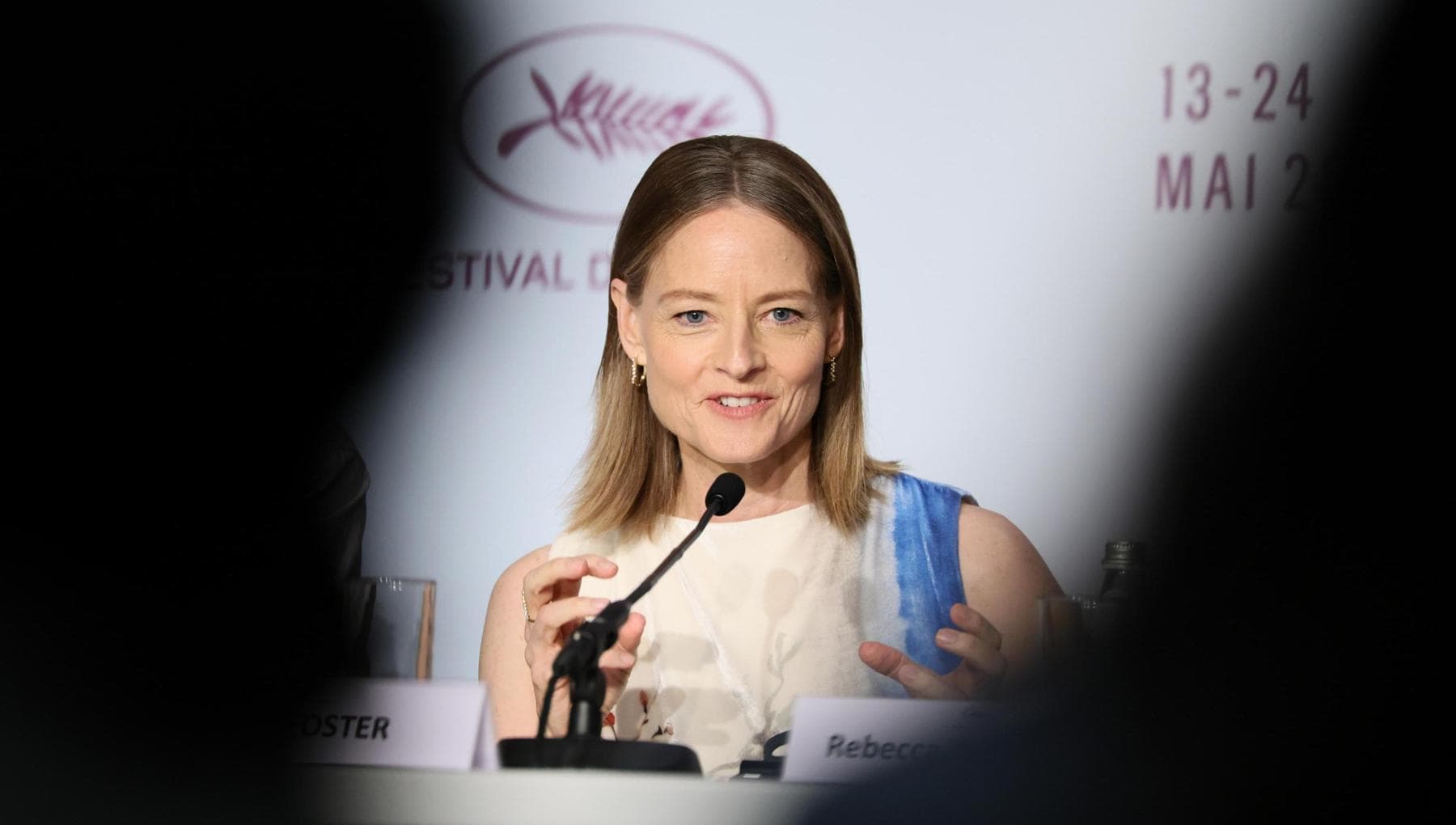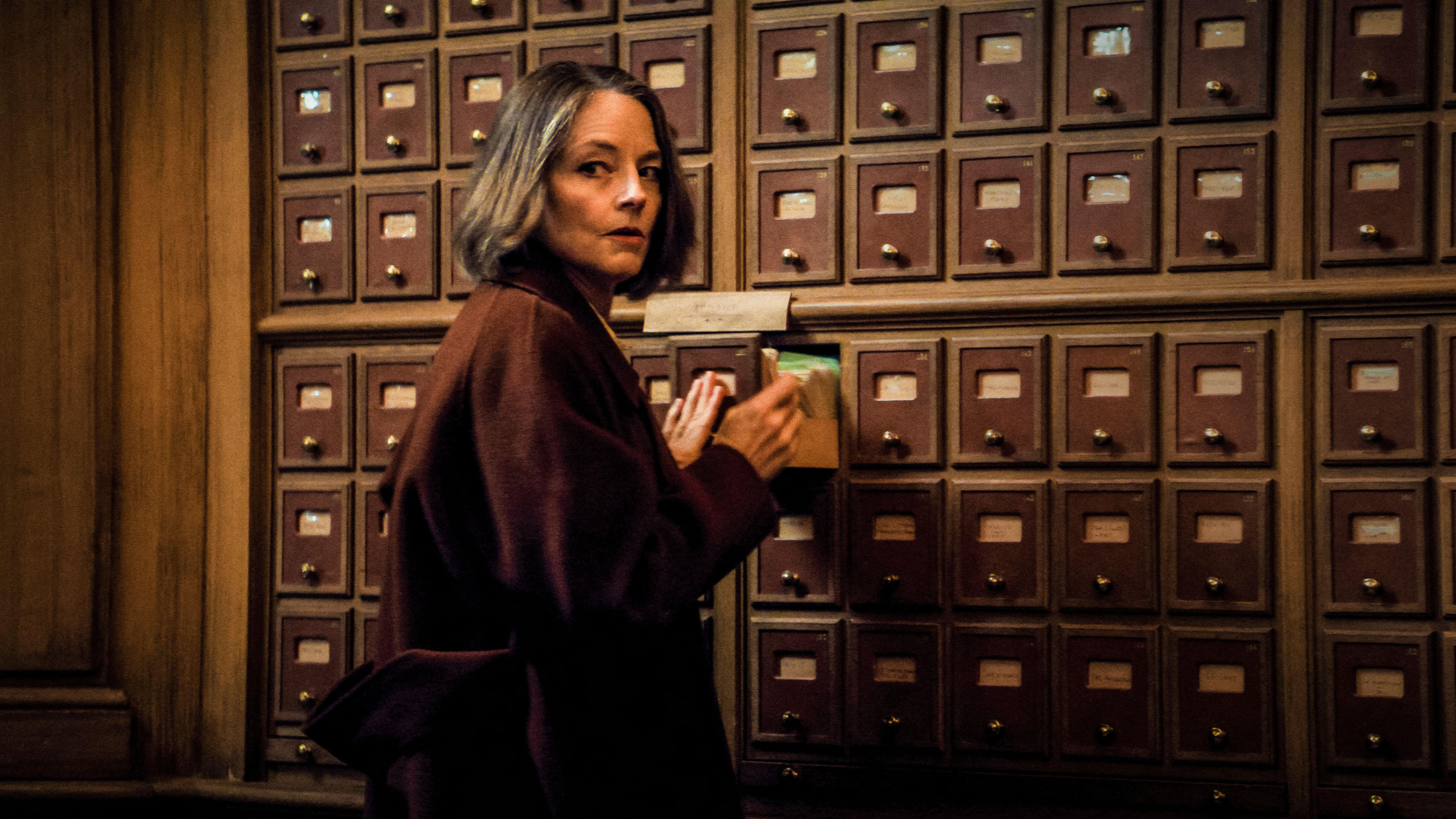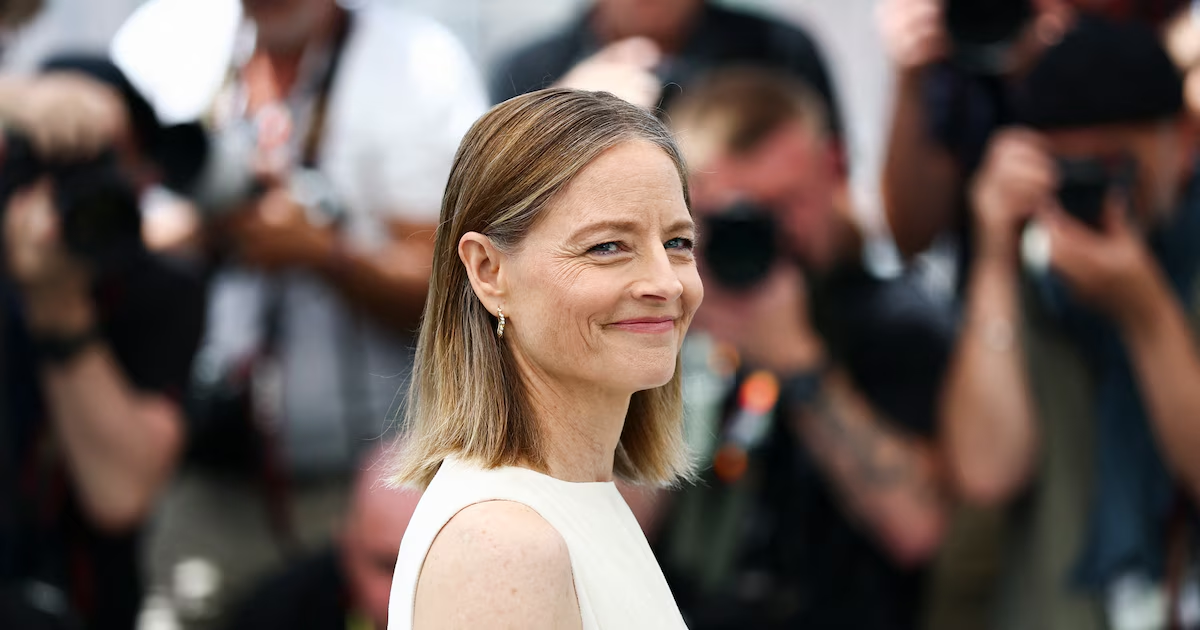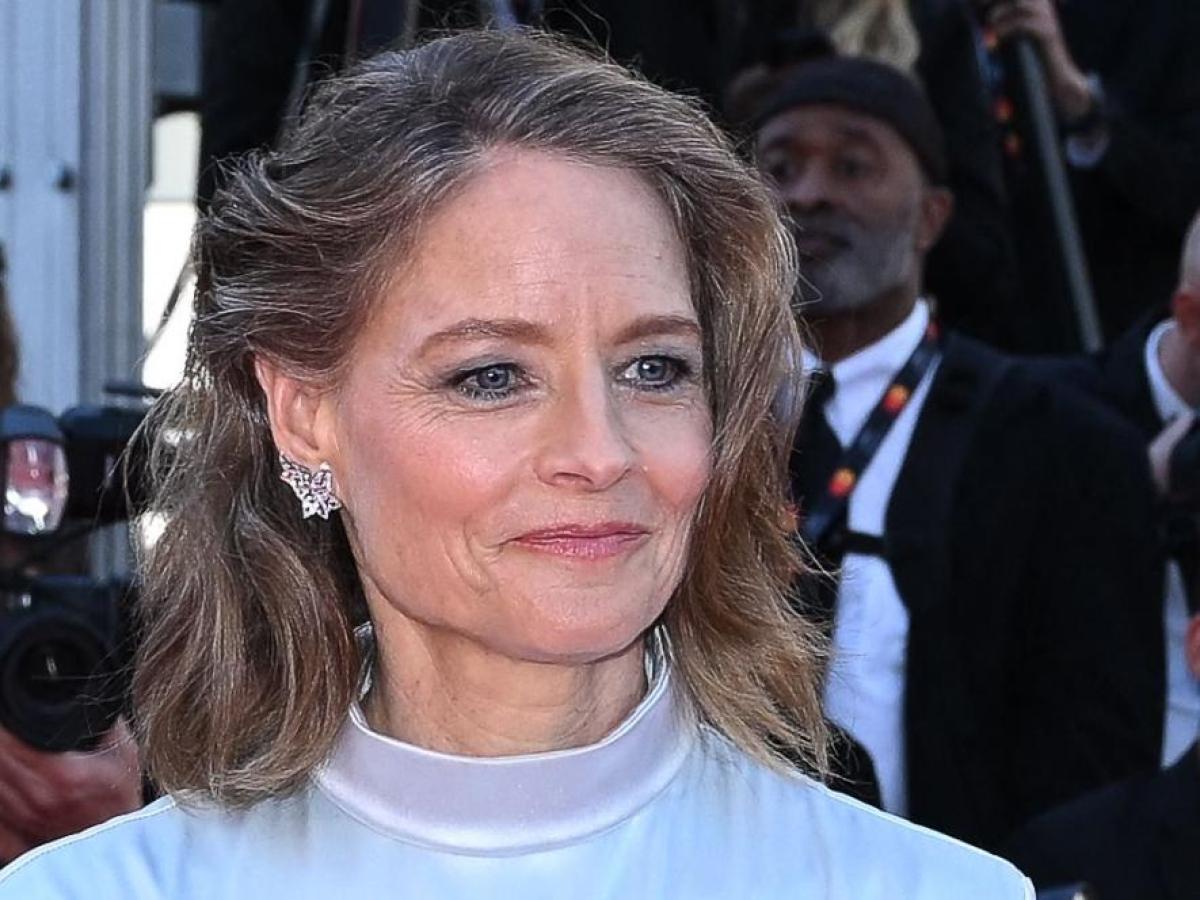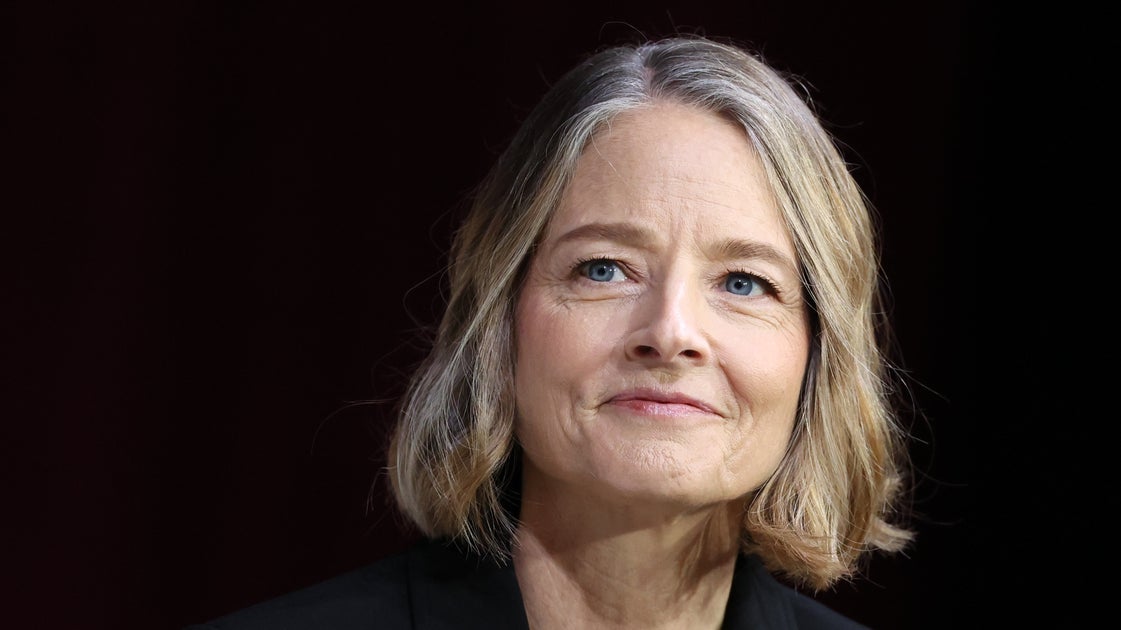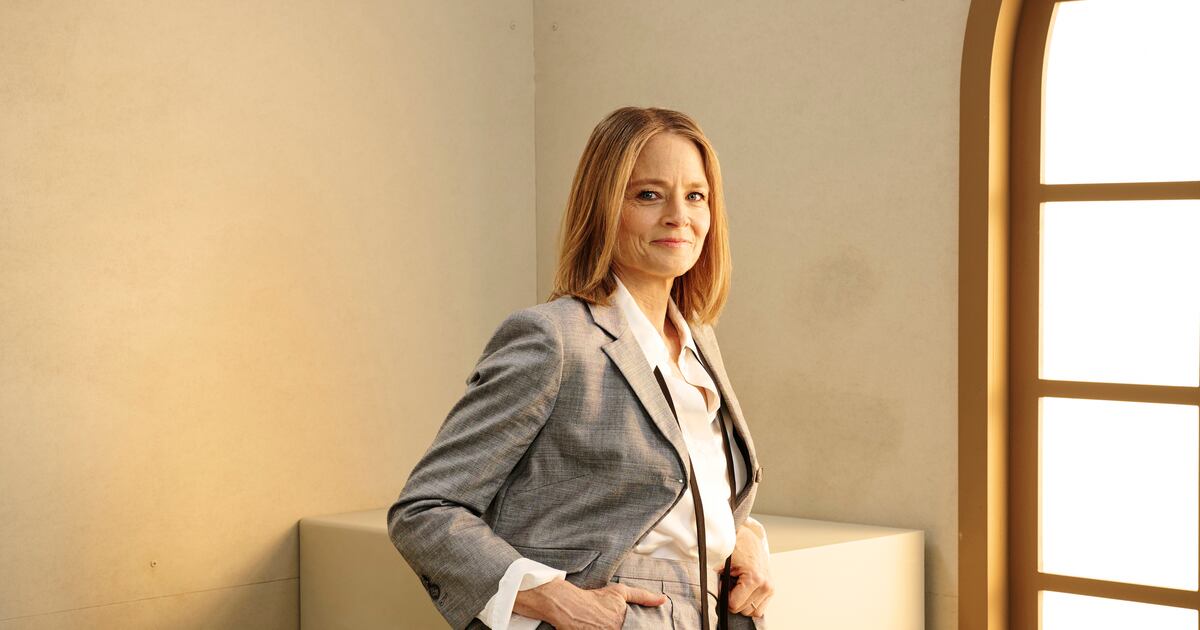
Jodie Foster couldn’t have concocted a superior palette had she consulted a squadron of stylists. As she sits in the gardens of an upmarket hotel in Marrakesh, her blue eyes sparkle among the orange- and fuchsia-flowering cacti. It’s a striking look.“This is someplace I’ve always wanted to come, because it’s spectacularly beautiful and exotic,” she says, gesturing at the plants around her.Foster, who has been unavoidable since she emerged, as an eerily natural child actor, in the early 1970s, has touched down in Morocco for the local premiere of Rebecca Zlotowski’s film A Private Life, a murder-mystery featuring the double Oscar-winner as a Parisian psychoanalyst investigating the death of a patient who she’s convinced has been murdered. The resulting action, pitched somewhere between Brian De Palma and Only Murders in the Building, requires much sneaking around. She has acted in French before, including in Claude Chabrol’s film Le Sang des Autres, from 1984, and the Jean-Pierre Jeunet feature A Very Long Engagement, with Audrey Tautou, from 2004. But A Private Life, which also stars Daniel Auteuil, Virginie Efira and Mathieu Amalric, is Foster’s first lead in a French-language movie. It’s natural terrain for the actor, who attended a French-language prep school and frequently dubs her English-language characters into the language. It’s not only a linguistic sojourn but also, as she notes, a break from a US outlook. “In the States we don’t really do Freud any more, right?” she says. “We don’t do psychoanalysis, because he’s cancelled for his misogyny and all that. “But in college I did a lot of work with Freud and Lacan, because it’s such a beautiful lens for literature and for cinema. Hitchcock and other film-makers have used that lens in the way you might use a feminist lens or a socialist lens. So I loved that in this film, which has a little humour at the expense of psychoanalysis.”She laughs.“When it first started, hypnosis was a part of psychoanalysis. Freud kind of rejected it over time. I did hypnosis once, to quit smoking. I thought it was dumb, and I couldn’t believe I’d given this guy $90. “And I never smoked again. There you go.”True Detective: Night Country. Jodie Foster as Liz Danvers and Kali Reis as Evangeline Navarro. Photograph: Netflix/HBO Foster has in recent years dedicated much time to projects directed by women. She was at the front of the TV series True Detective: Night Country, from the Mexican film-maker Issa López. On the big screen, she narrated Pamela B Green’s documentary Be Natural: The Untold Story of Alice Guy-Blaché, about that pioneering film-maker, and starred in the swimming drama Nyad, which was codirected by Elizabeth Chai Vasarhelyi. A Private Life allows her another opportunity to work with female talent. This is new, Foster says.“When I first started there were no female make-up artists,” she says of her more than five decades in the industry. “Little by little, there was usually a script supervisor. That was it. There were never any women on set. “I feel very grateful for the brothers and fathers who taught me everything. They really took me under their wing. They loved me, and they felt like I was their daughter. “They wanted me to have all these opportunities, but they didn’t realise they weren’t giving opportunities to other women. I recognise that I had a lot of chances that a lot of women in the film business didn’t.”Foster’s own directing credits date back to a 1988 episode of Tales from the Darkside. Since then she has quietly built a distinctive career behind the camera. Making her feature directorial debut with Little Man Tate, a sensitive drama about childhood giftedness from 1991, Foster established many of the qualities that would define her work as a director: an interest in outsiders, fractured families and, intersecting with her own professional precociousness, the psychological pressures of exceptionalism.Her subsequent films, including Home for the Holidays, The Beaver and Money Monster, swerve between mainstream accessibility and characters struggling with personal and social crises.“I wanted to be a director as a young kid,” Foster says. “When I was about six I did a TV show, and the guy who played the dad was also the director. I just thought, oh my God, they let actors become directors. “From that moment on, that was something I knew I wanted to do. I watched him the whole day. I knew I wanted to be a director, but there were virtually no American directors who were women. But there were many in Europe.“Growing up, I looked to European cinema and thought, oh, I guess I could do that.”Daniel Auteuil as Gabriel Haddad and Jodie Foster as Lilian Steiner in A Private Life, directed by Rebecca Zlotowski. Photograph: Jérôme Prébois/Altitude/Sony Pictures Classics Foster, who is now 63, has reached at a point in her career that feels like both consolidation and reinvention. Nearly six decades after she first appeared on screen, she continues to move between acting and directing with a consistency that has made her one of Hollywood’s most respected figures.She continues to break new ground. The fourth season of True Detective added an Emmy to a cluttered mantlepiece that already contains, alongside those two Oscars, an honorary Palme d’Or, three Baftas, four Golden Globes and a European Film Award.“It really is kind of like bingo, right?” she says. “Because my work is already done. And now I’m dressed up and at a fancy party and you hope somebody says your name. Bingo! “Weirdly, I think the work I’m doing now is some of the best work I’ve ever done. Because you hit a certain age and you just don’t care.“There’s something really beautiful about turning 60 and suddenly waking up one day and not caring about all the things you cared about when you were 45 or 50. I’m really not interested in being the centre of attention any more. What’s far more exciting is giving opportunities to other people.”Foster is chattier than you might expect from someone who has maintained a strict separation between her public and private spheres, rarely discussing her family. She is the mother of two sons, Charlie and Kit, whom she parented with the producer Cydney Bernard, who was her long-time partner until they separated, in 2008. She has remained guarded about her personal life after marrying Alexandra Hedison, a photographer, in 2014.I don’t want to dance on the table for people. I’m not interested in being the centre of attention— Jodie Foster“I’ve always compartmentalised my work life and my private life,” Foster says. “I’ve always made time for my private life, because when I was young I had to fight for that. I had to say, ‘No, I want to go to Disneyland, and I don’t want to have a camera crew following me,’ or, ‘I want to go to college, and I want to have that experience. I want to have experiences like other people.’ That has been important for me – to develop independently as a real human being and not just my job.”Foster’s apprenticeship in front of the camera began long before Martin Scorsese’s film Taxi Driver made her a household name in 1976. At the age of three she was cast in a sunscreen commercial after accompanying her older brother, Buddy, to an audition, a moment that has become part of Hollywood lore. Jodie Foster, Robert De Niro, Martin Scorsese and Paul Schrader at the Taxi Driver screening during the 2026 Tribeca Film Festival. Photograph: Dominik Bindl/Getty Images for Tribeca Festival The advertisement led to a steady stream of TV work, including campaigns for toothpaste and View-Masters, before Foster graduated to television roles in series such as Kung Fu, The Doris Day Show and Gunsmoke. She remains amused by actors who regard commercials as beneath them. Even before the sunscreen ad, visual media was a big part of her life.“For me, cinema was so important growing up because it was important to my mom,” Foster says. “For her, movies were this escape where she didn’t have to be worried and fearful and stressed out by all of her obligations trying to raise four kids on her own with no money. “She could go to the movies, and she could take me from school, put me in the movie theatre, we’d have dinner in the movie theatre, and we’d see two films back to back sometimes.”By the early 1970s Foster had become a box-office attraction in Disney productions, bringing a keen intelligence and composure to films such as Tom Sawyer, the original Freaky Friday and Candleshoe. She also starred in the television adaptation of Paper Moon, the film with Ryan and Tatum O’Neal. (Its cancellation after a single season did nothing to slow Foster’s ascent.)Even as a child Foster displayed a striking self-possession: when she was 12 she walked off the set of the psychological thriller The Little Girl Who Lives Down the Lane when its director, Nicolas Gessner, called for a nude scene.“I don’t know if it’s regret, because there are so many good things that are so singular and amazing about how I grew up,” the actor says. “Travelling so much, being on the road with my mom in different hotels all over the world and all over the country, working with 150 guys on every film. “I am so grateful. I’m also grateful that I am not self-conscious, because I was too young to be self-conscious. I don’t remember not being in front of a camera. “But there are things that I have resentments about. I wonder who I might have been. I wasn’t really designed to be an actor. I wonder who I would have been. I don’t want to dance on the table for people. I’m not interested in being the centre of attention.”I cannot believe how lucky I am to have fallen into the 1970s, to all these great film-makers— Jodie FosterIt was her performance in The Little Girl Who Lives Down the Lane that brought her to Scorsese’s attention. He cast her immediately in Alice Doesn’t Live Here Anymore and, soon after, in Taxi Driver – a production on which Robert De Niro was impressed enough to take time to run lines with his young costar.“I don’t 100 per cent remember meeting Scorsese for the first time,” Foster tells me. “I remember being in his office, but I can’t remember whether I was 12 or nine. I do remember the first day on the set of Alice Doesn’t Live Here Anymore. When I met him my hair was long, but when I arrived my hair was very short, because I was doing the Paper Moon TV series. Jodie Foster and Robert De Niro in Taxi Driver, directed by Martin Scorsese. Photograph: Columbia Pictures/Fotos International/Getty Images “They all just lost their minds. They were, like, ‘She looks like a boy.’ So they put me in a dress, and to this day people still say, ‘Wasn’t that a little boy in Alice Doesn’t Live Here Anymore?’ “I remember being annoyed. But I’m so grateful to Martin. I cannot believe how lucky I am to have fallen into the 1970s, to all these great film-makers. I was paying attention. I remember saying to myself, ‘This is going to be important. I have to remember all this stuff.’”After Taxi Driver she seamlessly transitioned into an adult career, winning an Academy Award for her portrayal of Sarah Tobias, a working-class woman seeking justice after a brutal sexual assault, in The Accused, from 1988. Three years later she landed the role that would define her career. Playing Clarice Starling, an FBI trainee, opposite Anthony Hopkins in Jonathan Demme’s The Silence of the Lambs, Foster created one of American cinema’s most enduring heroines: intelligent, vulnerable, ambitious and defiant in the face of institutional sexism. She knew it was a role like no other.The Silence of the Lambs: Jodie Foster as Clarice Starling in Jonathan Demme's 1991 film. Photograph: Orion “The hero’s journey has been around for thousands and thousands of years,” she says. “You have a solitary hero who encounters a problem and then has to go through the forest of experience – gnomes and demons and monsters and whatever – in order to do good and bring back to his or her people some sort of salvation. In the process the hero transforms. “The strange thing is that women were never allowed to be a part of that myth, at least in cinema. But in The Silence of the Lambs, that was the core foundational beauty of the book and then of the movie. They took a mythic idea, whether it’s Oedipus or whatever tragedy, and applied it to a woman and allowed a woman to do that. That’s why I wanted to do it.”But Clarice isn’t the character she feels closest to from those she has played. In Contact, the 1997 film adapted from the novel by Carl Sagan, she plays Dr Ellie Arroway, a radio astronomer whose lifelong search for extraterrestrial intelligence places her at the centre of humanity’s first confirmed contact with an alien civilisation.“She’s somebody who’s ambitious and solitary in some ways, and whose real journey is about bringing together a prodigious intellectual mind with a very emotional, almost spiritual experience. By necessity that’s going to be very lonely, because no one will ever be able to participate with you in that place.”Contact: Jodie Foster as Ellie Arroway in Robert Zemeckis's 1997 film. Photograph: Warner Bros Foster remains circumspect about the relative triumphs and lulls of her ongoing CV. Her career has included box-office hits such as Flightplan, Sommersby and Elysium, as well as less successful films, including Nim’s Island, Carnage and the Neil Jordan feature The Brave One. That’s how the business goes.“I’ve worked with big directors, but it doesn’t feel like that when you’re making films,” she says with a shrug. “When you’re making films you feel like you’re all in a trench together, eating bad food, drinking bad coffee, making decisions together and collaborating together. “That’s the best experience: working with people who listen and who are like good parents. They say, ‘Okay, the train is leaving the station at 8.42 and I’d like it to arrive at 9.57.’ And, whatever happens in between, you just go.”A Private Life is in cinemas from Friday, June 26th
Jodie Foster interview: ‘I turned 60 and suddenly woke up not caring about all the things I cared about at 45’
The actor and director on her first French-speaking lead role, her drive to give other people opportunities, and the role that most resonates with her
TL;DRAI
Questo articolo non è rilevante per **Warptech Tech News**. È un'intervista di entertainment su Jodie Foster e la sua carriera nel cinema — nessun elemento tech, AI, business, startup o governance. Non ha senso applicare il framework di riassunto per manager IT/CTO a un pezzo di intrattenimento puro. **Se l'articolo è stato caricato per errore**, verifica la fonte. Se invece vuoi che io eserciti il framework su qualunque testo, fammelo sapere e adatterò.
2,386 words~11 min read