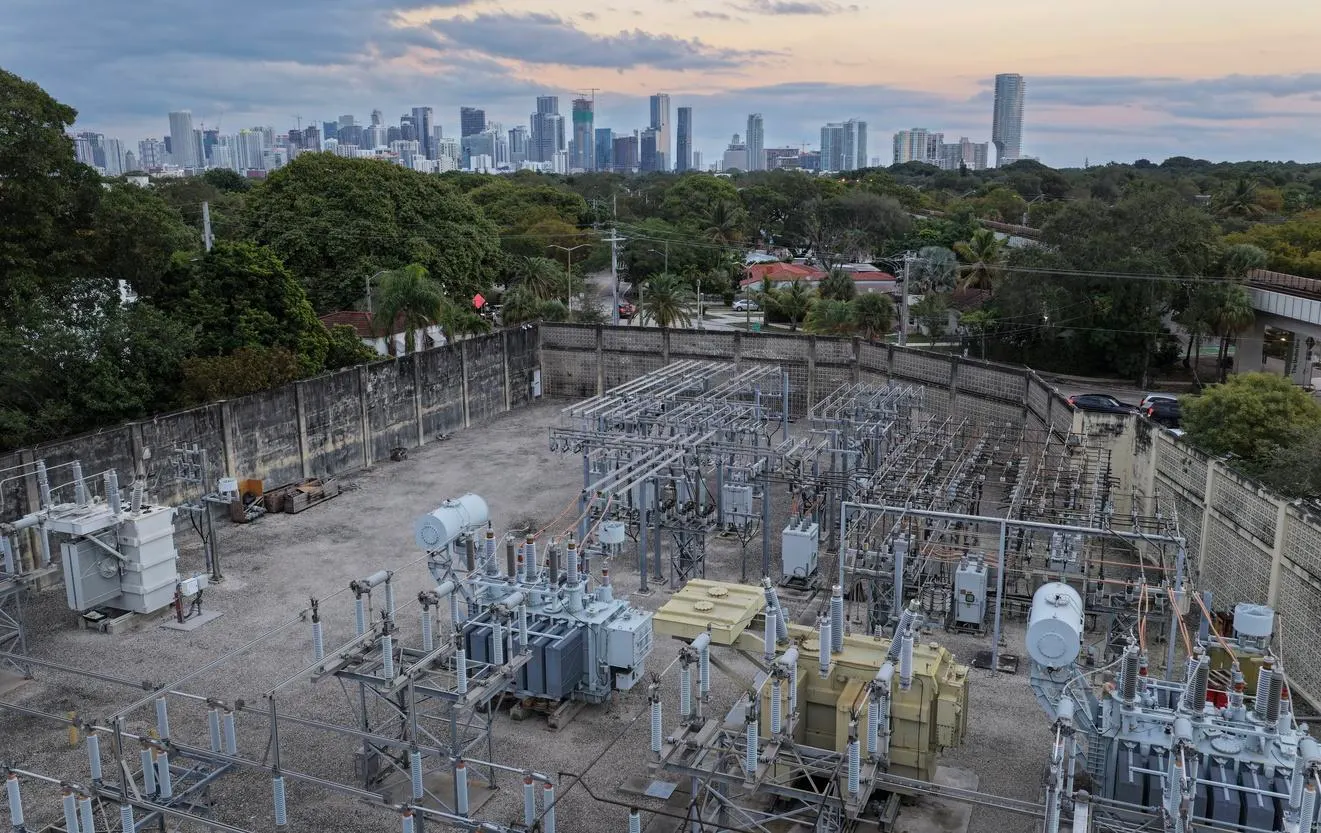
MIAMI, FLORIDA - JANUARY 14: In an aerial view, high voltage power lines run through a sub-station along the electrical power grid on January 14, 2026 in Miami, Florida. U.S. President Donald Trump announced that AI tech companies need to ‘pay their own way’ when it comes to their electricity consumption so that Americans don't 'pick up the tab' for their data centers. (Photo by Joe Raedle/Getty Images)Getty ImagesThe Federal Energy Regulatory Commission issued tailored show-cause orders this week to six regional grid operators under its jurisdiction, directing them to justify current rules for large electricity users or propose changes within 60 days. Specifically, the federal energy regulator has ordered six regional grid operators to justify, or rewrite, the rules that govern how massive new electricity users such as AI data centers connect to the grid. By pressing these operators to defend or change their rules for connecting large power users, federal regulators are effectively asking whether America’s electricity system can move at the speed of AI. The targets include data centers and manufacturing facilities, both of which now sit at the center of Washington’s race to expand AI industrial capacity. The FERC is basically telling grid operators that the old queue system may no longer fit the new economy. For AI companies, this creates a clearer path to getting the power they need without having to jump through procedural hurdles. For state and local governments, it creates a harder job. They will face more pressure to approve projects, defend ratepayers, manage land-use fights and decide which large loads deserve scarce capacity. The Specifics Of The FERC OrderThe agency used Section 206 of the Federal Power Act to push six regional transmission organizations and independent system operators to explain why their existing tariffs remain “just and reasonable” without clearer provisions for large-load customers. The regions have 60 days to answer or propose reforms. The order focuses on five areas: faster study processes, clearer transmission costs, rules for co-location and behind-the-meter generation, new services for flexible large loads, and a process for studying power plants that serve nearby large customers or co-located loads. The goal of the FERC order is to speed up paperwork and push the grid toward a general approach where a data center may connect faster if it can curtail load, bring its own power, co-locate near generation or pay for the upgrades it triggers. This is a major shift from the old data-center model, where developers hunted for cheap land, fiber and tax breaks, then expected the grid to catch up after the project was well under way. In the AI era, grid planning needs to happen well in advance. This is where slow processes have been getting caught in the loop.Reuters reported that FERC Chair Laura Swett called the issue “the biggest priority our country is facing at the moment,” tying the order to a broader U.S. goal of winning the global AI race. Data centers are no longer just another type of large commercial load. They are being treated as nationally significant infrastructure, closer to chip fabs, ports or defense plants than office parks. While that does not mean every AI campus is automatically green lighted for approval, it does mean grid operators, utilities and regulators are being asked to build special procedures for them.The FERC fact sheet uses the language “speed to power” to describe what large users need from grid operators to support AI leadership and manufacturing growth. No doubt that this is timed for the political realities of a campaign cycle already under way. Politicians and local support will use this phrase to help support the politicians that support “speed to power” and bolster support for local communities that are being increasingly questioned on large data center projects. Managing The Balance Of PowerThe FERC order is careful to say that it does not intrude on state authority to select, site and permit generation, nor on state public utility commissions’ authority over retail electricity rates, terms and conditions. It also says FERC is guarding against cost shifts among transmission customers, leaving states to prevent cost shifts among retail customers. State utility commissions will have to decide whether residential and small-business customers are protected from the cost of AI-driven upgrades. State economic-development agencies will have to prove that data center incentives are worth the power they consume. Governors will have to balance AI investment announcements against rising power bills and reliability fears.Texas, which sits outside FERC’s main jurisdiction, approved ERCOT’s “Batch Zero” process on the same day as the FERC announcement to show that it too sees the need for accelerated data center connections to the grid. The Batch Zero framework aims to speed up the study process by grouping qualified projects of at least 75 MW into one study so ERCOT can assess demand, allocate grid capacity and identify transmission upgrades. ERCOT is tracking more than 438,000 MW of large-load requests, with nearly 89% coming from data centers. Local governments will be directly impacted by the FERC order as well, even though they did not write it. Counties and cities control zoning, water permits, tax abatements, noise rules, emergency services and public hearings. They are where the AI buildout usually runs into local opposition. When new or upgraded transmission lines cross farms, large facilities sit near neighborhoods, water systems get stress-tested, and fire departments need to manage heightened risks, local communities ask who should bear the costs and risks.FERC’s order may accelerate grid procedures, but it cannot eliminate local politics. Municipal and local leaders will need more sophisticated data-center review standards. A project can no longer be judged only by jobs, taxes and square footage. Local officials will need answers on peak load, backup fuel, grid upgrades, curtailment commitments, water use, heat reuse, noise, air permits and who pays when promised infrastructure falls short.Not helping matters is the limited transparency into data center projects. Reuters reporting on fast-tracked power plants for AI data centers has already raised concerns about limited public scrutiny, shell companies and local nondisclosure agreements.AI companies want faster grid access. Communities want proof that the costs, emissions and risks will not be pushed onto them. It’s becoming clear that the next phase of the AI race will be shaped not only by electrical power, but by political power.
FERC Issues Orders To Speed Grid Access For AI Data Centers
FERC's order for grid operators to ease regulatory processes for data centers makes it clear that the next phase of the AI race will be shaped by both electrical and political power.
TL;DRAI
FERC ordered grid operators to accelerate AI data center connections within 60 days. Advance planning replaces post-hoc grid expansion, cutting timelines but shifting costs to utilities; IT leaders gain faster power access but encounter tougher local regulatory approval.
1,048 words~5 min read