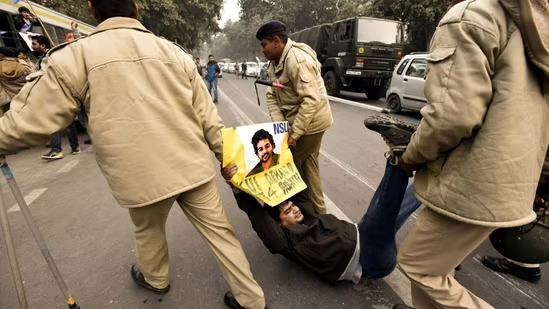
Public radio’s longest-running daily global news program.AboutContactDonateMeet the TeamPrivacyTerms of use©2026 The World from PRXPRX is a 501(c)(3) organization recognized by the IRS: #263347402.Challenges under India’s university reservation systemEach year, India reserves a block of seats in its public universities for the country’s most marginalized communities. These reservations were put in place to help India’s vulnerable groups overcome centuries of violence and discrimination under the caste system. But just like in the US, India’s version of affirmative action comes with controversy, and students who get in still deal with discrimination. Reporter Namrata Kolachalam has the story from India.In January 2016, protests erupted across India following the death by suicide of a PhD student named Rohith Vemula. Vemula came from the Dalit community, previously referred to as “untouchables” within the Hindu caste system — a strict social hierarchy.Vemula was ostracized because of his background, even losing his campus housing and fellowship. Before taking his life, he wrote of his birth as “a fatal accident.”Policemen try to stop Indian students as they march towards the office of Hindu nationalist Rashtriya Swayamsevak Sangh (RSS) or the National Volunteers Association’s office during a protest against the death of 26-year-old doctoral student Rohith Vemula in New Delhi, India, Jan. 30, 2016. Saturday marked the birthday of Vemula whose body was found hanging in a hostel room, on Jan. 17 weeks after he along with four others, was barred from using some facilities at his university in the southern tech-hub of Hyderabad.Altaf Qadri/AP/FileFrom 2019 to 2023, almost 100 higher ed students from oppressed castes died by suicide. These deaths are tragic reminders of how caste remains embedded in India’s education system — despite efforts to level the playing field.Each year, India reserves a block of seats in its public universities for its most marginalized communities. This “reservation system,” akin to affirmative action in the US, is meant to uplift segments of society that have faced violence and discrimination for thousands of years. But just like in the US, these efforts come with controversy and questions about how best to promote equality in modern-day India.The University of Mumbai.Justin Nisly/The WorldEntering at a disadvantageIn early May, the Tata Institute for Social Sciences (TISS) was quiet, with most of its students wrapping up final exams. At public universities like this one, about half of all seats are reserved for students from oppressed castes and Indigenous students, known as Adivasis.But getting a seat is just the first step.Students who enter college through reservations often start with disadvantages; for instance, many are studying in English — the primary language in most colleges — for the first time. In addition, their peers can frequently recognize their caste simply by their last name.Tata Institute of Social Sciences.Justin Nisly/The World“If you are able to communicate in English, you’re accepted as a scholar,” said Dr. Avatthi Ramaiah, who recently retired from teaching at the TISS Centre for Study of Social Exclusion and Inclusive Policy. “Otherwise, no. You’re not recognized as somebody with something to contribute.”The discrimination can sometimes even lead to fights on campus. Having come from an oppressed caste background himself, Ramaiah encouraged his students to focus on the big picture instead, saying, “Fighting here is not going to end the problem. I know there are challenges. First, get the degree.”Compared to when he was in college, Ramaiah believes society has become more just. But the legacy of caste still looms large. Privileged castes make up roughly a third of the population but hold a vast majority of professional and higher education degrees.He paraphrased Dr. B.R. Ambedkar, the architect of the constitution and a central figure in shaping modern India, who came from a Dalit background: “Caste is like a monster that confronts you wherever you go.”Statue of Dr. B.R. Ambedkar, an education reformer and author of the Indian Constitution, in front of the clock tower of his alma mater, the University of Mumbai.Justin Nisly/The WorldAnd, Ramaiah added, “that is the reality even today.”Campus hostilityIn addition to facing campus discrimination based on caste, marginalized students may also encounter resentment from peers because of the reservation system. This is partly because it has expanded over time.Previously, 15% of the seats were reserved for Scheduled Caste students (from historically oppressed castes), and 7.5% for Adivasi, or Indigenous students. Then, in the early 2000s, 27% more seats were reserved for other marginalized students. That left roughly half of all remaining seats for “general admission.”For the nearly 50% who enter on reservations, daily life can be difficult.Shivani, a graduate of TISS, asked not to use her last name due to the sensitive nature of the topic. She’s a high achiever who holds two master’s degrees. But when she was in South India studying for her first graduate degree, the intensity of campus hostility threatened to divert her attention from her studies.“You need to have ways to cope with casteism and sexism and everything,” she said, “by students and professors alike.”The outside of Siddharth College of Arts, Science & Commerce building in Mumbai, India.Justin Nisly/The WorldProfessors would say things like, “Why are you people even studying?”Students were quick to share stories of oppressed caste individuals gaining a measure of wealth: “I know a Dalit with an iPhone. So, why do we need reservations anymore?”To Shivani, it seemed that students did not understand that their challenges were often less dire than their oppressed-caste peers. Their lack of wealth, compared to those of similar social status, made them feel equally vulnerable.“You not being able to go on vacation is not equal to a Dalit person who almost had to drop out [of college] because they couldn’t afford the fees.”In 2019, government officials passed a new education policy for such socially dominant but financially less well-off students, carving out an additional 10% of college and university seats for economically disadvantaged applicants from non-oppressed castes.Despite such measures, marginalized caste students continue to face prejudice: Government data shows complaints of caste-based discrimination on college campuses jumped 118% from 2019-2020 to 2023-2024.Reservation impactsHigher education reservations were written into the Indian constitution in large part due to Dr. B. R. Ambedkar, the social reformer from a Dalit background. His vision was to move India towards a caste-free society.Today, the number of students from oppressed castes attending higher education is trending up — offering them a chance to earn higher-paying jobs and escape the cycle of poverty.“When you see this modern ethos of democratic values being ushered, they are not just fancy words, they have to be put in action,” said Dr. Suraj Yengde, a professor at the University of Pennsylvania and author of “Caste: A Global Story.” “And India is a great example of how democracy is put into action.”Yengde, himself, benefited from reservations and has since taught at some of the world’s most elite institutions. He acknowledges his story is extremely rare. But reservations can create a foothold for growth. “It [has] created a middle class that has access to a joint income of several billion dollars per month.”Rajesh Vilas Wagh is one of these upwardly mobile young people. “If [the reservation system] wasn’t there, I wouldn’t be able to afford admission in college,” he said. He grew up with great respect for Dr. Ambedkar, regarding him as a god in his community. Grateful for the reservations, Wagh shared that his success not only benefited him but also his entire family.Rajesh and his wife come to seek blessings at Ambedkar’s memorial shrine, Chaitya Bhoomi, after their wedding.Justin Nisly/The WorldWhen his sisters were admitted to an engineering college, their financial agreement required an up-front payment, with a promised refund after 1-2 years. To finance their education in the meantime, their mother gave her jewelry to a goldsmith, including a sacred necklace that signified her marriage.Fortunately, when Wagh graduated from college and was hired into the public sector, the situation changed. “Once I joined my job, I could take back the gold and clear the loans,” he explained. Wagh now aspires to attain the highest rank in the Indian civil service.Dr. Ambedkar’s legacy also extends to a network of higher education institutions, under the umbrella of the “People’s Education Society.” As part of this network, he founded the Siddharth College of Commerce and Economics, which aims to educate all its students, including many from marginalized backgrounds, with a commitment of justice and equality.Siddharth College of Commerce & Economics in Mumbai, India.Justin Nisly/The WorldThe principal, Dr. Vishnu Bhandare, comes from an oppressed caste background and grew up in a slum area. “The idea was to give [the marginalized] sufficient representation and bring them at par in all sectors of society,” he said.Many of his students have improved their standard of living, which he said, “leaves a very good feeling.”Dr. Vishnu Bhandare, principal at Siddharth College of Commerce & Economics, works at his desk.Justin Nisly/The WorldOf the reservation system, he added, “It’s not a concession. It’s representation.”Looking ForwardOften, institutions of higher education are too expensive for marginalized students to attend. Despite scholarships, students who get into public schools on reservation face financial challenges. Many drop out due to high costs as well as stigma.That is why Professor Avatthi Ramaiah of TISS has suggested schools could eventually consider financial need and caste discrimination separately. “I would say in the longer run, reservations based on economic criteria would be an ideal thing,” he said.After all, most marginalized caste communities are poor. However, he clarified that if a student faces caste discrimination, school administrators must step in and firmly intervene to stop the perpetrator.As for private institutions, over the past year, the Parliamentary Standing Committee on Education, Women, Children, Youth and Sports has called for reservations to apply not just to public universities but also to private ones, where marginalized students are severely underrepresented. For example, Adivasi students make up less than 1% of the enrollment at several prestigious private schools.Meanwhile, in the state of Karnataka, a bill is moving forward to protect students from caste discrimination, named after Rohit Vemula, the PhD student who took his own life in 2016. And this year, India’s leading education commission issued new guidelines that offer greater support to marginalized groups in college.But the Supreme Court has halted the implementation of these guidelines for now.Progress has not been linear, but as Professor Suraj Yengde pointed out, the caste system was in place for thousands of years. It’s unrealistic to believe its legacy will be erased overnight.Bookseller selling books by and about Dr. B.R. Ambedkar near Chaitya Bhoomi, his memorial shrine.Justin Nisly/The WorldHe added that for genuine progress to be made, society at large must adapt and grasp that a better-educated population benefits everyone.“This has to precede with a mental, moral revolution among people. The leadership has to understand that it’s fundamentally helping you, your organization, your structure.”
Challenges under India’s university reservation system - The World from PRX
Each year, India reserves a block of seats in its public universities for the country’s most marginalized communities. These reservations were put in place to help India’s vulnerable groups overcome centuries of violence and discrimination under the caste system. But just like in the US, India’s version of affirmative action comes with controversy, and students who get in still deal with discrimination. Reporter Namrata Kolachalam has the story from India.
1,792 words~8 min read