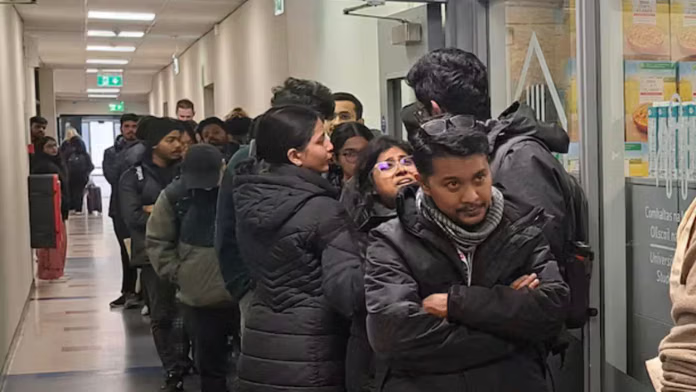
There is a quiet but consequential conversation happening in Indian households right now. It is not happening in boardrooms or policy corridors, it is happening at dinner tables, in WhatsApp groups of anxious parents, in the offices of education counsellors in cities like Indore, Coimbatore, and Patna. The question being asked, perhaps for the first time with genuine seriousness, is this: Does my child really need to go abroad to get a great education?Education (Getty Images/iStockphoto (PIC FOR REPRESENTATION))For decades, the answer felt obvious. A degree from a university in the US, the UK, Canada, or Australia carried an almost mythological promise, of global exposure, better salaries, and a life well-constructed. Indian families saved for years, took on significant debt, and sent their children across oceans with hope and sacrifice in equal measure. At peak, India was dispatching over 13 lakh students annually to pursue higher education overseas, making us one of the largest source countries in the world.That calculus is now being stress-tested, by global events, by economics, and, quietly, by government signals that deserve our attention.The numbers are striking. Annual tuition and living expenses for an Indian student in the US now routinely cross ₹50 to 60 lakh. In the UK and Australia, the figures are comparable. Meanwhile, the Indian rupee has depreciated significantly against the dollar, from around ₹70 five years ago to around ₹96 today, effectively making overseas education 15-20% more expensive in real terms, even before accounting for inflation in host countries.This comes at a time when visa environments have become unpredictable. Canada, once the preferred destination for its relatively open immigration pathway, tightened student visa approvals sharply in 2024, with acceptance rates in some categories reportedly falling below 50%. The US, under renewed policy pressure, has made international students increasingly anxious about post-study work rights. Australia has introduced caps on international enrolments. The geopolitical instability that defines this decade, from trade wars to real ones adds a layer of uncertainty that families simply did not have to factor in five years ago.Prime Minister Modi's recent call to Indians to prioritise domestic spending over international outflows was a reflection of a larger national mood. When the government signals that capital, talent, and aspiration are best invested at home, families that were already on the fence tend to listen.Something else is changing, and it matters more than any visa policy: Indian employers are increasingly indifferent to the geography of a degree. What they want is demonstrable skill, relevant domain knowledge, and the ability to contribute from day one. A student with a specialised certification from a well-regarded Indian institution, who has done meaningful internships in a growing domestic sector, is often more job-ready than one who spent three years and ₹60 lakh acquiring a generic international degree.India's private higher education ecosystem has matured considerably. Institutions across engineering, management, design, health care, and liberal arts have invested in industry-linked curriculums, global faculty, and placement networks that now rival - and in some cases exceed - what many second-tier international universities offer. The old assumption that quality education only exists abroad is simply no longer true.Here is what is perhaps most significant and most overlooked. The shift toward domestic education is not being led by students from India's metros. It is being led by the next wave of aspirational students from cities like Nagpur, Bhopal, Lucknow, and Mangaluru.These students and their families have high ambitions but are also acutely ROI-conscious. The ₹50 lakh overseas gamble was never really within reach for most of them. What they are discovering is that India now offers credible, career-oriented programmes in emerging fields: Data science, fintech, logistics, health care management, and more. And critically, financing for these programmes is increasingly accessible.In the education lending space, we are observing a meaningful shift in demand patterns. Loan applications for domestic professional programs, particularly from non-metro cities are growing at a faster clip than overseas education loans. Students who might have aspired to study abroad five years ago are now actively exploring and financing high-quality Indian programmes. This is not a consolation choice. For many, it is the smarter one.India is, at this moment, both a story of global uncertainty and domestic possibility. The world outside is expensive, unpredictable, and increasingly unwelcoming. The world inside is growing, investing in education infrastructure, and beginning to reward homegrown talent on its own terms.That dinner table conversation, “does my child really need to go abroad?” is no longer a question that families ask with resignation. Many are answering it with confidence, and choosing India. Not because the world closed its doors, but because India finally opened enough of its own.The next generation of ambitious, skilled, globally-minded Indians may well be educated right here. That is not a retreat. That is a reorientation, and it has been a long time coming.(The views expressed are personal)This article is authored by Prashant A Bhonsle, founder & CEO, Kuhoo.
Where Indian students choose to study in a shifting world
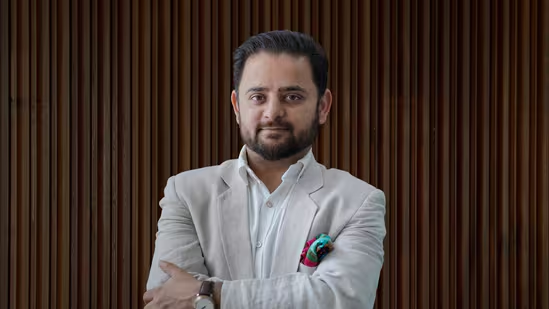
This article is authored by Prashant A Bhonsle, founder & CEO, Kuhoo.
817 words~4 min read