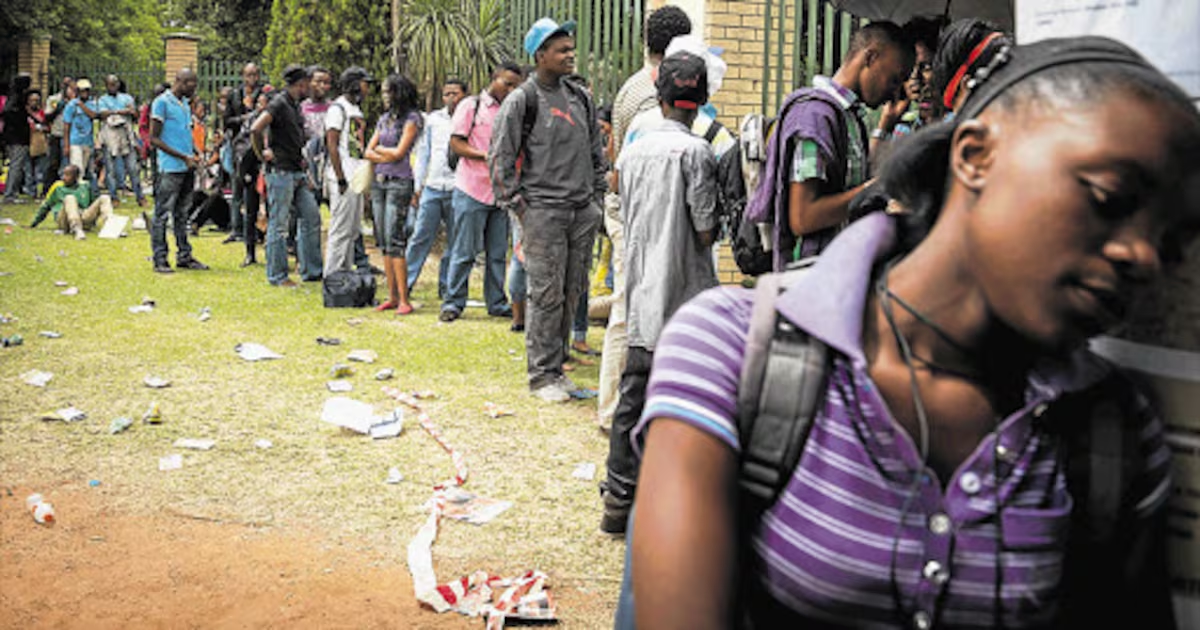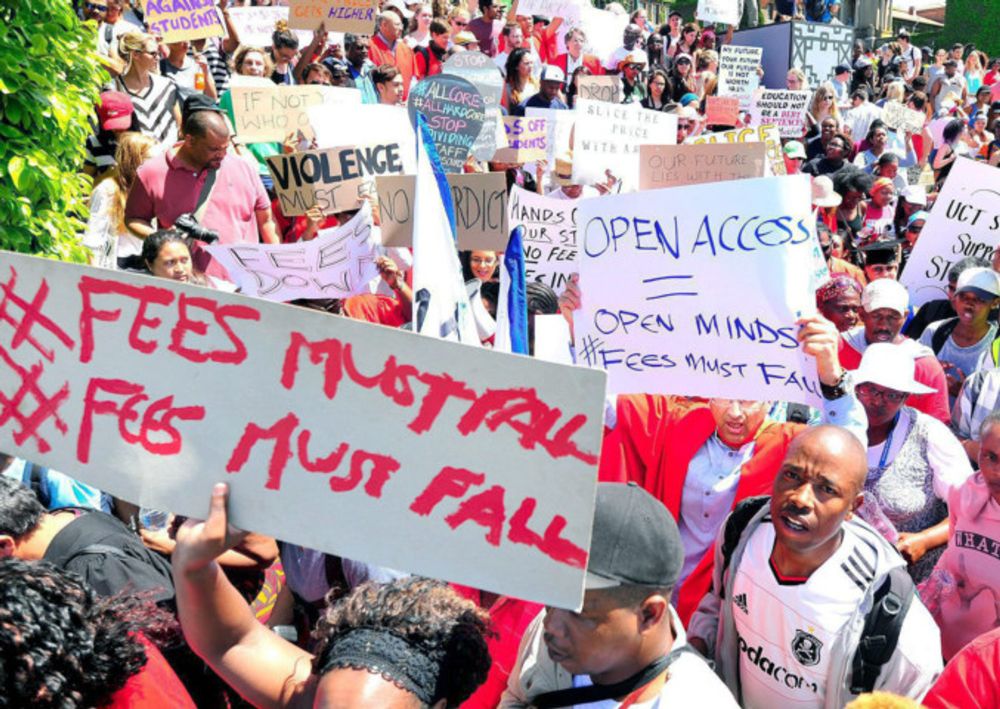
Public radio’s longest-running daily global news program.AboutContactDonateMeet the TeamPrivacyTerms of use©2026 The World from PRXPRX is a 501(c)(3) organization recognized by the IRS: #263347402.South African students to continue to fall into an education accessibility gapIn Apartheid South Africa, young Black people were excluded from fully accessing higher education due to race. Now, the restrictions on education are about money and class. With the country’s financial aid organization in turmoil, hundreds of thousands of South African students find themselves with enough money to get into school, but not enough to stay.South Africa has a long history of students standing up for what they believe in. Youth Day, on June 16, commemorates the 1976 Soweto Uprising, in which young people protested against Apartheid policies in schools.Children wearing school uniform observe the iconic image taken by photographer Sam Nzima, displayed at the Hector Pieterson Memorial in Soweto, South Africa, June 16, 2023, as the country celebrates Youth Day. The day is celebrated annually to commemorate the 1976 uprising, when learners protested against the use of Afrikaans as the official language of instruction in Johannesburg schools.Themba Hadebe/AP/FileIn 2015, university campuses again flared with tension during the Fees Must Fall protests over study costs. Their call to action was heard, with then-President Jacob Zuma agreeing to their main demand by allowing a 0% increase in university fees in 2016.In that moment, it felt like the students had changed history, because they had in a way.Students and supporters shout slogans as they march to the Chamber of Mines in downtown Johannesburg, Oct. 14, 2016. About 1,000 people participated in a peaceful march to the Chamber of Mines as part of the Fees Must Fall protest for free university education, attempting to highlight the mining industry’s role in the country’s economy.Denis Farrell/AP/File“Things are no longer as hard as they used to be,” said Nonofo Quinton Oliphant, who represents the South African Union of Students. “It’s not like before, where nobody was getting assistance.”After that year-long reprieve in 2016, fees continued to increase, but more students were able to get into colleges and universities.That’s largely because of changes to the National Student Financial Aid Scheme, or NSFAS. The program allowed students from families with slightly higher incomes to access funding. That funding was now mostly given as grants, instead of loans.University undergraduate degrees can cost around $3,000 to $5,000 a year, and NSFAS also covers accommodation, books and more.Students outside of the Wits Citizenship and Community Outreach office at Wits University in South Africa.Elna Schütz/The WorldEssentially, the dream of accessible education became possible for more people.“There are those who we can still today point out and say that, because of this model, here you are, you managed to become a beacon of hope [for] your family and [for] your community,” Oliphant said.But, in recent years, NSFAS has faced budget shortfalls, corruption scandals and governance crises. While politicians debate how to administer funds, students on the ground are still struggling.For instance, at the Wits Citizenship and Community Outreach office in Johannesburg, lunchtime means free meals for qualifying students. The University of Witwatersrand has seven campuses and around 42,000 students. It is considered one of the top 1% of universities in the world.Students hand in their student cards to one of the volunteers and wait in line. When their number is called, they go to the red, metal, shipping container, where another student will hand them their portion.Students at Wits University access free lunch meals at the Wits Citizenship and Community Outreach office to lighten their financial troubles in Johannesburg, South Africa, May 14, 2026.Elna Schütz/The WorldEvery weekday, the WCCO office feeds around a thousand students. Several times a week, they also hand out food parcels containing simple items such as rice, baked beans and a jar of mayonnaise.One of the volunteer leaders, Fumani Somlota, has been using the service for about three years. He tells the story of a friend inviting him to lunch at no cost, but he worried it would put him in debt. He soon discovered that the WCCO was a valuable resource.While his study fees have been covered by scholarships and NSFAS, he still has difficulty making ends meet. Somlata recently finished his undergraduate degree, but some of his classmates were missing from the graduation stage.Volunteer leader Fumani Solata found needed support through the university’s food program in Johannesburg, South Africa, on May 14, 2026. Elna Schütz/The World“A lot of my friends did not graduate because of student debt,” he said. “It’s a very sad situation, because you don’t know where you’re gonna get the funds from.”Universities will withhold diplomas if students are in debt. So, students who have finished their studies can’t do anything with their degree. It’s part of what analysts call “the student debt trap” that many of the country’s working class are caught in.Somlata said this traces back to the inequalities that Apartheid ingrained in the country. Historical patterns of segregation and exclusion continue to affect young Black South Africans.“Most of us are from a family of working-class people who are also children of working-class people, so it seems as if it’s too difficult to get out of that working-class cycle,” he explained.Food packages are handed out to students at the Wits Citizenship and Community Outreach office at Wits University, in Johannesburg, South Africa, May 14, 2026. Elna Schütz/The WorldThis is such a deep-running issue that the Fees Must Fall protesters coined the term “the Missing Middle.” This describes students who struggle to pay tuition and expenses but aren’t considered poor enough to qualify for sufficient government support to cover the gap.Mabalane Nzapheza Nzedensi is the student development coordinator of the office handling the food program. He said there’s more funding support for the missing middle than before, but the problem has increased as the middle class has expanded.“It’s still a problem that we’ve seen,” he said. “In fact, it has even grown more than before, because as the middle class grows in South Africa, and the classification of the middle class, it becomes difficult.”Student development coordinator Mabalane Nzapheza Nzedensi has helped thousands of students facing poverty, hunger, and homelessness in Johannesburg, South Africa, May 14, 2026.Elna Schütz/The WorldIn his work with students, he’s found that these funding gaps show up in more ways than just hungry youngsters and missed graduations. Especially if students are coming from more rural, underserved areas of the country, they’ll go to great lengths to keep studying, including being homeless for a period of time.Some students admitted to sleeping behind the library in the open winter air, with only their book bags for comfort. Some kept belongings with friends and sneaked into campus residences for a quick shower.Civil engineering student Raymond Rulani Ngona came from a village a few hours away from Johannesburg in Gauteng province. “I remember I also had to go to school and ask my teachers to financially contribute a bit in terms of enabling me to travel from home to Gauteng.”Civil engineering student Raymond Rulani Ngona has faced financial hardships and homelessness during his educational journey in Johannesburg, South Africa, on May 14, 2026. Elna Schütz/The WorldIt took a lot from his family and community to get him to university, but at the start of his second year, he couldn’t afford to live.“So, what I did was decide to stay here and sleep at the computer labs, and during that time, there was no one who I would say was helping me financially to make my way around, making sure that I eat, study, I attend classes.”He eventually got enough support to find a home, but the practice carries on.“Yes, because I was not sleeping alone at the computer lab, so especially at Wits, I feel like it’s tough because I had to end up making friends there, sleep together there,” he admits.If that’s what it takes to make your family proud and get that promising future in the form of a degree, that’s what students will do.Access to higher education has improved, but the legacies of exclusion remain. And so does students’ resilience.There’s a long history of South African students who have fought for their right to education. And as Nzedensi from the food programme reminds, change is always possible.“Collaborative effort needs to happen from both private and government institutions, and once we solve the institutions of higher learning problems, we can solve a whole lot of problems within our country.”
South African students to continue to fall into an education accessibility gap - The World from PRX
In Apartheid South Africa, young Black people were excluded from fully accessing higher education due to race. Now, the restrictions on education are about money and class. With the country’s financial aid organization in turmoil, hundreds of thousands of South African students find themselves with enough money to get into school, but not enough to stay.
1,400 words~6 min read