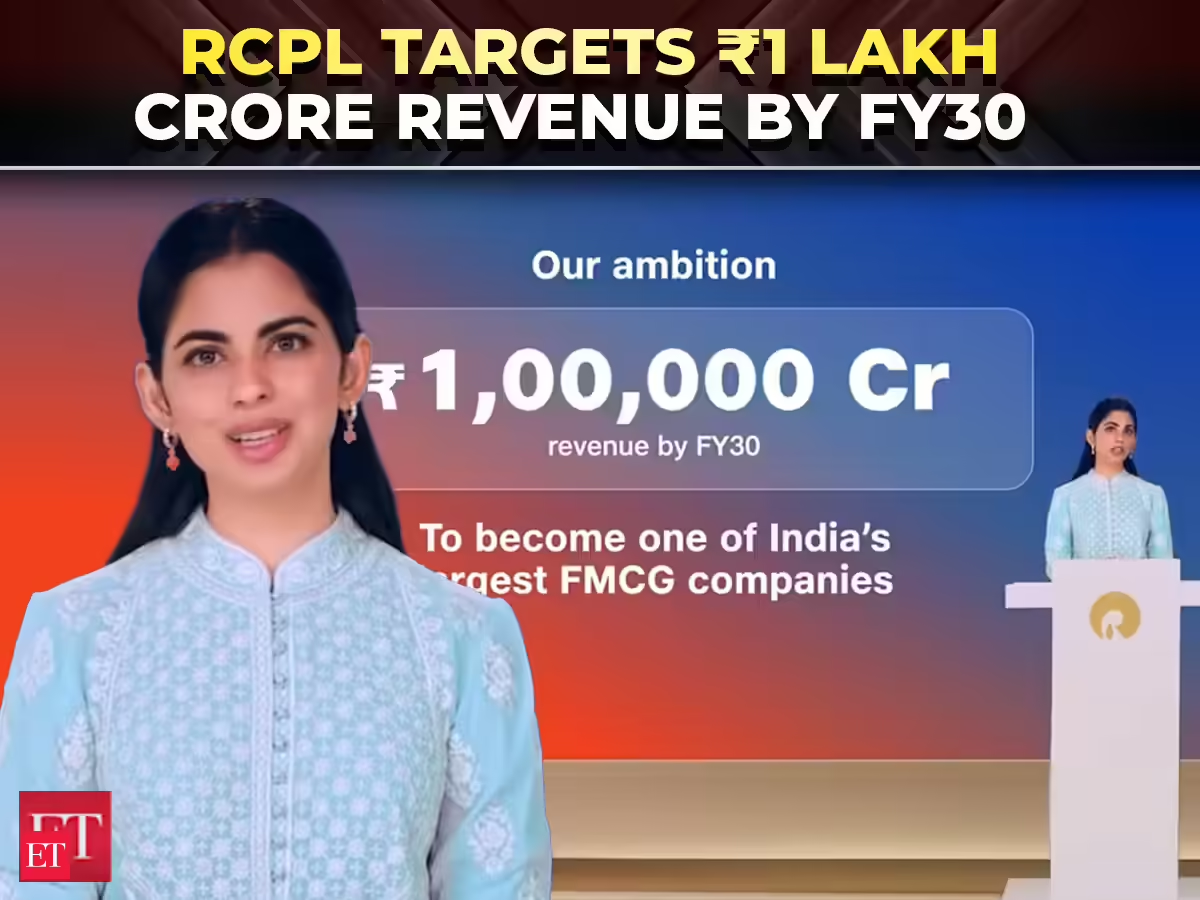
Isha Ambani on Friday unveiled an ambition to build Reliance Consumer Products Ltd (RCPL) into a ₹1 lakh crore business by FY30, backed by plans to invest ₹30,000 crore in integrated food parks, expand its presence to more than 40 countries and scale brands such as Campa and Independence.For decades, India’s consumer goods industry has been shaped by brand-building, distribution reach and incremental market-share gains. Reliance is attempting to rewrite that playbook by combining brands with ownership of retail shelves, digital commerce platforms, consumer data, manufacturing assets and one of the country’s largest distribution networks.If successful, the strategy would place RCPL among India’s largest consumer goods companies and compress into less than a decade a scale-building journey that took rivals such as Hindustan Unilever, ITC and Nestle generations to achieve. “RCPL’s near-term ambition is to reach ₹1 lakh crore in revenue by FY30. Our long-term ambition is to become one of India’s largest FMCG companies, with a global platform to match,” Ambani told shareholders.The Blueprint behind the ambitionThe roadmap unveiled by Ambani offers the clearest blueprint yet of how Reliance intends to build consumer products into its next major growth engine alongside Jio and Retail. RCPL doubled revenue to ₹22,000 crore in FY26, expanded its presence to more than 40 countries, grew Campa into India’s fourth-largest carbonated soft-drink brand and strengthened its portfolio through acquisitions across foods, beverages and personal care. Together, the announcements suggest Reliance is pursuing growth through a combination of manufacturing scale, distribution reach, acquisitions and brand building, rather than relying solely on the traditional FMCG playbook.The ambition is striking not just because of its size, but because of its timeline. Hindustan Unilever, India’s largest FMCG company, generates annual revenue of about ₹65,000-70,000 crore, while Nestle India and ITC’s FMCG businesses are each in the ₹20,000-25,000 crore range. In just four years, RCPL has already reached a scale comparable to Nestle India and ITC, a journey that took established consumer goods companies decades to achieve. Reliance now wants to take the next leap — to ₹1 lakh crore in revenue by FY30, effectively compressing generations of FMCG expansion into a single decade.The significance extends far beyond a revenue target. With India’s FMCG market expected to grow in high single digits, Reliance cannot achieve its ambition through industry growth alone. The company will need to capture market share across beverages, staples, packaged foods and personal care, setting up a direct challenge to incumbents such as Hindustan Unilever, ITC, Nestle India, Dabur, Marico and Godrej Consumer Products.A Different FMCG PlaybookFor investors, the announcement raises a larger question: can Reliance do to FMCG what Jio did to India’s telecom industry and what Reliance Retail did to organised retail?Unlike traditional FMCG companies that spent decades building brands before expanding distribution, Reliance is attempting the reverse. It is leveraging an ecosystem that already spans more than 20,000 retail stores, 387 million registered customers, quick-commerce operations, digital commerce platforms and a rapidly expanding FMCG distribution network. RCPL now reaches more than 3 million outlets through over 5,000 distributors, giving it a route-to-market that few consumer companies have enjoyed at a similar stage of their evolution.The company’s strategy is simple: use the scale of Reliance Retail, JioMart, quick commerce and its distribution network to place products in front of consumers faster than traditional FMCG rivals and shorten the timeline for building brands.Campa Leads the ChargeThe beverage business has emerged as the spearhead of that strategy. Campa generated more than ₹4,700 crore in gross sales during FY26 and has become India’s fourth-largest carbonated soft-drink brand, while Campa Sure has helped RCPL emerge as the country’s third-largest packaged drinking water player. The beverages portfolio grew 3.2 times during the year, giving Reliance a foothold in categories traditionally dominated by Coca-Cola and PepsiCo.The broader playbook appears to be using beverages as a wedge in the FMCG ecosystem before expanding across daily essentials, foods and personal care. Independence, Reliance’s daily essentials brand, generated ₹2,600 crore in revenue during FY26, while acquisitions including Udhaiyam Agro Foods, Southern Health Foods and Australia’s Goodness Group Global have expanded the company’s portfolio and manufacturing capabilities.Reliance is also investing in product development. Its consumer products R&D centre employs more than 125 scientists and developed over 100 products during the year, underscoring an ambition to build an innovation-led FMCG platform rather than rely solely on distribution scale.The ₹30,000 crore manufacturing betPerhaps the most consequential announcement was not about brands but about manufacturing. After investing ₹10,000 crore in production infrastructure, RCPL plans to invest another ₹30,000 crore over the next three years to build integrated food parks across India. Reliance said the facilities will be AI-driven, robotics-enabled and designed to create scale efficiencies across categories ranging from staples and packaged foods to chocolates and beverages.The investment signals that Reliance is seeking more than market share. By controlling sourcing, manufacturing, distribution and retail, the company is attempting to build structural cost advantages that could allow it to maintain aggressive pricing while preserving profitability.The manufacturing push is backed by Reliance Retail’s sourcing network, which procured about 5.7 lakh tonnes of fruits and vegetables from more than 40,000 farmers and sold 12 lakh tonnes of staples during FY26, creating synergies between sourcing, processing and distribution.What It Means for HUL, ITC and NestleThe implications extend well beyond Reliance. To reach ₹1 lakh crore in revenue by FY30, RCPL will need to win business from established players rather than simply benefit from industry expansion.That places companies such as Hindustan Unilever, Nestle India, ITC, Dabur, Marico and Godrej Consumer Products directly in Reliance’s competitive crosshairs. For an industry long defined by incremental gains and patient brand building, Reliance’s push represents one of the most aggressive attempts yet to redraw the competitive landscape of Indian consumer goods.Ambani made clear that consumer products are now being positioned as the group’s next major pillar, telling shareholders that RCPL would soon become “a value-creating engine for Reliance Industries, comparable in scale and profitability to our retail business.”Published on June 19, 2026
Isha Ambani sets ₹1 lakh-crore business target as Reliance Consumer Products takes on HUL, ITC and Nestle
Isha Ambani aims to grow Reliance Consumer Products to ₹1 lakh crore by FY30, challenging industry giants with innovative strategies.
TL;DRAI
Isha Ambani targets ₹1 lakh crore for RCPL by FY30, backed by ₹30,000 crore in AI-robotics manufacturing. Reliance's integrated platform (retail, distribution, JioMart, AI) compresses FMCG scale-building to a decade—forcing incumbents to accelerate digital and manufacturing investments.
996 words~5 min read