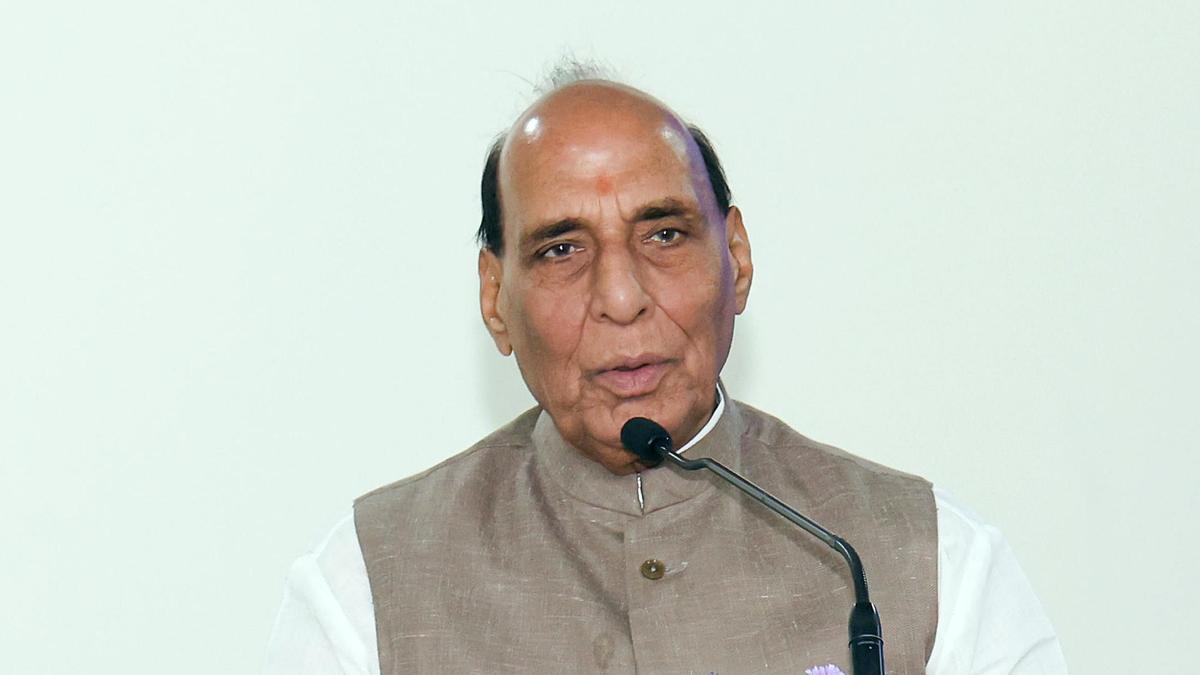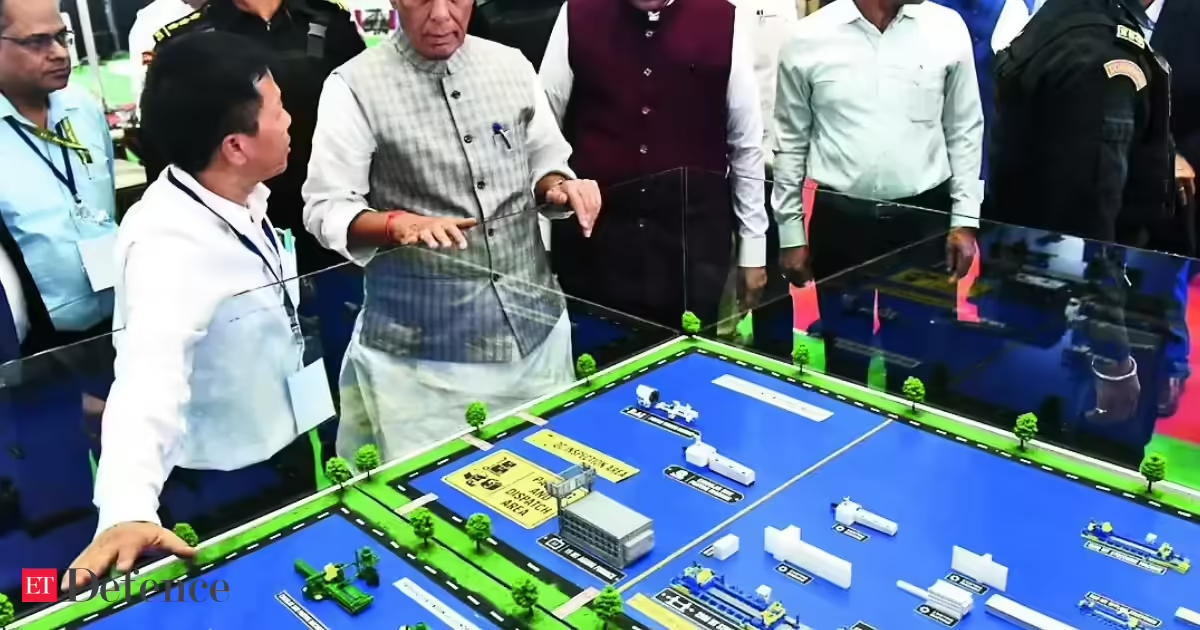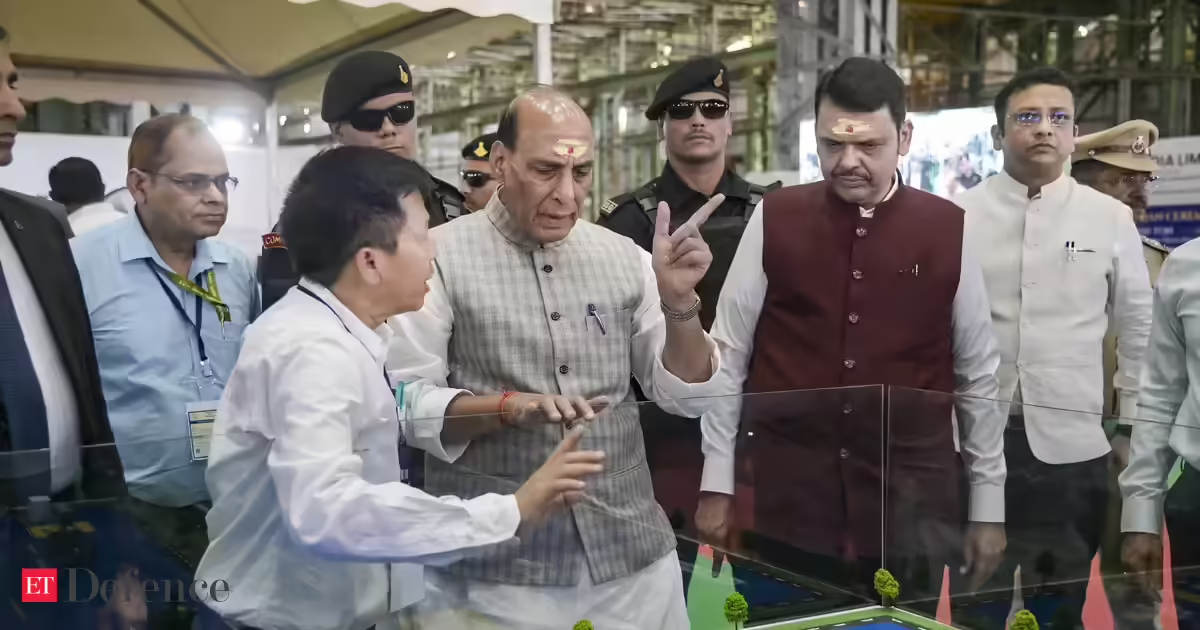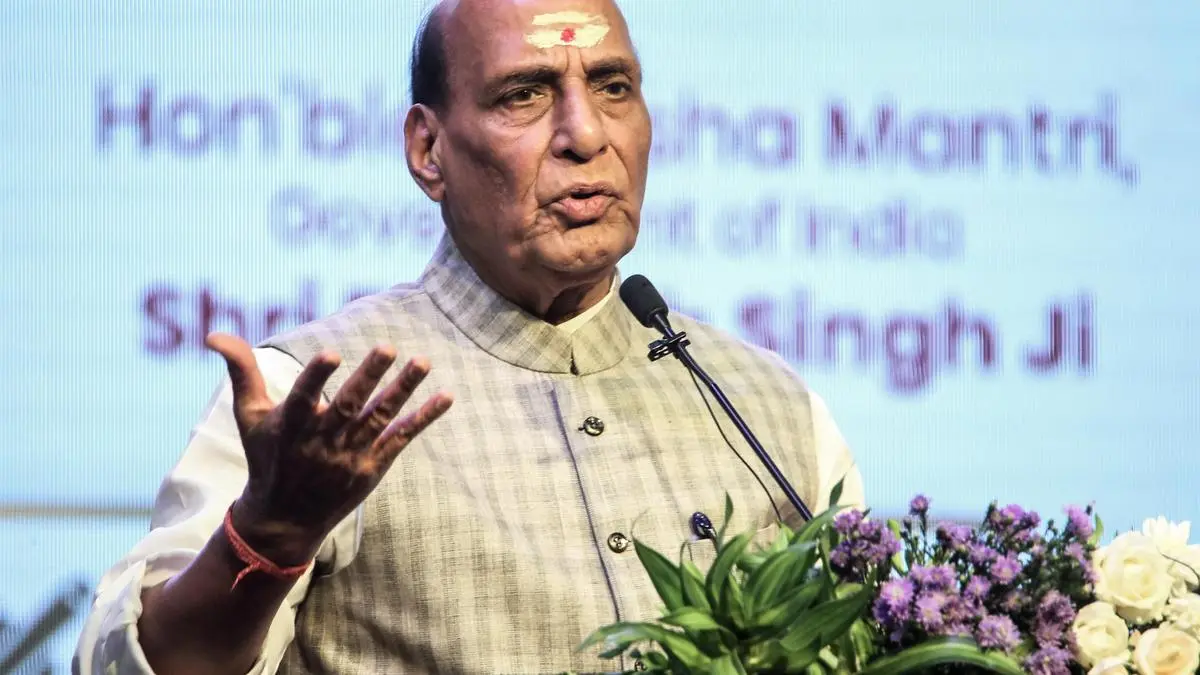
Union Defence Minister Rajnath Singh addresses during the Bhoomipujan and stone plaque unveiling ceremony at Ordnance Factory Ambajhari, in Nagpur
| Photo Credit:
The Ordnance Factor Board’s (OFB’s) production value has grown by 106.05 per cent in the last six years, increasing from ₹12,755 crore in the pre-corporatisation year of FY 2019-20 to now ₹26,282 crore in FY 2025-26. Meanwhile, in defence exports, the OFB’s contribution has seen an exponential growth of over 55 times in those 6 years, with the state-owned units now selling abroad products to the tune of ₹4,561 crore, a significant increase from ₹81 crore in FY 2019-20.Defence Minister Rajnath Singh shared these figures during his speech on Friday after he performed the ‘bhoomi pujan’ for the 10,000-tonne Aluminium Extrusion Press, along with Maharashtra Chief Minister Devendra Fadnavis, at Ordnance Factory Ambajhari, Nagpur, a unit of Yantra India Ltd (YIL).OFB was dissolved and its 41 ordnance factories were converted into seven distinct, 100 per cent government-owned Defence Public Sector Undertakings (DPSUs), in October 2021.“A nation capable of meeting its own requirements moves forward with the greatest confidence towards safeguarding its interests,” said the senior NDA Minister.Operational AutonomyAcknowledging the self-reliance initiatives of the YIL, he stated that the corporatisation of the OFB was carried out to make the system stronger and more agile in view of the changing times, and emerging technologies. “Post-corporatisation, we envisioned that the new entities would enjoy sufficient operational autonomy and gain opportunities to excel in innovation, risk-taking, research and exports. All the new DPSUs have successfully moved in that direction. OFB’s production, which stood at ₹12,755 crore in the pre-corporatisation year of FY 2019-20, has risen to ₹26,282 crore in FY 2025-26. In defence exports, the figure stood at a mere ₹81 crore prior to corporatisation. It has now surged to ₹4,561 crore, with YIL contributing ₹ 397 crore,” he stated.This was due to the government’s persistent efforts, emphasised Singh, as the domestic defence production, which stood at ₹46,000 crore in 2014, has risen to a record ₹1.78 lakh crore in FY 2025-26. He added that the nation was exporting arms and equipment worth less than ₹1,000 crore in 2014, which has now skyrocketed to an all-time high of ₹38,424 crore.“This represents not just a rise in numbers, but a growth in India’s capabilities. It signifies a boost in the nation’s self-confidence. We are poised to achieve the targets we have set for the next 2-3 years: ₹3 lakh crore defence production and ₹50,000 crore defence exports ahead of schedule,” he said.He observed that the Extrusion Press symbolises a shift in the country’s approach from relying on imports to producing critical goods domestically. He described taking control of security-related necessities as imperative in the present geopolitical scenario to remain future-ready.Strengthening Supply ChainThe Ministry of Defence also stated that the proposed press will be one of the most advanced facilities of its kind in the country. It will support the manufacture of large and complex aluminium alloy profiles required for defence systems and platforms, aerospace and aviation structures, missile programmes, railways, the transportation sectors and other strategic industrial applications. The project will help reduce dependence on imports of critical aluminium extrusions and strengthen the domestic supply chain, while supporting the future requirements in strategic sectors through indigenous production.According to him, while the nature of warfare is evolving and enemies are harder to detect, conventional warfare and its associated means remain just as relevant as they were in 1947, and will retain much of the same relevance in 2047 as well. He further stated that the importance of a strong military-industrial base will continue for a long time, and the Extrusion Press is a step towards fulfilling a major national need, keeping the future requirements in mind.Published on June 19, 2026