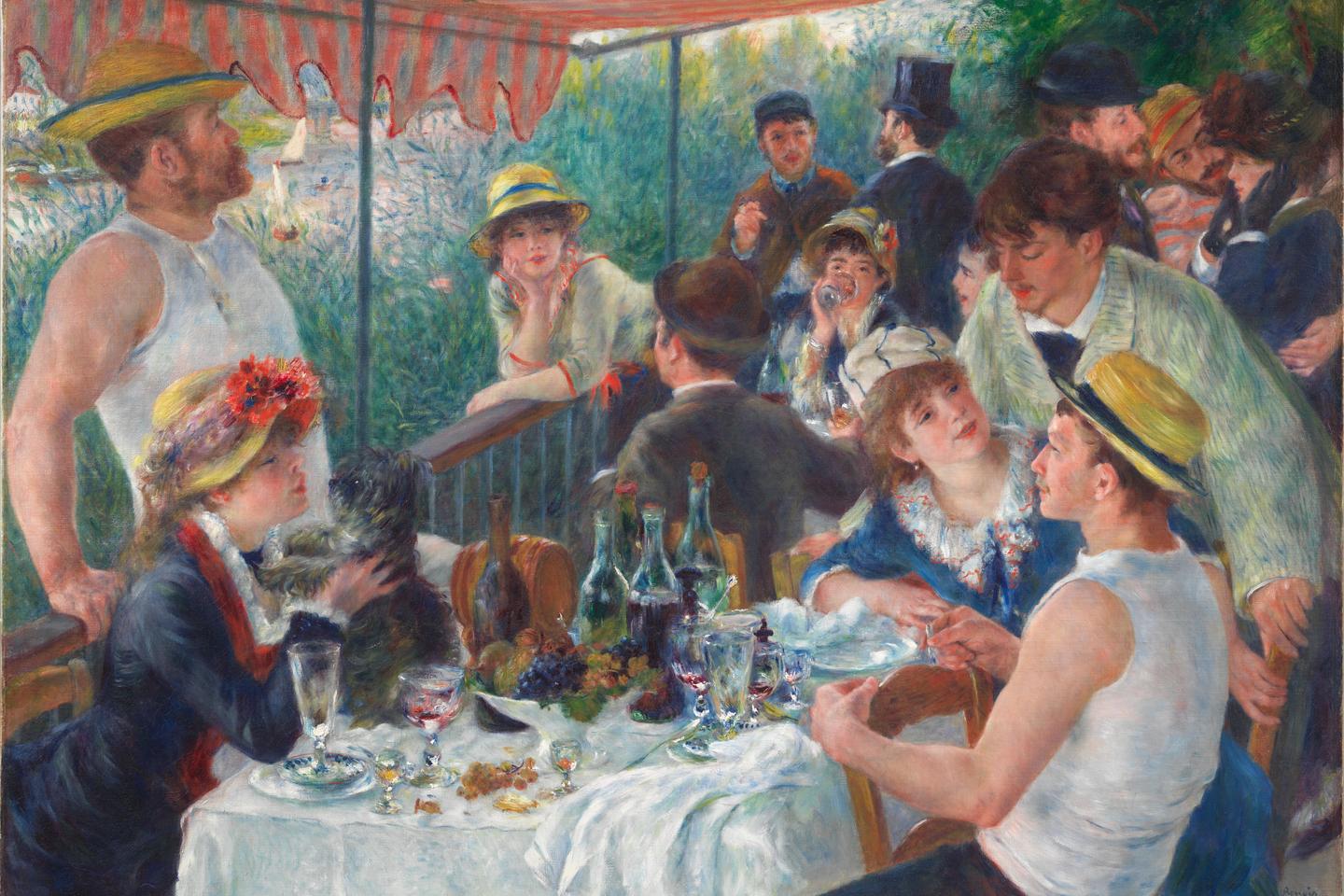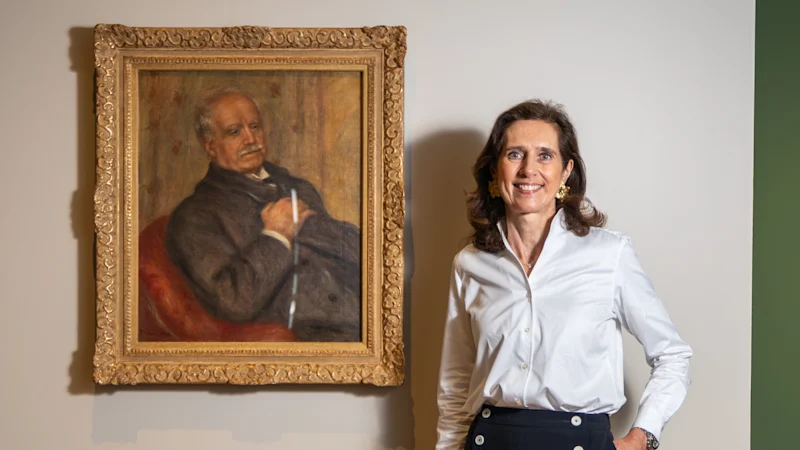
June 19, 2026 — 7:00pmThe first painting you see is a portrait of a man. He’s wearing a dark jacket and leaning back, his hand resting on his chest. This isn’t a posture of relaxation. He’s looking out of frame and his eyes seem as though they’re not seeing what’s in front of them; it’s the look of a man who is thinking deeply, broadly, continuously.This is Paul Durand-Ruel, painted by Pierre-Auguste Renoir – and without Durand-Ruel, there’s a high chance that many of the paintings displayed in the exhibition that sprawls out behind his portrait may never have been created.Claire Durand-Ruel pictured with a portrait of Paul Durand-Ruel by Auguste RenoirRuby AlexanderDiscovering the Impressionists: Paul Durand-Ruel is a new exhibition at Geelong Gallery bringing together more than 70 paintings by both the big names of the impressionist movement, and a forgotten generation of artists who have mostly slipped under the radar. Some of the works will be familiar but most are not, with a large percentage of the paintings sourced from private collections. About a third of the works have not been seen in public for more than a hundred yearsCo-curated by Marianne Mathieu and Durand-Ruel’s great-great-granddaughter Claire Durand-Ruel, the exhibition not only tells the story of impressionism and the man who fought for it, but also shines a light on the movement’s impact over generations of artists.It’s easy to forget that there was a period of time when Monet, Renoir and Pissarro were the rejects of the art world. Their works – now held in galleries across the world, and sold for many millions at auction – were then dismissed, sneered at and held in low esteem. Even the term “impressionism”, which later came to define the movement they pioneered, was meant derogatorily – their work was thought of as lazy and amateurish. But not by Paul Durand-Ruel, who championed the impressionists passionately, even when it nearly sent him bankrupt. Twice.“This man was completely in love with art,” says Claire Durand-Ruel. “Even if he didn’t have the money, he just couldn’t help himself ... he was a gambler. When he championed an artist, he was totally devoted and obsessed by the artist and supported him. Even if he didn’t have the income to support him, he would continue and do his best to find money to still buy and support.”A pair of doors commissioned featuring the work of Albert AndréRuby AlexanderDurand-Ruel’s support of artists was comprehensive. He not only bought works, but also paid artists a monthly salary so they didn’t have to think about paying their bills, allowing them to completely devote themselves to their work. “There are thousands and thousands of letters between the dealer and the artist saying, just really quick notes, ‘Dear Mr Durand, can you send me 500 francs to pay for my groceries?’” Claire Durand-Ruel says.The exhibition unfolds across a series of brightly painted rooms. In the first section, painted in green, some of the biggest names in the exhibition are placed side by side. Mathieu explains that the idea is that it is difficult to differentiate who painted what. “It seems to be the same, so it is the visual explanation that there is a link between them,” Mathieu says.As you head further into the exhibition, that’s where familiarity begins to slip away. There’s a work by Renoir that deviates strongly from what we expect of the artist, and there’s a pairing of works by Berthe Morisot and her husband, Eugène Manet (brother of Édouard), which sees both depict the same scene in their own way. The middle section is dedicated to the work of Albert André and Georges d’Espagnat, artists that Mathieu describes as the second generation of impressionists.Woman and Peacocks by Albert André on display at Geelong GalleryRuby AlexanderOne of the most striking elements is a collection of three sets of interior doors, stretching high up into the ceiling. Each door features a series of seven painted panels – two doors feature the work of d’Espagnat, while the other is the work of André. Putting the doors back together was a particular challenge – across the years the panels were removed and sold separately. Reconstituting them meant tracking down each one. “We wrote, and we met the owner[s], and we said, ‘This is a part of a door – and we would like to reconstitute [it],’” says Mathieu.“Can’t say I’ve ever heard of that one,” says a woman behind me as we both look at d’Espagnat’s In the garden c1913. It’s a scene that is both bright and somehow hazy like recent memory: a woman in blue looks directly at the viewer while a child sits nearby reading a book. Nearby a series of works by André depict quiet scenes of women getting ready for the day. They’re intimate and vibrant.The big names in this exhibition might be what first pull the crowds in, but it’s the quiet stories and the artists who have been just to the right of the limelight that most stay with you.More:Visual artWhat’s onFor subscribersVictoriaArtsGeelongSee & DoFrom our partners
The big names in this show will draw people in. But something else will make them stay
Without the support of art dealer Paul Durand-Ruel, artists such as Renoir and Monet may never have become household names.
845 words~4 min read