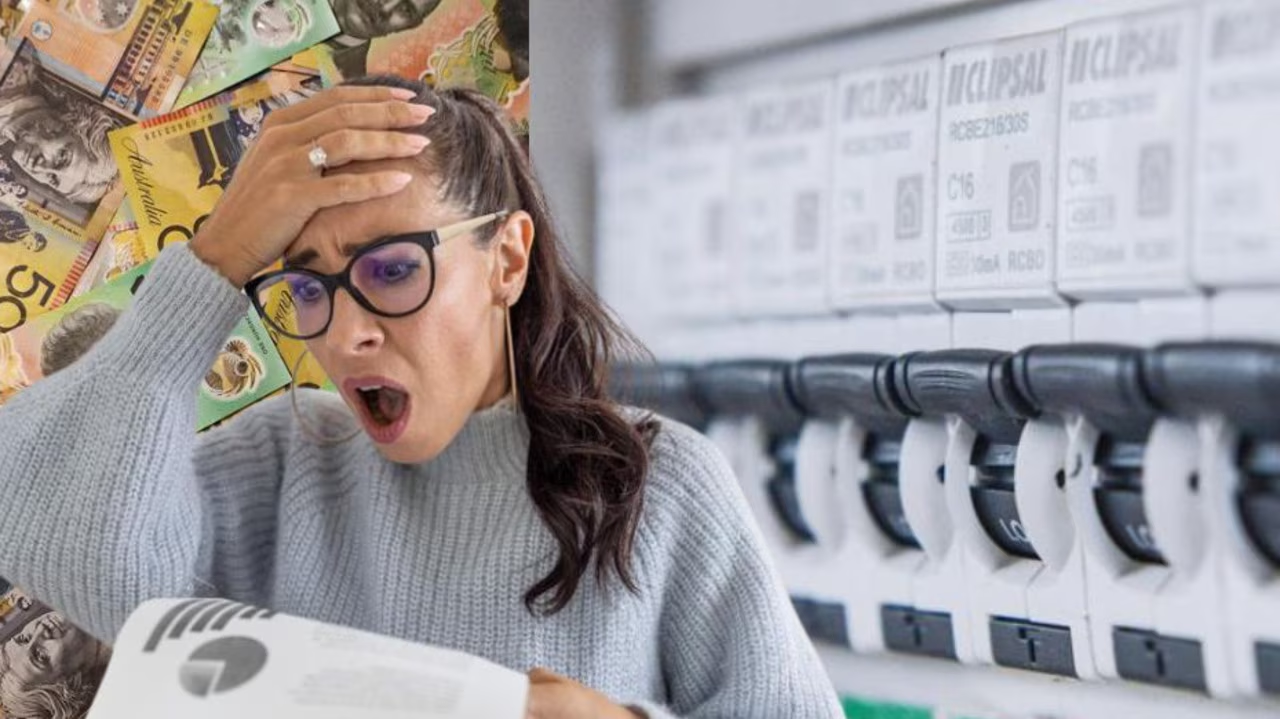
Australians are paying hundreds of dollars more on their power bills in a kind of “loyalty tax”, thanks to their energy provider leaving them on outdated plans.The issue has been described as a “massive missed opportunity” by an independent advocate organisation, who says “shining a light” will not address the issue. Energy Consumers Australia (ECA) chief executive Brendan French said households, small businesses and retailers often found themselves entangled in it losing hundreds of dollars. “We cannot allow more than a million households – who are often lower-income or otherwise disadvantaged, as the AEMC acknowledges – to fund short-term benefits for those with the time and resources to repeatedly switch retailers,” Mr French said. According to the ECA, Australians are offered “unrealistic” low prices, often hiked up by 20 per cent or more annually by providers who want to keep their market share. “Instead of spending money on marketing and customer churn, this should be invested in better products, services, and fairer, more sustainable pricing for everyone,” he said.The Australian Energy Market Commission (AEMC) recently announced four comprehensive recommendations to make power prices simple and fair for Australians. In its final recommendations, published on Thursday, the group suggested offering households straightforward plans – just like a single shelf-price for milk. The commission also proposed rewarding small businesses or households that own solar or battery, as well as developing tools that help them compare plans for sophisticated energy products beyond just the pricing comparison. The energy markets authority also exposed the loyalty tax trap issue, describing it as a “penalty for loyalty” that most Australians did not even realise they were paying. To protect these long-term customers, the commission proposed energy retailers notify anyone who has been on the same plan for four years and tell them exactly how much extra money they were paying compared to a better current market offer. But Mr French slammed the recommendation, saying it “simply won’t address the issue”. “It fails to address the structural market failure because no retailer can realistically act alone to fix this,” he said. “The failure to tackle the loyalty tax in a substantive way is yet another example of how broken the current energy market is for consumers.”The Energy Market Commission’s chairwoman Anna Collyer said the recommendations would need more work, consultation and collaborations. “Electricity pricing has become too complex, too hard to compare, and too often unfair. You shouldn’t need to be an energy expert to get a fair deal, and longstanding customers should not pay more than someone who just walked in the door,” she said. This comes after a recent announcement by the Australian energy regulator to lower power bills for millions of Australians. Last month, the Australian Energy Regulator’s final Default Market Offer (DMO) for flat rate residential customers showed an annual reduction between 3.4 per cent ($66) and 5 per cent ($137) in NSW and by 7.2 per cent ($155) in South East Queensland compared with last year.However, flat rate prices in South Australian households will increase by 1.4 per cent ($33) for households.For smart meter households on a time of use standing offer, there are savings across all three regions where the DMO applies.
‘Loyalty tax’ costing Aussies dearly
Australians are paying hundreds of dollars more on their power bills in a kind of “loyalty tax”, thanks to their energy provider leaving them on outdated plans.
TL;DRAI
Over 1M Australian households lose hundreds yearly via "loyalty tax"—outdated plans while switchers get discounts. Transparency-only regulation fails to fix the structural issue; binding price controls required—a pattern seen in opaque cloud/SaaS markets.
531 words~2 min read