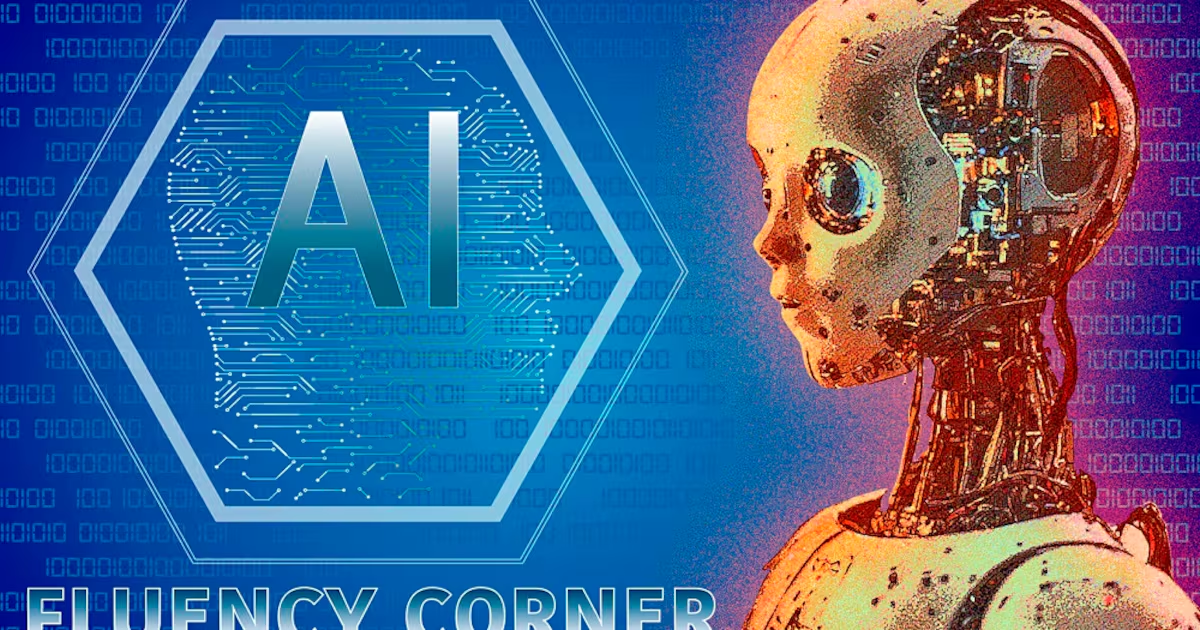
This is the fifth instalment of AI Fluency Corner, a 16-part weekly series building a connected mental model of artificial intelligence (AI) in plain language.Your face unlocks your phone in the dark. A banking app reads a handwritten receipt. A chatbot routes a spoken complaint to the right department. None of this is guesswork, magic, or especially good luck. It is deep learning — and the same underlying architecture powers all three. Last week, we examined machine learning: systems improving by finding patterns in data. This week we step inside the architecture behind the most capable AI. Neural networks are not new. What changed is what happens when you make them very, very deep. What a neural network actually is — and isn’t The name is borrowed from biology but should not be romanticised. A neural network is not a digital brain — it does not think, reason or feel. It is a mathematical structure: layers of connected processing nodes, each receiving inputs, applying a weight and passing a result forward. Here is the analogy that makes it click. Imagine a talent show with 50 judging rounds. Round one: pitch high or low, performer moving left or right. Scores passed forward. Round two uses those scores to notice more — rhythm, timing, contrast. By round 50 the final judges have never seen the performer. They have received only increasingly refined summaries — and yet they identify the act with precision. That is a neural network. Intelligence emerges from the sequence, not any single layer. When there are many layers, the system is a deep neural network, and the approach is called “deep learning”. “Deep” means many layers, not profound wisdom — an important distinction. How your face becomes a mathematical certainty Facial recognition illustrates this most clearly. When your phone scans your face, the image enters a convolutional neural network as a grid of pixel values. The initial layers detect only elementary features: edges, curves and contrasts. They have no idea what a face is. They are reading light. Middle layers combine those edges into recognisable structures: eye socket, nose bridge, and jawline. The deepest layers assemble these into a geometric signature — the distances and angles between your features, unique to you — and compare it against a stored template. Match within a learnt tolerance and the phone unlocks. This is why a photograph does not fool modern systems. A flat image produces a two-dimensional edge pattern. A real face has curvature, shadow and depth — a difference the deeper layers learnt from thousands of examples. The system never memorised your face. It learnt what makes your face mathematically yours. Where deep learning is already doing the work FNB, Standard Bank and Nedbank deploy models for fraud detection, combining transaction amounts, device signals, timing, location and behavioural history into probability scores no rule-based system could replicate. The power is not one dramatic flag. It is dozens of weak signals becoming a confident conclusion. The voice note your phone converted to text, the email summary your client generated, and the retail recommendation are all transformer-based deep learning. ChatGPT, Copilot and Gemini learnt which word sequences follow which others across billions of examples. When they sound coherent, it is because they excel at linguistic pattern-matching — not because they understood your question the way you did. The limits that never appear on the slide deck Neural networks have one built-in structural weakness: they cannot explain themselves. A deep learning credit model may accurately decline applications across a million cases. Ask why it declined this specific person, and the architecture has no answer. The decision emerged from millions of calculations across dozens of layers — no rule to surface, no reasoning chain to read. This is the black-box problem, and in regulated industries it is not a technical inconvenience. It is a liability. South Africa’s Protection of Personal Information Act grants individuals the right to human review of automated decisions. The National Credit Act requires adverse credit outcomes to be explainable. A vendor who cannot say why their model said no may be failing a legal test, not only a technical one. The second limit: the model knows the world it was trained on, not the world as it stands. A language model built on English-dominant text may underperform in Zulu or Sotho — not because those languages are lesser, but because they were underrepresented in training. A model cannot know what it was never shown. A model nobody is watching is not a system. It is an assumption, running unattended. Three questions that separate fluency from faith What was the model trained on — and does that cover your context? A system built on US or European faces, accents and financial behaviour may underperform precisely where you need it most. Can outputs be explained decision by decision? Accuracy across a population does not satisfy the obligation to explain an outcome to an individual. The brochure features accuracy. Ask about the explanation. How is performance monitored after deployment? Neural networks do not self-correct. As behaviour shifts and markets move, an unmonitored model drifts — confidently, quietly, in the wrong direction. A model nobody is watching is not a system. It is an assumption, running unattended. Our task this week The next time an AI feature seems to see, hear or understand context, pause and ask: what was this model trained on — and what has it probably never seen? That question, consistently applied, is worth more than any product demonstration. The most dangerous thing about a neural network is not what it gets wrong outright. It is that it gets things wrong enough, often enough, that you stop asking. • Mafinyani is senior partner in financial engineering & AI at specialised finance, risk and applied technology firm Intellica Analytics. Next week: natural language processing — where it is already embedded in the tools you use and where it can replace manual text work.
RUFARO MAFINYANI | Neural networks and deep learning
Why neural networks excel at pattern-matching but struggle to explain decisions
991 words~5 min read