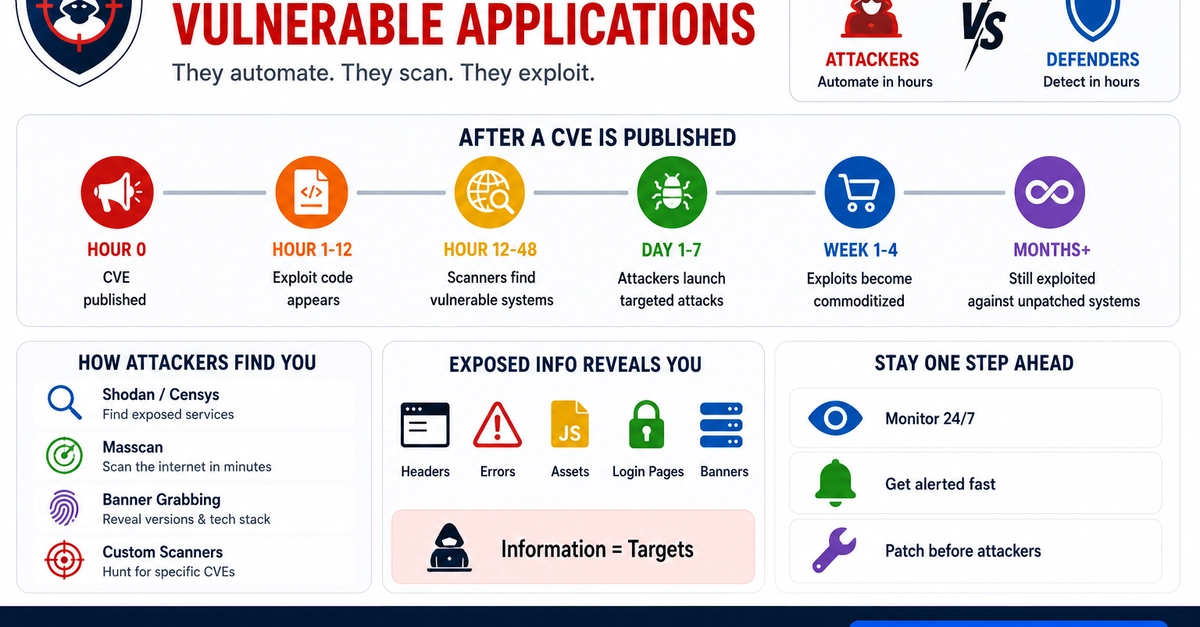
Attackers do not need to know your company, your codebase, or your roadmap. If your application exposes a vulnerable dependency, framework, server, plugin, or API, automated systems can find it before your team opens the next security ticket.
That is the uncomfortable truth behind how attackers find vulnerable applications. They watch public CVE feeds, scrape vendor advisories, build scanners, fingerprint exposed services, and search the internet for systems that match known vulnerable patterns. Defenders who rely on occasional manual checks enter the race late.
The Attacker’s Timeline — What Happens After a CVE Is Published
CVE stands for Common Vulnerabilities and Exposures. When a CVE becomes public, defenders see an advisory. Attackers see an opportunity. The gap between disclosure and exploitation can be days, hours, or already gone when exploitation started before public disclosure.
For common open source packages, the process moves quickly because the information is public. A vendor advisory may include affected versions, fixed versions, vulnerable components, proof details, and exploit conditions. Security researchers may publish technical analysis. Attackers convert that information into scanning rules and exploit attempts.