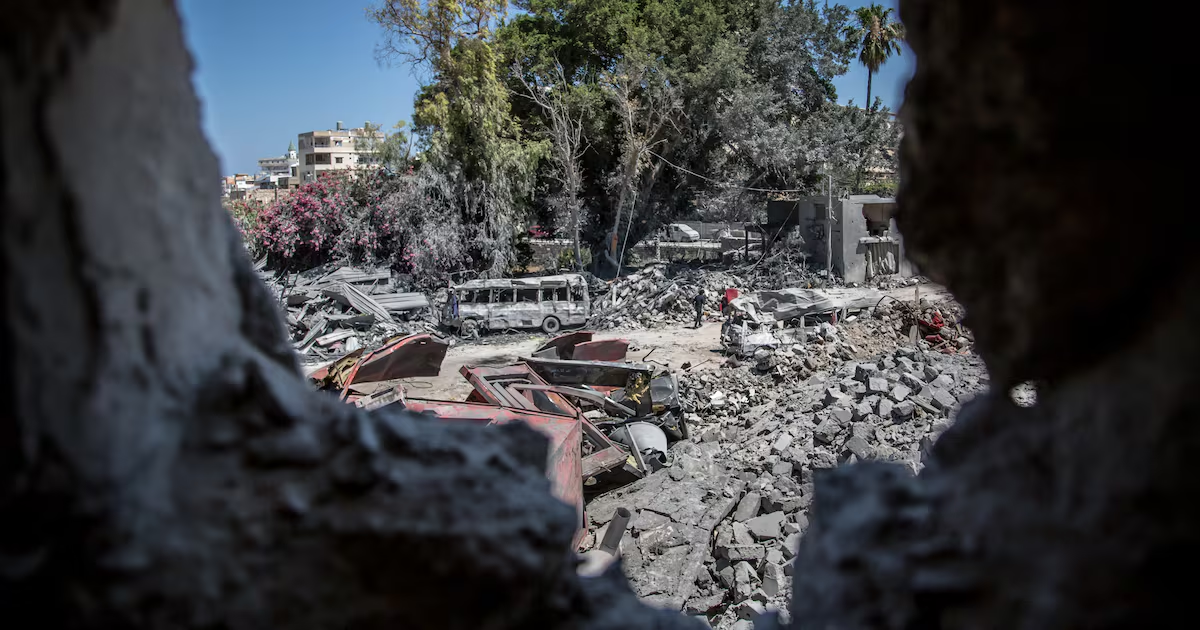
Fatima Sultan stands on the roof of her home, pointing toward a patch of land the Israeli army is believed to still occupy, then sweeping her hand across towards neighbouring villages scarred by months of fighting. The 60-year-old has just returned to the southern Lebanese village of Souaneh after the latest ceasefire announcement, driving along roads lined with destruction and shattered homes in a region where the future still seems far from certain.She offers glasses of water with rose syrup while describing the effort of cleaning her damaged home.Then she lists the dead. Around 30 fighters were killed from her village, many of whom were her relatives, says Sultan. “Of course I feel proud,” she says. “This is not [Israel’s] land, it’s our land ... I’m not married [but] if I was and had children, I would sacrifice them for the cause ... if the men all die, the women will fight.”A boy stands with a monkey in front of the site of an air strike in the southern Lebanese city of Tyre. Photograph: Sally Hayden A stuffed toy lies among rubble at the site of an air strike in Tyre. Photograph: Sally Hayden The full consequences of the new peace deal agreed this week between the US and Iran are yet to be determined: Israel continues to occupy hundreds of thousands of kilometres of Lebanese territory, and both the Israeli military and Hizbullah have carried out attacks since the deal was announced last Sunday.But even a temporary and partial ceasefire means a chance for many Lebanese to take stock and figure out what has been destroyed and what remains standing. It offers a chance to mourn the dead and hold proper funerals for those in temporary cemeteries.[ Israel blindsided by US–Iran pact tying Gulf ceasefire to LebanonOpens in new window ]Southern Lebanon has faced nearly three years of war, if the previous 15-month ceasefire period is included – a ceasefire decried by many as one-sided because Israeli attacks continued throughout. Israel has said it was acting in response to Hizbullah attacks.The Israeli military is carrying out mass demolitions in the area it has labelled a “security zone”, covering about 55 Lebanese towns and villages. On Wednesday, Amnesty International said Israel’s forcible transfer of civilians was a flagrant violation of international law. On Thursday, the Israeli military reiterated that it would continue to operate in an area approximately 10km deep inside the country.Men clear up in Al-Shaabiyeh, southern Lebanon, shortly after the latest peace deal was announced. Photograph: Sally Hayden A man flashes the victory sign in Al-Shaabiyeh. Photograph: Sally Hayden Since March 2nd, at least 3,800 people in Lebanon have been killed and more than 11,800 injured, according to Lebanon’s ministry of health. The full count of Hizbullah fighters killed is unclear, though most estimates put it at a minimum of thousands since 2023; it is not certain that fighters are always counted in the ministry toll.Though Israel says its war is against Hizbullah alone, its forces have been accused of operating with impunity, killing huge numbers of civilians, including journalists and healthcare workers. US president Donald Trump this week criticised Israeli actions in Lebanon. “When two drones are shot into the desert and drop harmlessly, you don’t have to knock down buildings in Beirut,” he said at the G7 on Wednesday.During two trips to south Lebanon over the past week, Lebanese interviewees outside of Israeli-controlled areas spoke of devastation and resilience. On both trips, The Irish Times was mostly accompanied by Hizbullah representatives, though they did not listen in on conversations or control who we spoke to.While some people in the southern city of Tyre were clear in their support for Hizbullah, others said they would rather not speak at all when asked who they hold responsible for the current situation. In Shia-majority villages closer to the border, residents who returned after the ceasefire seemed more likely to be vocal in their support of Hizbullah and critical of the Lebanese government as well as Israel.In the village of Al-Shaabiyeh, a 29-year-old woman, who did not give her name, said she had just returned after the ceasefire was announced. “I’m not afraid,” she said. “There are young guys, they are protecting us.” Her parents were buying vegetables before returning to their home, which they heard was damaged.A man in a car with Hizbullah and Iranian flags flying from the windows drove by. “The Lebanese state cannot protect us. If the Israelis do not leave, the resistance and the people will force the occupier to leave. We are ready to sacrifice every single person in the south. We are living martyrs,” he said.Painter Ali Douqmak (36) returned the day before. His three-year-old twins were still in Beirut with his wife. “I’m only angry at the government, the state has abandoned its own people. The state has to stand with the people in the south.” An air strike site in the southern Lebanese city of Tyre. Photograph: Sally Hayden Destruction in Al-Shaabiyeh district, Tyre. Photograph: Sally Hayden He said he believes roughly 150 people from his area were killed, around half of them fighters. During the previous 15-month ceasefire, from November 2024 to March 2026, he said his fighter cousin was phoned by Israelis while at home and told, “You die with your family or leave and die alone.” His cousin left but was still targeted in front of his home, in sight of his family and children, Douqmak said. While The Irish Times could not independently confirm his account, similar accounts have been previously reported.When asked whether it had been a mistake by Hizbullah to fire rockets into Israeli-controlled Shebaa Farms in October, 2023, “in solidarity” with Hamas, Hussein Al Jishi, an MP with the group, cited the 2024 pager attacks as evidence that Israel was planning to attack Hizbullah long before 2023. For safety, he personally no longer uses or carries a mobile phone.Hizbullah wants Israeli forces to withdraw from Lebanon, he said. When asked about the high human cost of the war so far, Jishi said, “Victory needs a price. We have a purpose and we will get our targets. Look at the Algerian revolution – it cost about a million martyrs.” Speaking last week, Issam Balagie, a paramedic with the Hizbullah-affiliated Islamic Health Authority, said the historic city of Tyre had recently become “a city of ghosts” after Israeli warnings pushed many to evacuate. Yet, after a short time, “people come back, they’re attached to their land”.Amina Ali Hadous says she feels she has a duty to stay in southern Lebanon to protect the land. Photograph: Sally Hayden Rabih Al Sawei in Tyre’s El Sawei neighbourhood. Photograph: Sally Hayden In Tyre’s El Sawei neighbourhood, fisherman Rabih Al Sawei said he stayed throughout the war, with his father and two neighbours, “to protect our homes from thieves”. An air strike hit nearby just over a week ago, he said. “I felt like I was flying in the air.” He pointed at scrapes on his arms and at his father’s destroyed car. Amina Ali Hadous fled Yatar village, 30km southeast of Tyre, and was running a shop in Tyre. “We will fight Israel if they enter here. We’ll boil oil the same as before and throw it on the soldiers,” she said. “This is our land, it’s our duty. We have to protect it.”She believed Hizbullah was not wrong to target Israeli positions in October 2023. “Now we have to think about ourselves,” she said. But “of course it was right to support Gaza, this is humanity. Humanity said you have to protect your brother”.Dalal Kasab is sleeping outside the municipality building in the southern Lebanese city of Tyre. Photograph: Sally Hayden By the Tyre municipality building, Dalal Kasab (60) was using a walker to move from a plastic chair to the mattress she sleeps on. Her 11-year-old granddaughter was staying with her – Kasab had no idea where the child’s parents had gone. She shrugged when asked if she felt safe there, and shrugged again when asked who she blamed. “Let’s not talk about it,” she said. “It doesn’t matter who solves it, we need a solution to live in peace.” Her area has been destroyed too, she said. “It will take a long time to rebuild.” Israeli orders to evacuate Tyre’s Christian area were issued for the first time earlier this month, after Israel accused Hizbullah members of hiding there. Many fled for a few days and then returned, locals said.An Irish pub in the southern Lebanese city of Tyre remains closed. Photograph: Sally Hayden A Christian man, who did not want to give his name, was standing close to to a shuttered Irish pub – he said its owner left recently too. The man said Tyre is usually “all one neighbourhood”, with “no difference between Christians and Muslims”. When asked who he holds responsible for the war, he said, “We cannot talk anything about that,” suggesting journalists should instead “ask the powerful people what they can do”.“Nobody’s a hero,” he said, but, “Where should we go? We prefer to stay in our land.”The aftermath of an air strike in the southern Lebanese city of Tyre. Photograph: Sally Hayden
‘A city of ghosts’: Grief and defiance in Lebanon’s shattered south
Residents return after ceasefire to assess destruction, mourn the dead and weigh an uncertain future
1,532 words~7 min read